Laima Brand Guidelines
Riga’s chocolate maker since 1870, its red circle and its clock.
Aa
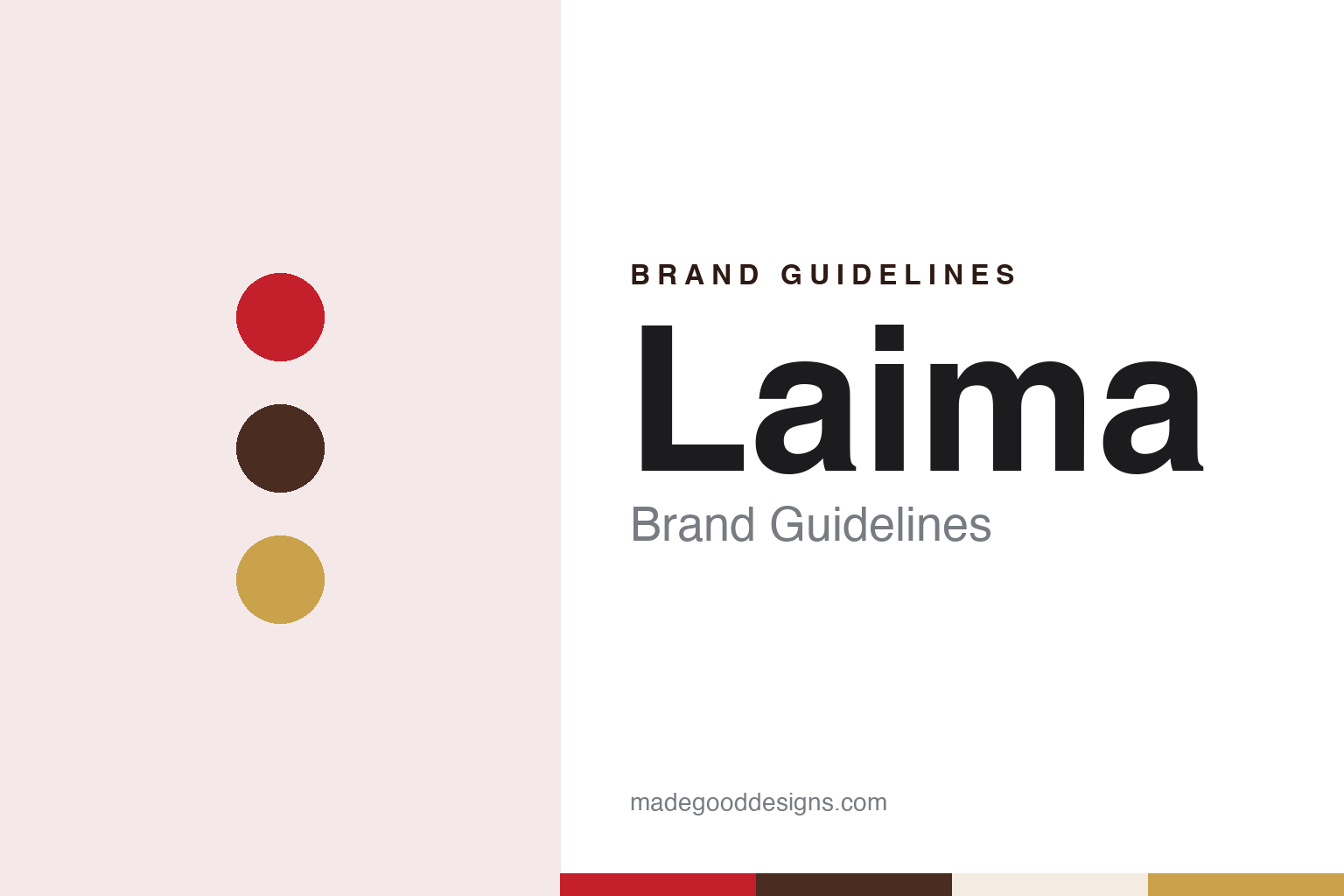
Two constants: a Laima red, chocolate and gold palette and a warm display serif register. Abstract homage — not a Laima product or mark; no wrapper, logo or clock face is reproduced.
Riegert, Maķedonija and Laima
A German chocolatier, a small sweets workshop and a new name in 1925.
Laima counts its age from 1870, though the name is younger. Latvian Wikipedia, citing the 1968 Latvijas saimniecības vēsture, says that in 1870 the German industrialist Theodor Riegert founded the first chocolate and coffee factory in Latvia, on Zaļā iela in Riga, and named it after himself. It grew into one of the best-known confectioners in the Baltic provinces of the Russian Empire, stopped for several years during the First World War, and from 1922 was leased for ten years to a joint-stock company, making mainly cocoa powder, cocoa butter and table chocolate.
The Laima name came from a different firm. In 1921, Latvian Wikipedia says, the Jewish entrepreneur Eliyahu Fromchenko (Iļja Hromčenko in Latvian) opened a sweets factory called Maķedonija on Karlīnes iela, the street now called Miera iela; it had four workers and relied on hand work. At the start of 1925 its founders and shareholders formed a new company, AS Laima, which took over Maķedonija’s patents, and the finance minister approved its statutes on 8 January. Laima is the Latvian word for luck and the name of a goddess of fate in Latvian folklore. English Wikipedia tells the founding slightly differently, saying the name was adopted in 1925 after a merger with the brothers Eliyahu and Leonid Fromchenko.
The business grew quickly: Latvian Wikipedia puts its workforce at 500 by 1930. In 1933 Fromchenko emigrated to Palestine and sold the company; there he founded Elite, the chocolate and coffee maker in Ramat Gan that is now part of Strauss Group. Back in Riga, Latvian Wikipedia says, Laima was bought by the state-controlled Latvijas Kredītbanka during the Ulmanis period and in 1937 merged with AS Th. Riegert into a single state-owned AS Laima, which took the best machines and staff from Riegert and from AS E. Mežits and became the largest confectioner in the country, with 790 workers.
The building most associated with the brand followed. Latvian Wikipedia says a modern, well-equipped factory was built on Miera iela in 1938; the company credits its building there to the architect Staņislavs Borbals and dates it to 1936. That site still holds the company offices and the Laima Chocolate Museum.
Colour
Soviet chocolates, a city clock and a museum.
After the Soviet occupation in 1940 all three of Riga’s big confectioners were nationalised and renamed. Latvian Wikipedia says the Ķuze factory became “17. jūnijs” and turned to biscuits, Ludmila Goegginger’s firm became “Uzvara” and specialised in caramels and marshmallow-like zefīrs, and Laima became the Laima confectionery factory, concentrating on chocolate. It was the only one of the chocolate factories to keep its own name. During the German occupation the factory also made wartime goods such as barley coffee and dried yeast, and after the war its equipment had to be replaced, because the machinery had been taken to Germany.
Much of what Latvia made in the Soviet years was sold in other Soviet republics, and Laima’s boxed chocolates became widely known. Latvian Wikipedia lists among them Vāverīte (“little squirrel”), Sarkanā magone (“red poppy”), Karakums, Lācītis ķepainītis, Trifele and Serenāde, and the chocolate bar Rigonda. From the late 1960s, it says, Laima specialised in sweets, chocolate and chocolate products; a 1988 encyclopaedia of Riga records an Italian Carle & Montanari moulding line installed in a new building in 1986. The brand has used that past since independence: in spring 2018, for Latvia’s centenary, it brought back the Karakums and Talismans sweets after a public vote in a project called “Nostalģija,” Laukos.lv reported.
The brand’s best-known piece of street furniture is not a product. The Laima Clock (Laimas pulkstenis) at the edge of Riga’s Old Town was completed in 1924 to a design by the architect Artūrs Medlinger and was first known simply as the Big Clock. According to Latvian Wikipedia, which cites the guide Cita Rīga, it carried advertising for the Riegert company in the early 1930s and was decorated with Laima’s symbols in 1936; the Baltic News Network also dates the Laima name on the clock to 1936. In the Soviet period it served as a political information stand. It was fully reconstructed in 1999 at Laima’s expense, and on 29 December 2017 a renewed clock, designed by Arvis Sproģis and paid for by Orkla as a gift for the centenary, was unveiled. Latvian Wikipedia describes its stainless-steel body painted a dark chocolate brown and says it plays one of 24 melodies by the composer Raimonds Pauls on the hour. The square around it is one of the city’s favourite meeting places, and in 2012 a second Laima-branded clock went up in Sigulda.
The company opened the Laima Chocolate Museum in the Miera iela building on 18 December 2013. Its oldest exhibit is a chocolate figure made in 1894 at the Riegert factory, and it had welcomed more than 300,000 visitors by its tenth anniversary, Brīvā Daugava and Orkla Latvija reported in December 2023.
Typography
Design and documentation.
The seven brands in this group all make food or drink, and all of them come from Latvia and Estonia: Laima, Selga, Spilva, Riga Black Balsam, Aldaris, Saku and A. Le Coq. Food and drink brands in general sit at many different points in the trade, from firms that still carry a founder’s name to names that now belong to much larger groups, and a single brand can be sold everywhere from a corner shop to a supermarket shelf.
A food or drink brand’s identity is usually carried less by a single product than by a pack, a name and the taste it promises, because the company behind the name may have changed hands, moved its factory or grown far beyond the town where it started. That makes the questions behind each name worth asking plainly: who started it, who owns it now, and where its products are actually made and packed.
Each guide separates what independent sources record from what the company says about itself — its founding story, its owners over time, where its products are made and how its packaging has changed — and marks plainly what rests only on the company’s own word.
Aa
A warm display serif for a confectioner whose logo pairs modern lettering with a flowing line from the 1920s. (Specimen set in Fraunces, a serif STAND-IN; NOT the Laima logo.)
Laima
Privatisation, mergers, Orkla and a new mark.
Latvia’s independence brought Laima back into private hands. Latvian Wikipedia says Laima was privatised in 1993 and Uzvara in 1994; in January 1998 the two merged under the Laima company name while keeping both trade marks, and in 2000 Laima combined with the confectioner Staburadze, keeping a single trade name, Laima. In the late 2000s a management company, NP Foods, was set up over Laima and other Latvian food businesses.
Norway’s Orkla agreed to buy NP Foods, including Laima, in August 2014, LSM reported; Latvian Wikipedia’s Staburadze article says the deal was completed in March 2015. In June 2015 Diena reported that Laima would stop grinding its own cocoa beans and use bought-in cocoa mass instead. On 10 February 2016 AS Laima, AS Staburadze and AS Latfood were merged into SIA Orkla Confectionery & Snacks Latvija, now SIA Orkla Latvija, the trade site Klientu portfelis reported; Laima has since been a brand of that company rather than a separate firm.
The same month Laima changed its logo. Neatkarīgā (nra.lv) reported in February 2016 that the new visual identity would cover all Laima products, its sweet shops and the Chocolate Museum and would be phased in. Laima’s marketing team told the paper that the mark combined elements from three periods of the brand: the plain modern lettering was kept and a flowing line from the first Laima logo of the 1920s was added, a line meant to suggest a smile, and the lettering was set in white or gold on a bold red circle so the products would stand out on the shelf. Red, the team said, had been Laima’s characteristic colour for more than 40 years. Erik Smith-Hansen, then chairman of Orkla Confectionery & Snacks Latvija, told the paper the aim was to carry the brand’s heritage forward in a modern, competitive hand.
Production has partly moved out of the city. Latvian Wikipedia, citing Dienas Bizness and LA.LV, says a new Laima plant at Ādaži, north-east of Riga, was put into service on 16 March 2020 and formally opened on 9 September 2021; it has five buildings with 7,820 square metres of floor space. The Miera iela factory continues with specialised production, including chocolate sweets, bars, zefīrs, wafer sweets and hand-made sweets. In 2023 Orkla opened a separate biscuit and wafer plant next door, which now makes Selga.
For a design guide, Laima shows how a confectioner can turn a long, layered history — a German founder, a Jewish founder who went on to start Elite, state ownership and a Nordic owner — into one red mark and one public clock. Compare Kalev, Estonia’s confectioner and another Orkla brand, and Selga, the Riga biscuit now made beside Laima’s Ādaži plant. For this guide we use Laima red, chocolate brown and foil gold with a warm display serif, an unofficial interpretation; no product or logo is reproduced.
Explore & save
Keep Laima’s identity on hand — save it to a board in the Made Good inspiration library.
Laima identity set
Pin the Laima red, chocolate brown and foil gold palette and the warm display serif register to your own board.