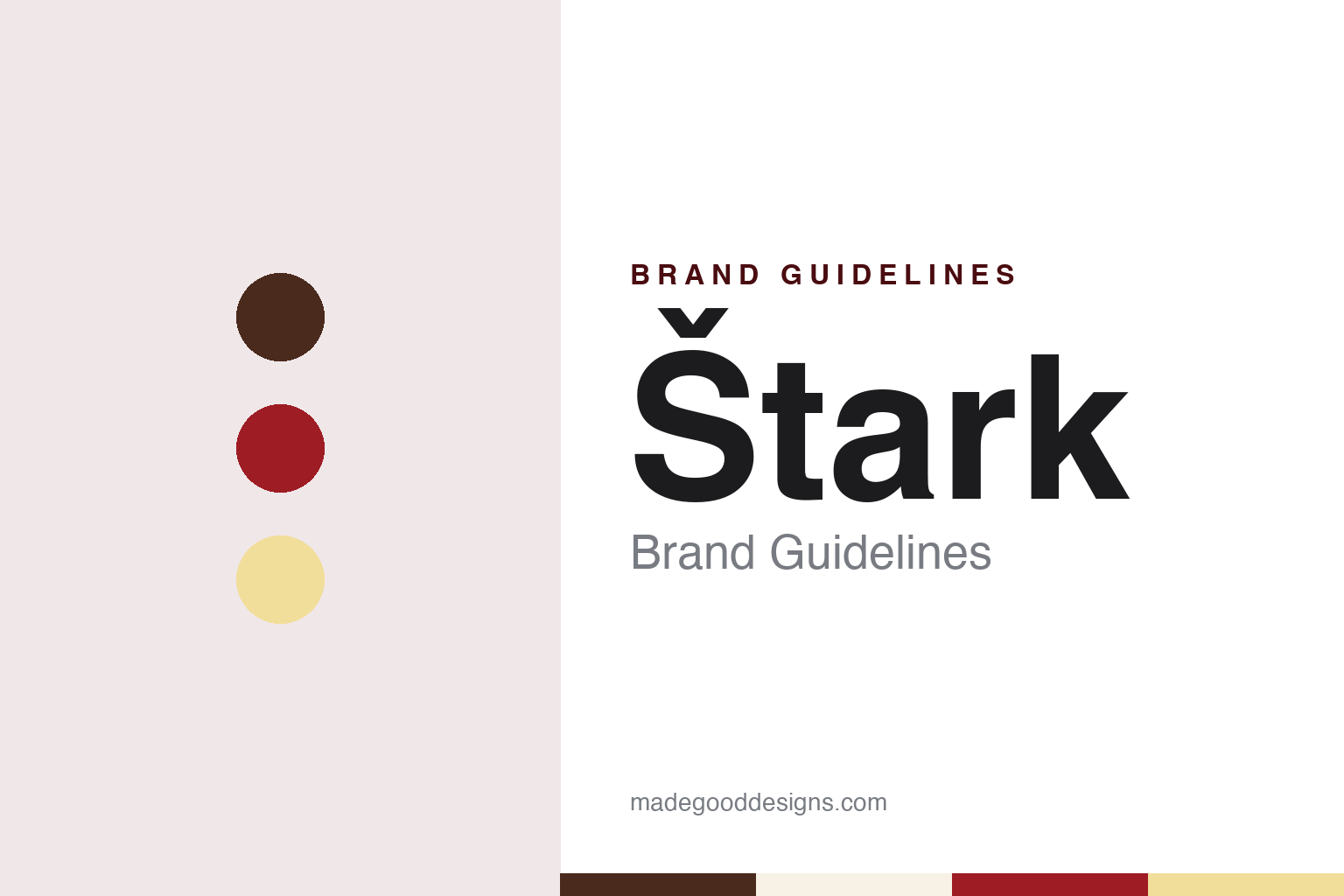
Štark Brand Guidelines
The Belgrade chocolate factory behind Smoki and Najlepše želje.
Aa
Two constants: a cocoa, wish red and banana cream palette and a chocolatier’s serif register. Abstract homage — not a Štark product or mark; no pack, logo or sweet is reproduced.
Louit, Roda and Nada Štark
A French officer, a stork and a postwar name.
Štark’s name does not belong to its founder. Serbian Wikipedia, citing the local paper Zemunske novine in 2015, says the company’s roots go back to 1922 in Zemun, then a separate town across the Sava from Belgrade and now part of the city. A French officer who had served on the Salonika front, Daniel Pechmajou, stayed on in Yugoslavia after the First World War and set up an import-export firm called Louit. High customs duties pushed him into manufacturing, and in 1924, Serbian Wikipedia says, he brought second-hand machines from France and opened a chocolate factory. The company tells the story more romantically: a French officer who stayed for love of a Zemun woman named Terezija, and of chocolate, and who brought with him the secret of French chocolate-making.
In 1927 the factory passed to another Frenchman, Marcel Baslar, who renamed it Roda — “stork,” or La Cigogne in French. Under Roda the business grew; Serbian Wikipedia says it employed 200 people by 1935 and made a chocolate called Roda, which it describes as the first Serbian chocolate and the forerunner of today’s Menaž cooking chocolate. In 1938 Roda launched a chocolate-covered foam sweet shaped like a banana, created by the chocolatier Franja Vaja, of Hungarian origin, from Vršac; under the name Bananica it remains a favourite sweet in Serbia and the region, Serbian Wikipedia says. Baslar returned to France when the Second World War began, and production continued under the occupation at reduced capacity.
The Štark name arrived with socialism. In 1946 the factory was nationalised and renamed Nada Štark, after Nada Štark, a sweet-factory worker from Osijek and a member of the Communist Party and the Partisan movement, Serbian Wikipedia says.
Colour
Soko, Voždovac and a puffed-corn first.
After the war Nada Štark became one of the best-known chocolate and sweet factories in Yugoslavia. By 1960, the company and Serbian Wikipedia both say, it had almost 500 employees and made more than 2,000 tonnes of sweets a year. In 1966 it merged with Prva parna pekara “Soko”, the first steam bakery in Zemun, which the company says was founded in 1931 by a Jewish joint-stock company to bake bread and pastries. The combined business became Soko–Nada Štark, a factory for biscuits, chocolate and sweets, and later simply Soko Štark. In 1975 production moved from Zemun to a new factory in Voždovac, in Belgrade, where the company says its sweets are still made today.
The best-known products come from these decades. In 1972 Soko Štark brought out Smoki, a puffed-corn snack flavoured with peanut, which English Wikipedia, citing Superbrands Serbia and the Smoki website, calls the first of its kind in south-east Europe; the name, it says, became a generic word for puffed-corn snacks across the former Yugoslavia. A chocolate-coated Čoko Smoki followed in September 2006, and Smoki Wow, with a chocolate and peanut-butter filling, in 2023. Alongside them sit Najlepše želje — “Best Wishes” — the milk-chocolate bar that English Wikipedia calls the company’s hallmark, sold in several fillings and sizes, and Prima salty sticks. In 2007 the company said Bananica was its best-selling product.
Like other socially owned Yugoslav firms, Soko Štark was run under workers’ self-management until the early 1990s. Serbian Wikipedia includes three logos: one used from 1966 to 1990, another from 1997 to 2022, and a new mark dated 2022, the company’s centenary year, which its website marks with the line “Love that lasts 100 years.”
Typography
Design and documentation.
The seven brands in this group all make food or drink, and all of them come from Serbia: Jaffa, Takovo, Štark, Swisslion, Knjaz Miloš, Imlek and Zlatiborac. Serbian food and drink brands in general sit at many different points in the trade, from family firms that still carry a founder’s name to names that now belong to much larger food groups, and a single brand can be sold everywhere from a village shop to a supermarket shelf.
A food or drink brand’s identity is usually carried less by a single product than by a pack, a name and the taste or occasion it promises, because the company behind the name may have changed hands, moved its factory or grown far beyond the town where it started. That makes the questions behind each name worth asking plainly: who started it, who owns it now, and where its products are actually made and packed.
Each guide separates what independent sources record from what the company says about itself — its founding story, its owners over time, where its products are made and how its packaging has changed — and marks plainly what rests only on the company’s own word.
Aa
A chocolatier’s serif for a Belgrade factory with French roots. (Specimen set in Fraunces, a serif STAND-IN; NOT the Štark logo.)
Štark
From shares to a Zagreb group.
The break-up of Yugoslavia brought Soko Štark into privatisation. In 2001, Serbian Wikipedia says, it became a joint-stock company and began trading as Štark, keeping Soko Štark in its legal name. In 2005 it was sold to the Serbian company Grand Prom, English Wikipedia says, and in March 2008 the Slovenian food company Droga Kolinska became Grand Prom’s majority owner, the Belgrade daily Blic reported.
The present owner arrived in 2010, when the Croatian consumer-goods company Atlantic Grupa, based in Zagreb, bought Droga Kolinska and with it Štark — a deal the Serbian broadcaster B92 headlined in July 2010 as Croatians buying “Smoki and Bananica.” The company says that about a decade later it changed its official name to Atlantic Štark; the brand on its products stayed Štark. Its products reach the United States through an importer, English Wikipedia notes.
Štark’s name has also gone up on a building. In October 2017 the public broadcaster RTS reported that the Belgrade Arena, the city’s largest indoor hall, would carry the name Štark Arena for five years under a sponsorship deal.
For a design guide, Štark shows how a postwar factory name, a banana-shaped sweet and a peanut-flavoured snack can carry one Belgrade brand through a century of changing owners. Compare Bambi, the Požarevac biscuit maker behind Plazma, and Jaffa Crvenka, another Serbian sweet-biscuit maker. For this guide we use cocoa brown, a wish red and a banana cream with a serif, an unofficial interpretation; no product or logo is reproduced.
Explore & save
Keep Štark’s identity on hand — save it to a board in the Made Good inspiration library.
Štark identity set
Pin the Štark cocoa, wish red and banana cream palette and the chocolatier’s serif register to your own board.