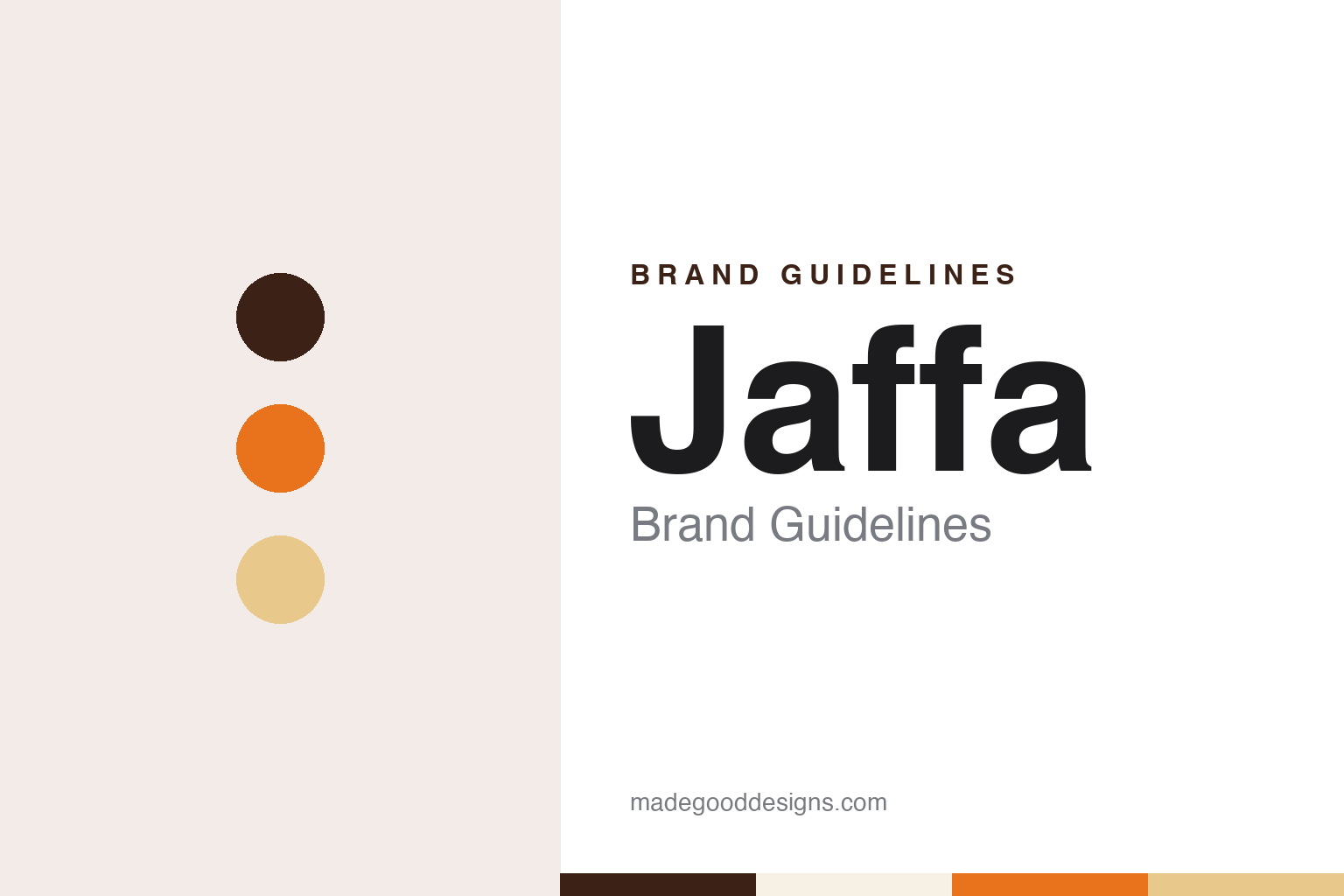
Jaffa Brand Guidelines
The Crvenka biscuit maker that took a McVitie’s licence in 1976.
Aa
Two constants: a dark chocolate, orange jelly and sponge gold palette and a rounded friendly sans register. Abstract homage — not a Jaffa product or mark; no pack, logo or biscuit is reproduced.
A licence from McVitie’s
A Vojvodina town, a British recipe and 36,000 eggs a day.
Jaffa is a confectionery company in Crvenka, a small town in the municipality of Kula in Serbia’s northern province of Vojvodina. It was founded in 1975, on the initiative of several local businessmen, English and Serbian Wikipedia say, citing a 2013 report by the Serbian news portal Mondo; The Nutshell Times, an English-language magazine about the Balkans, described the founders in 2020 as a group of “Anglophile socialist businessmen.” The company’s own history, which it calls the Jaffa time machine, says the idea came earlier: in 1970 state agencies in Yugoslavia came across the Jaffa Cakes made by McVitie’s and opened talks to make them under licence at home. The foundation stone in Crvenka was laid in 1975.
Production began in 1976. English Wikipedia, citing The Nutshell Times, says the company acquired its licence from McVitie’s; Serbian Wikipedia says the technology was bought from United Biscuits, the British group that then owned McVitie’s. The company says its first line used fresh eggs, cracking 36,000 of them a day, and that the first packaging and the first advertisement appeared that year, with each box holding exactly 12 cakes. Serbian Wikipedia says the plant was rated the most economical investment in Vojvodina in the 1970s. In 1978 the “Jaffa” name was legally protected as a brand in Yugoslavia, the newspaper Blic reported in 2018.
The Serbian company is separate from McVitie’s, the British biscuit maker whose own Jaffa Cakes, the company notes, date from 1927.
Colour
Munchmallow, sanctions and a wider shelf.
The company’s second signature arrived in 1981. Munchmallow is a thin biscuit topped with an egg-white cream and covered in chocolate, English Wikipedia says; The Nutshell Times called it a local variant of the Tunnock’s teacake. The company tells its own origin story for it: six employees travelled to McVitie’s in Glasgow to learn how to make the product, ate the sample biscuits on the flight home and rebuilt the recipe from memory, which it says is why its Munchmallow tastes different. From 1980, the company says, it made its own chocolate and jelly in Crvenka rather than buying them in. In 1985 it ran its first promotion, “Sweet Treasure,” a game modelled on Battleship that was printed on Munchmallow packs.
The 1990s were a decade of making do. During the sanctions years, the company says, it added plain biscuits and an Extra Biscuit made from wholemeal flour; in 1995 it modernised the plant with large ingredient silos, and in 1997 it added a 300-gram family box of Jaffa cakes.
The range widened in the 2000s. English Wikipedia dates the start of the expansion to 2004, with the O’cake wholegrain biscuits, followed by new Jaffa and Munchmallow flavours, “Domaći keks” teacakes in 2006 and the company’s own Petit Beurre and Polo biscuits in 2007; Serbian Wikipedia puts the start in 2000. The company says a new plant of 12,000 square metres opened in 2006. In 2008 it entered salty snacks with the Tak cracker, launched with the slogan “Cracker of the crackerism!” as the company translates it, and the same year added wafers, sold as Napolitanke. Serbian Wikipedia lists lemon and cherry Jaffa cakes from 2009 and miniature versions of the biscuits from October 2007. By 2013 the factory produced 12,000 tonnes of confectionery a year, Mondo reported.
Typography
Design and documentation.
The seven brands in this group all make food or drink, and all of them come from Serbia: Jaffa, Takovo, Štark, Swisslion, Knjaz Miloš, Imlek and Zlatiborac. Serbian food and drink brands in general sit at many different points in the trade, from family firms that still carry a founder’s name to names that now belong to much larger food groups, and a single brand can be sold everywhere from a village shop to a supermarket shelf.
A food or drink brand’s identity is usually carried less by a single product than by a pack, a name and the taste or occasion it promises, because the company behind the name may have changed hands, moved its factory or grown far beyond the town where it started. That makes the questions behind each name worth asking plainly: who started it, who owns it now, and where its products are actually made and packed.
Each guide separates what independent sources record from what the company says about itself — its founding story, its owners over time, where its products are made and how its packaging has changed — and marks plainly what rests only on the company’s own word.
Aa
A rounded friendly sans for a biscuit sold by the dozen. (Specimen set in Nunito, a sans STAND-IN; NOT the Jaffa logo.)
Jaffa
An Olympic box, a bought rival and a welcome.
Jaffa has used its packs as a promotional surface. In 2012 it became an official sponsor of the Olympic Committee of Serbia and released limited-edition Olympic boxes, the company says. In 2016 it reformulated its Napolitanke wafers with 80% filling and says they became the market leader in Serbia; in 2019 it launched a new website telling its history and added Jaffa Kolači, soft cookies with a chocolate and orange filling. Serbian Wikipedia gives the company’s slogan as “Dobrodošli u Jafa svet,” or “Welcome to the Jaffa world.”
The company has also grown by buying a rival. In 2017 Jaffa bought the insolvent confectionery group Banini, of Kikinda, also in Vojvodina, after a Serbian court ordered the sale of Banini’s factory to repay its creditors, the business news service SeeNews reported. English Wikipedia gives Jaffa’s legal form as a limited-liability company in Crvenka, in its current form since the end of 1989, and names its parent as Kappa Star Limited; Serbian Wikipedia says the factory follows ISO 9001, ISO 22000 and HACCP principles.
Its products are made in Crvenka. The company says the new plant it opened there in 2006 was fitted with production lines from the equipment makers APV and Haas, and that its 1995 modernisation brought large silos that feed ingredients to the lines automatically. Serbian Wikipedia lists the current range under five headings: Jaffa cakes, in orange, raspberry and cherry; Munchmallow, including a white-chocolate version; Napolitanke wafers; O’cake biscuits; and Tak salty crackers. The 1976 licence product, a sponge base with orange jelly under a chocolate top, still heads the list nearly half a century later.
For a design guide, Jaffa shows how a licensed British recipe can become a national brand of its own, with packs that have carried games, Olympic rings and new flavours. Compare McVitie’s, whose Jaffa Cakes it was licensed to make, and Tunnock’s, whose teacake Munchmallow resembles. For this guide we use dark chocolate, an orange jelly and a sponge gold with a rounded sans, an unofficial interpretation; no product or logo is reproduced.
Explore & save
Keep Jaffa’s identity on hand — save it to a board in the Made Good inspiration library.
Jaffa identity set
Pin the Jaffa dark chocolate, orange jelly and sponge gold palette and the rounded friendly sans register to your own board.