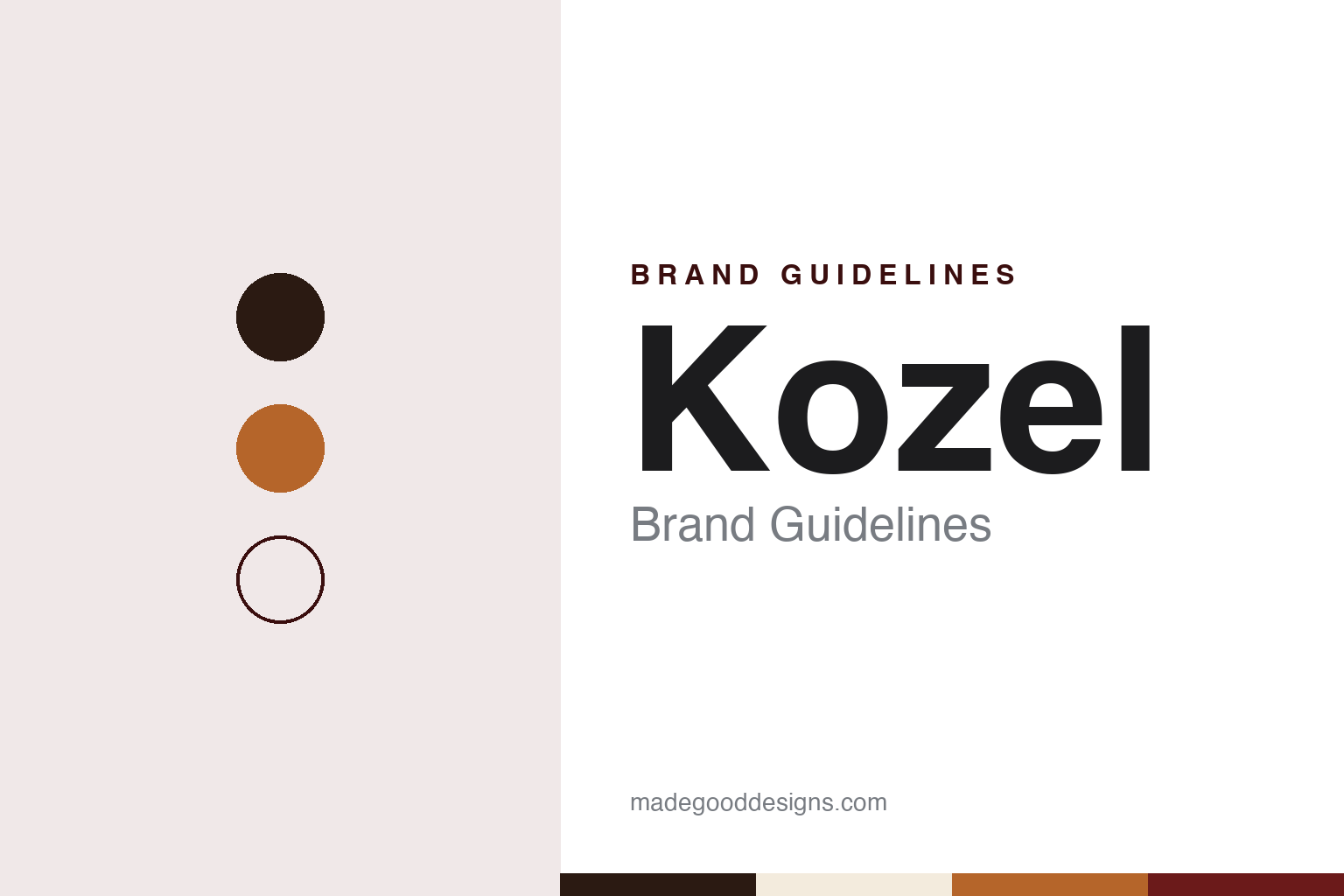
Kozel Brand Guidelines
The Velké Popovice beer with a goat on the label.
Aa
Two constants: a dark lager, copper and foam cream palette and a bold display serif register. Abstract homage — not a Kozel product or mark; no label, glass, goat or logo is reproduced.
A Ringhoffer brewery
An industrialist, a village near Prague and a December brew.
Kozel takes its full name, Velkopopovický Kozel, from its home: Velké Popovice, a village about 25 kilometres south-east of Prague, English Wikipedia says. Kozel is Czech for a billy goat. Brewing in the village goes back centuries; the company’s history, as cited by Czech Wikipedia, traces the first written mention of a brewery there to the 14th century. The modern brewery is the work of František Ringhoffer, the industrialist and mayor of Smíchov, then a town beside Prague. Czech Wikipedia says he bought land in Velké Popovice in 1870 and began building a new brewery in 1871, fitting it with new technology and new wells.
The first batch was brewed on 15 December 1874, according to a brewing history on pivovary.info cited by Czech Wikipedia, and 1874 is the date the brand uses today; the company says Kozel was “brewed in 1874 by the Ringhoffer family.” Its own timeline describes that first batch as a dark beer made in a 60-hectolitre cauldron. English Wikipedia, citing an older company page, says the brewery building itself was completed in 1875. Around the turn of the century a large reconstruction raised its capacity from 18,000 to 90,000 hectolitres a year, Czech Wikipedia says.
The brewery came through the First World War on restricted output. Between the wars it was known for a strong dark beer that locals called kozel, after the German Bock, which also means goat; the Second World War brought fresh limits on production. After 1945 the brewery was nationalised and short of workers, and in 1951, the company’s history says, it hired women for the first time; by 1962 the ratio was close to even, and the bottling hall was run entirely by women. In 1965, the company says, Kozel became the first brewery in the world to deliver beer to pubs in tanker lorries, starting the Czech tradition of “tank pubs.”
Colour
A French painter, a live goat called Olda and a horned glass.
The goat is the brand. The company’s own story says that in 1919 a lost French painter passed through Velké Popovice and, in thanks for the food and shelter he was given, left the village a painting of a billy goat; the brewery took the figure as its emblem. The painter is not named in any of the company’s accounts. The documented date is later: the goat mark was registered as a trademark in March 1922, Deník reported in 2019, and a history of the brand published by the brewery in 2012 marked “90 years since the founding of the Velkopopovický Kozel brand.” From then on every beer from Velké Popovice was sold as Kozel, with the goat on its labels.
The emblem soon had a living counterpart. In the 1930s the owners brought a live goat to the brewery, from Uzhhorod in what was then eastern Czechoslovakia, Deník reported; a brewing history on pivovary.info dates its arrival to 1938. A goat has lived at the brewery ever since. The company says that since the 1970s every one of them has been called Olda, in honour of Oldřich Lenc, a brewery worker who looked after the goat, and that the current animal is Olda XV.
The goat has also shaped the glassware. In 2009 the Czech artist Jan Čapek designed a Kozel mug whose handle is shaped like a goat’s horn, the company and Czech Wikipedia say. Advertising has leaned on the same character. In 2012, in a viral campaign in Russia, a can of Kozel was carried towards space by balloon and brought down by parachute while a camera streamed the flight online, iDNES.cz reported; Deník had reported in 2008 that Kozel was the best-selling Czech beer in Russia. Since 1993 the brewery has held an annual beer festival, Den Kozla, or Goat Day, Czech Wikipedia says.
The range today centres on pale lagers and the dark Kozel Černý. In 2018 the brewery dropped its 12-degree Kozel Premium in the Czech Republic and moved to a new recipe sold as Kozel Mistrův ležák, E15 reported, and in 2020 it introduced new recipes for its 11- and 12-degree beers, Czech Wikipedia says.
Typography
Design and documentation.
The seven brands in this group all make food or drink, and all of them come from the Czech Republic or Slovakia: Opavia, Budvar, Kozel, Mattoni, Horalky, Figaro and Zlatý Bažant. Czech and Slovak food and drink brands in general sit at many different points in the trade, from names that still belong to the town or company where they began to names that now belong to much larger international groups, and a single brand can be sold everywhere from a village shop to a supermarket shelf abroad.
A food or drink brand’s identity is usually carried less by a single product than by a pack, a name and the taste or moment it promises, because the company behind the name may have changed hands, moved production or grown far beyond the place where it started. That makes the questions behind each name worth asking plainly: who started it, who owns it now, and where its products are actually made and packed.
Each guide separates what independent sources record from what the company says about itself — its founding story, its owners over time, where its products are made and how its packaging has changed — and marks plainly what rests only on the company’s own word.
Aa
A bold display serif for a village brewery with a long memory. (Specimen set in Playfair Display, a serif STAND-IN; NOT the Kozel logo.)
Kozel
Independence, Radegast, SAB and Asahi.
The brewery regained its independence in 1991 and became a joint-stock company in 1992. Its majority shareholder by the late 1990s was the Radegast brewery, and in March 1999 a merger of Plzeňský Prazdroj and Radegast was approved; from October 1999 the whole group belonged to South African Breweries, later SABMiller, and the formal merger of the Czech breweries was entered in the commercial register in October 2002, Czech Wikipedia says. Velké Popovice has been part of Pilsner Urquell’s company, Plzeňský Prazdroj, ever since.
When Anheuser-Busch InBev bought SABMiller, European regulators required it to sell much of SABMiller’s brewing business in the region. In December 2016 Japan’s Asahi agreed to buy Plzeňský Prazdroj with its Czech breweries and brands, including Kozel, the German news agency DPA reported, and the new owner took over in 2017, Czech and English Wikipedia say. The international Kozel website is now run by an Asahi company.
Where it is made depends on where it is sold. Czech Wikipedia, citing the company, says Kozel is brewed at Velké Popovice, at Nošovice and at Plzeň, and that it is also brewed under licence outside the Czech Republic. A 2014 report by iDNES.cz on Plzeňský Prazdroj’s export record called Kozel the best-selling Czech beer brand in the world, sold in around thirty countries, and the company now describes it as “the world’s favourite Czech beer.” Its brewmaster since 2011, the company says, has been Vojtěch Homolka.
For a design guide, Kozel shows how a single animal can carry a village beer from a 1922 trademark to tap handles worldwide, with a live mascot to keep the story real. Compare Pilsner Urquell, its sister brand under Asahi, and Budvar, the state-owned brewery of České Budějovice. For this guide we use a dark lager brown, a copper and a foam cream with a bold display serif, an unofficial interpretation; no product or logo is reproduced.
Explore & save
Keep Kozel’s identity on hand — save it to a board in the Made Good inspiration library.
Kozel identity set
Pin the Kozel dark lager, copper and foam cream palette and the bold display serif register to your own board.