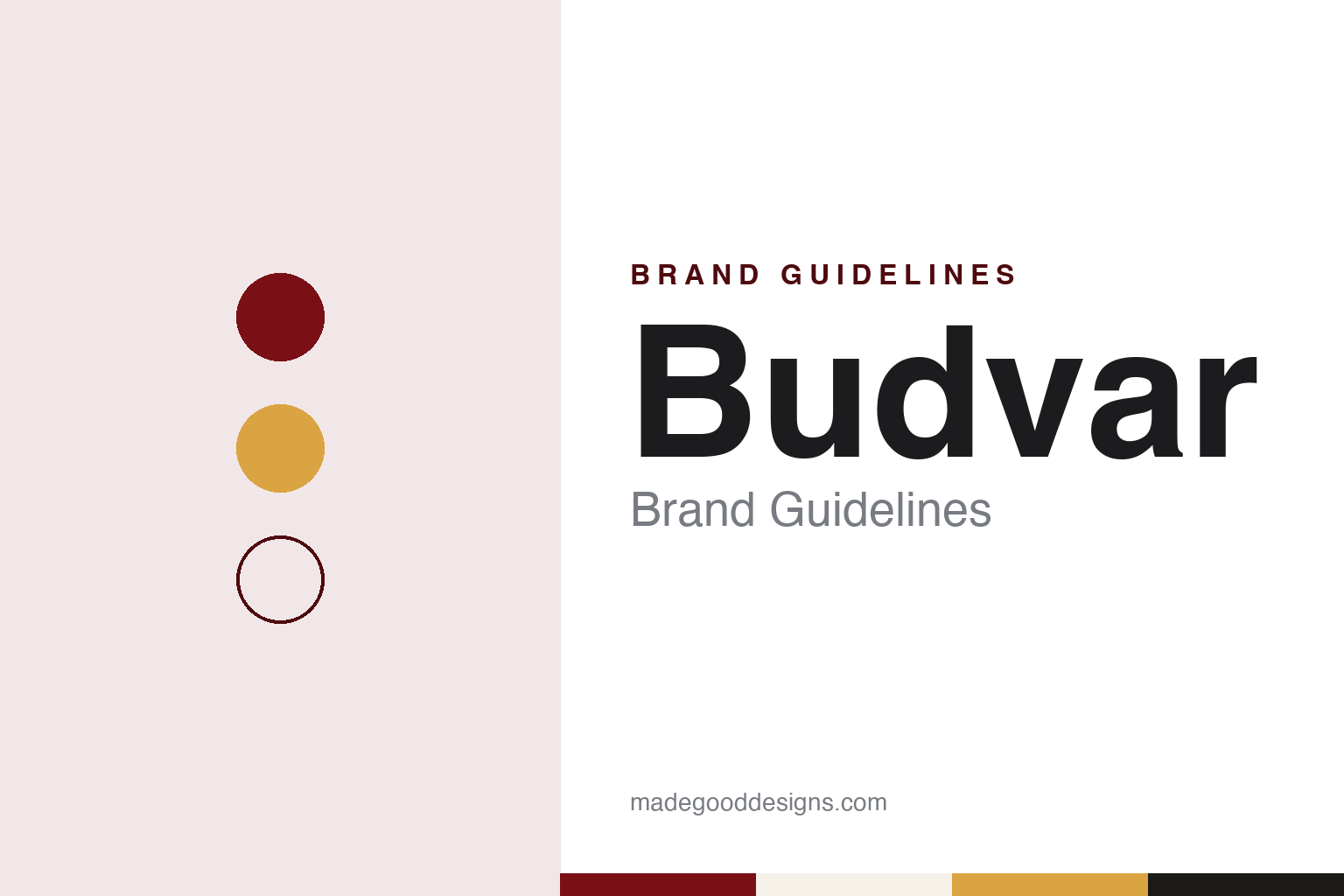
Budvar Brand Guidelines
The state-owned Budějovice brewery behind Budweiser Budvar.
Aa
Two constants: a Budvar red, gold and cream palette and a traditional serif register. Abstract homage — not a Budvar product or mark; no bottle, label or logo is reproduced.
Český akciový pivovar
Czech brewers in a German-speaking town.
Budějovický Budvar — Budweiser Budvar abroad — is the state-owned brewery of České Budějovice, known in German as Budweis, in South Bohemia. The town’s brewing is older than the company: English Wikipedia dates its brewing rights to 1265, under King Ottokar II of Bohemia, and says beer from the town became known in German as Budweiser Bier, “beer from Budweis.” Another brewery there, the city brewery founded in 1795 by German-speaking citizens, is now owned by Anheuser-Busch InBev.
Budvar itself was founded in 1895 as the Český akciový pivovar, the Czech Joint-Stock Brewery. The company says it was set up by Czech holders of brewing rights who were dissatisfied with the mostly German-oriented city brewery, backed by Czech business leaders, and it dates its first brew to 7 October 1895. Czech Wikipedia names leading founders including August Zátka and František Hromada, and the first brewmaster as Antonín Holeček; it says the brewery reached full operation in 1896, opened its own restaurant in May of that year, and was sending beer to Prague, Vienna and Trieste from 1897.
Between the wars the brewery modernised. Czech Wikipedia says an artesian well was dug in 1922 and that the company registered trademarks including Český budějovický granát in 1922 and Crystal in 1925 before registering Budvar in 1930 — a contraction of “Budějovický pivovar,” Budějovice brewery — and the German equivalent, Budbräu, in 1934. The firm took the Budvar name in 1936, Czech Wikipedia says.
Colour
A national enterprise.
After the Second World War the brewery was nationalised. Czech Wikipedia says a national enterprise, Českobudějovický pivovar, was formed from the former joint-stock brewery’s assets on 13 September 1946. On 1 January 1967 the present Budějovický Budvar, národní podnik — national enterprise — was established as successor to both the joint-stock brewery and the town’s older city brewery, according to the company, and Czech Wikipedia adds that it took over most of their trademarks. It remains owned by the Czech state, and Czech Wikipedia describes it as the most significant Czech national enterprise still operating in that legal form.
Exports shaped the business. By the end of the 1980s, Czech Wikipedia says, 75 per cent of output went abroad, and a general reconstruction begun in 1967 was still unfinished in 1989. Canned beer arrived in 1973, filled by hand at first; until May 1974 Budvar’s beer was canned on the line of the Slovak brewery Zlatý Bažant. Budvar opened its own canning line in February 2013, and in March 2017 a 164-metre technological bridge joined the two halves of its site across Kněžskodvorská street.
English Wikipedia says the lager is brewed in České Budějovice with water from artesian wells beneath the brewery, Moravian barley and Saaz hops from the Žatec region, and that the Original is matured for at least 90 days. The European Commission granted the geographical indications “Budějovické pivo” and “Českobudějovické pivo,” effective from 1 May 2004. Czech Wikipedia reports record output of 1.946 million hectolitres in 2025, and English Wikipedia calls Budvar the fourth-largest beer producer in the Czech Republic and its second-largest beer exporter.
The brand has also been built through places to drink it. Czech Wikipedia says beer from the brewery has been poured since 1953 at Masné krámy, a well-known restaurant in České Budějovice; that the company began fitting out its own Budvar Bars, with distinctive interiors, in 1998; and that the first Original pivnice Budvarka, a branded pub, opened in the town in 2003, the start of a chain.
Typography
Czech and Slovak brands.
The seven brands in this group all make food or drink, and all of them come from the Czech Republic or Slovakia: Opavia, Budvar, Kozel, Mattoni, Horalky, Figaro and Zlatý Bažant. Czech and Slovak food and drink brands in general sit at many different points in the trade, from names that still belong to the town or company where they began to names that now belong to much larger international groups, and a single brand can be sold everywhere from a village shop to a supermarket shelf abroad.
A food or drink brand’s identity is usually carried less by a single product than by a pack, a name and the taste or moment it promises, because the company behind the name may have changed hands, moved production or grown far beyond the place where it started. That makes the questions behind each name worth asking plainly: who started it, who owns it now, and where its products are actually made and packed.
Each guide separates what independent sources record from what the company says about itself — its founding story, its owners over time, where its products are made and how its packaging has changed — and marks plainly what rests only on the company’s own word.
Aa
A traditional serif for a brewery founded in 1895. (Specimen set in Playfair Display, a serif STAND-IN; NOT the Budvar logo.)
Budweiser Budvar
One town name, two beers.
Budvar is not the American Budweiser, a separate brand with a separate history. That beer is brewed by Anheuser-Busch, whose founder, Adolphus Busch, named it after the Budweis brewing tradition in 1876, English Wikipedia says; Budvar’s own history quotes an 1876 Anheuser-Busch label describing the beer as brewed to the Budějovice recipe. The two brewers have disputed the name for more than a century; on 29 July 2010, English Wikipedia says, Anheuser-Busch lost its final appeal at the European Court of Justice over registering Budweiser as an EU trademark for beer. In the United States, Canada and some other markets the Czech lager is sold as Czechvar.
Budvar’s look has a documented starting point. The company’s history dates its first label with today’s design elements to 1959, and records a packaging redesign in 2014 intended, it says, to bring the packs into line with the brand’s values and make products easier to identify; the same year it launched an ice-concentrated beer, B:CRYO. Besides the Budweiser Budvar and Budějovický Budvar names, the brewery sells beer under the Pardál brand, Czech Wikipedia says, and it set up subsidiaries in Germany in 1997, the United Kingdom in 2001 and Slovakia in 2012.
For a design guide, Budvar shows how a town name, a state enterprise and a long naming dispute can all meet on one label. Compare Kozel, another Czech lager brand, and Zlatý Bažant, the Slovak brewery that once canned Budvar’s beer. For this guide we use a label red, lager gold and cream with a serif, an unofficial interpretation; no product or logo is reproduced.
Explore & save
Keep Budvar’s identity on hand — save it to a board in the Made Good inspiration library.
Budvar identity set
Pin the Budvar red, gold and cream palette and the traditional serif register to your own board.