Kägi Brand Guidelines
The Toggenburg baker whose wafers became a Swiss institution.
Aa
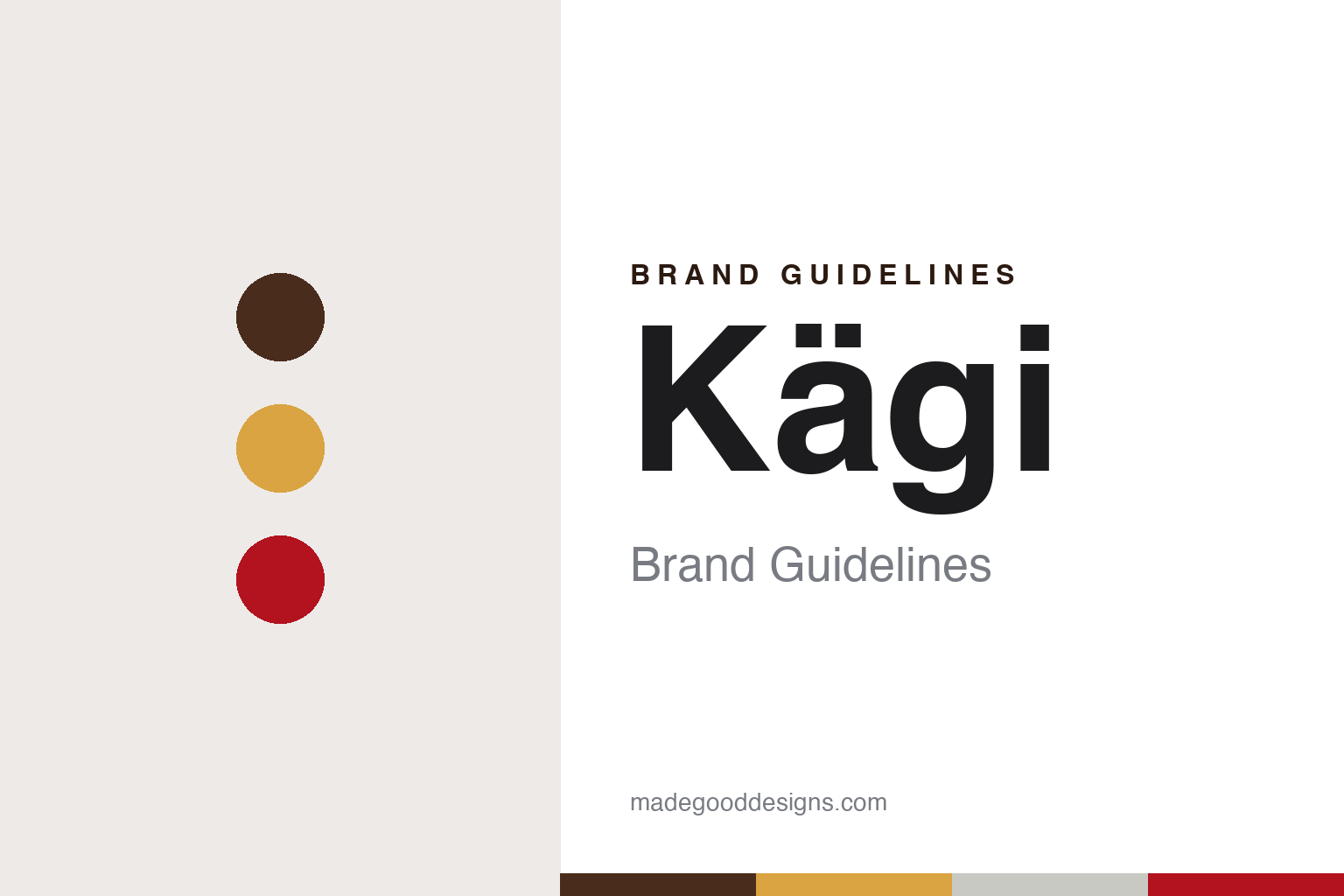
Two constants: a Kägi cocoa, gold and red palette and a warm bakery serif register. Abstract homage — not a Kägi product or mark; no pack, logo or wrapper is reproduced.
Zum Hecht
A baker in Lichtensteig.
Kägi is a family name and a Toggenburg one. In 1934 the baker Otto Kägi, a native of eastern Switzerland, set up shop in Lichtensteig, a small town in the Toggenburg valley of the canton of St. Gallen, swissinfo reported in 2009. English and German Wikipedia place the bakery in the “Zum Hecht” inn and pastry shop, where he made pastries for restaurants and for direct sale. Lichtensteig already had six bakeries, so he went out by bicycle to sell in the villages around it, the company’s chief executive Beat Siegfried told swissinfo; the bicycle, the article said, could still be seen in the factory shop.
Wafers came next. “Eight years later in 1942 he started the wafer business,” Siegfried said, and what was handmade then is now done by machine. In 1950 the firm bought a larger factory building, and in 1951 it became a general partnership with Otto Kägi’s three sons at its head, according to both Wikipedias. Wafers and biscuits have been made on the same site in Lichtensteig since the 1950s; Wikipedia dates the current building to 1954.
The workforce grew with the product: ten people in 1950 and 120 in 1960, not counting seasonal workers, English Wikipedia says. From 1960 the company made its own chocolate from raw cocoa beans, refined in long conches, and it still describes the chocolate in its products as made in house. The company still dates itself to 1934, and says its recipes have been used, practically unchanged, since then.
Colour
The Kägi fret.
The product that carries the family name is the Kägi fret. The word “fret” is the tail of the French gaufrette, a wafer, swissinfo and both Wikipedias say. Sources date it differently: swissinfo wrote in 2009 that the first chocolate-coated, multilayered wafers — “the classic Kägi-fret” — appeared in 1952, while English and German Wikipedia date the bar under that name and in its current form to 1958.
The bar is built from four wafer sheets joined by three layers of cream filling and covered in milk chocolate, English Wikipedia says, citing the company and swissinfo; an air-jet process gives the coating its rippled surface. German Wikipedia says the pack changed in the early 1960s to two bars in a foil wrapper with a paper sleeve. Alongside the classic bar there are versions with dark chocolate, hazelnut, orange and coconut, and a second specialty, the Kägi Toggenburger butter biscuit.
Exports began early. A first shipment went to the United States in 1956, Wikipedia says, and swissinfo recorded the legend that Marilyn Monroe was a fan of the wafers when they were imported into the US in the 1950s. Abroad the bar was long sold as Toggi, after the Toggenburg; swissinfo found the name in use in the Middle East and Asia in 2009, along with a sweeter “Toggi choco” made for the Middle East, and Wikipedia says the international name became Kägi in 2013. Exports were 37 percent of the business in 2009, with Saudi Arabia the biggest market, swissinfo reported; the company gave 47 percent in 2021, and the products reached more than 30 countries by 2022, according to Nau.
At home the bar became a fixture of kiosks and school breaks. swissinfo called Kägi-fret wafers “a national Swiss institution” in 2009, and a survey reported by Blick in 2020 ranked the brand seventh among the Swiss brands people trust most.
Typography
Design and documentation.
The seven brands in this group all make food or drink, and all of them come from Austria or Switzerland: Zipfer, Gösser, Inzersdorfer, Rivella, Emmi, Kägi and Rauch. Austrian and Swiss food and drink brands in general sit at many different points in the trade, from family firms that still carry a founder’s surname to names that now belong to much larger groups, and a single brand can be sold everywhere from a village shop to a supermarket shelf.
A food or drink brand’s identity is usually carried less by a single product than by a pack, a name and the meal or moment it promises, because the company behind the name may have changed hands, moved its production or grown far beyond the town where it started. That makes the questions behind each name worth asking plainly: who started it, who owns it now, and where its products are actually made and packed.
Each guide separates what independent sources record from what the company says about itself — its founding story, its owners over time, where its products are made and how its packaging has changed — and marks plainly what rests only on the company’s own word.
Aa
A warm bakery serif — friendly, traditional and rounded. (Specimen set in Fraunces, a serif STAND-IN; NOT the Kägi logo.)
Kägi
A family firm, then investors’ property.
The Kägi family ran the business for more than six decades. The brothers sold it in 1996, swissinfo reported; the buyer was Valora, the Swiss consumer-goods and kiosk group, according to English and German Wikipedia. In 2008 Valora passed the company to the investment firm Argos Soditic, and in 2010 it was sold to the Swiss holding company WM15, part of the Burger Söhne group, both Wikipedias say. German Wikipedia names the current owner as WM2030 Holding AG, of Rotkreuz, and Cédric El-Idrissi as chief executive since September 2024.
Through those changes the company kept its name, Kägi Söhne AG — “Kägi Sons” — and its site. It says its products are “100% Swiss made” in Lichtensteig, where in 2021 it gave its workforce as 140 people; it runs factory shops in Lichtensteig and in Landquart, in the Grisons. Its 2021 website described the company as working “at the foot of the Churfirsten mountain range,” and English Wikipedia says the Churfirsten peaks are used in the corporate logo. Its current slogan, on the company website, is “Glück lässt sich ganz einfach geniessen” — happiness is simple to enjoy.
The brand has also lived well online. Kägi fret’s Facebook page was voted the most popular Swiss Facebook page at the 2014 Swiss Facebook Awards, the St. Galler Tagblatt reported.
For a design guide, Kägi shows how a single product, a place and a family name can hold together through decades of changing owners. Compare Loacker, a South Tyrol wafer maker with a mountain in its logo, and Kambly, another Swiss biscuit maker named after its founder. For this guide we use cocoa brown, wafer gold, foil silver and a Swiss red with a serif, an unofficial interpretation; no product or logo is reproduced.
Explore & save
Keep Kägi’s identity on hand — save it to a board in the Made Good inspiration library.
Kägi identity set
Pin the Kägi cocoa, gold and red palette and the warm bakery serif register to your own board.