Villars Brand Guidelines
The Fribourg chocolate maker of the Villars cow.
Aa
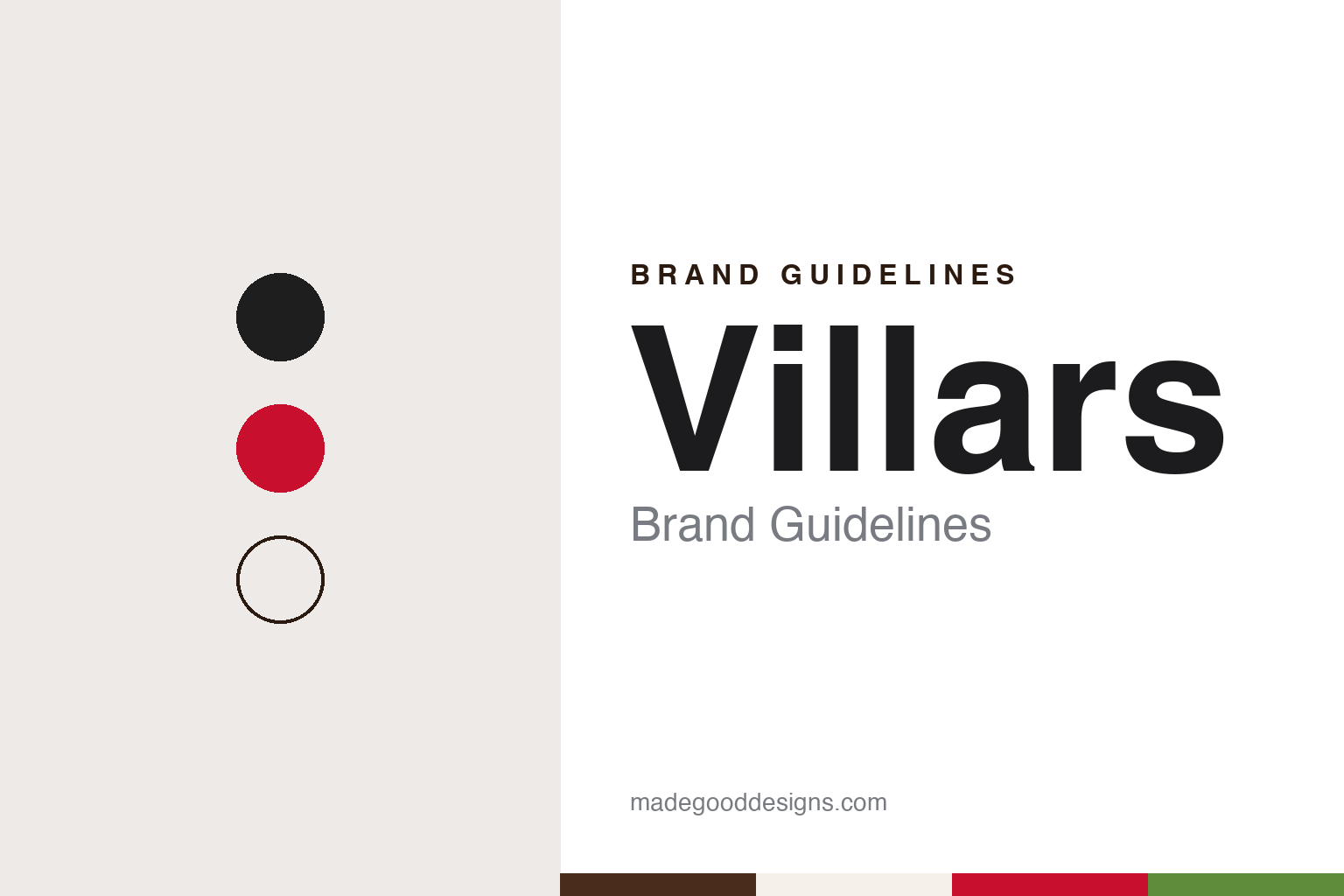
Two constants: a cocoa brown, Swiss red and milk white palette and an old-style chocolatier serif register. Abstract homage — not a Villars product or mark; no pack, logo or cow figure is reproduced.
Pérolles, 1901
A Bern merchant’s son and a factory on a plateau.
Villars began on 22 May 1901, when Wilhelm Kaiser founded a chocolate factory on the Pérolles plateau, an industrial area that then lay in the commune of Villars-sur-Glâne and is now part of the city of Fribourg, French and German Wikipedia say. The Historical Dictionary of Switzerland (HLS), in its entry on Kaiser, says he came from a Bern merchant family and trained in commerce in Bern, with spells in England and Germany; the company calls him a 28-year-old from Bern. The business took the name Villars SA in 1904, so the brand carries the name of the commune where it started rather than that of its founder.
The early years were hard. The HLS says the young firm struggled to compete with established makers, and that its first products were milk chocolate, confectionery and biscuits, with tea and coffee added later. In 1911 Kaiser left the Swiss chocolate makers’ cartel and built his own sales and distribution network, selling direct to customers; the HLS calls him a pioneer of direct selling and a forerunner of Gottlieb Duttweiler, the founder of Migros. The University of Fribourg gave him an honorary doctorate in 1938, the same source says.
The factory grew quickly. The HLS puts its workforce at about 1,200 in the 1920s. German Wikipedia, citing a 1989 history of the Fribourg labour movement by Alain Meyer, says Villars was one of only five companies in the canton with more than 100 employees in 1914, and that in 1915 it became the first employer in Switzerland to give its workers two weeks of paid holiday. The company says the quality of its chocolate made Villars an official supplier to European royal courts.
In 1935, German Wikipedia says, Villars added a coffee roastery and launched a bar of chocolate filled with liqueur; the company calls these liqueur bars, sold as Larmes de Kirsch, a world first. The 1930s were also a downturn, and by the 1950s, the HLS says, strong competition had brought the company close to bankruptcy. A history of its first half-century, Chocolats Villars SA (1901–1954): le parcours d’une entreprise atypique by Samuel Jordan, was published by the University of Fribourg in 2001.
Colour
A cow by the roadside, and a Swiss cross on the bar.
The brand’s best-known image is a cow. The Villars cow was created as an advertising figure by the Zug artist Martin Peikert, French and German Wikipedia and the company say, and for decades it stood beside Swiss roads and railway lines, the company says, as an emblem of the factory’s Fribourg roots and of the Swiss milk in its chocolate. French Wikipedia dates the figure to 1921, while a caption in German Wikipedia says it first appeared in 1928. Peikert’s Villars posters are held in the collection of the Museum für Gestaltung Zürich.
Its numbers fell later. The Swiss television programme DRS aktuell reported on the cut-out cows in 1984, and German Wikipedia says their number had to be greatly reduced, partly because of road-safety rules on roadside advertising. One survives in the Thurgau commune of Bichelsee-Balterswil, whose council fought to keep it, although it may no longer advertise Villars, La Liberté reported in 2012.
Villars’ recent design work leans on its Swiss origin. The company says it introduced a new, colourful graphic identity to underline its commitments, its Swiss roots and its premium positioning, and it marks its bars with the Swiss cross. Since 2017, Swiss law has required at least 80% of a food’s raw materials to come from Switzerland before it can carry the Swiss cross, German Wikipedia notes. The company says it uses 100% Swiss milk and sugar, its sugar coming from the Aarberg refinery about 40 km away, and that it selects and roasts its own cocoa beans at the Fribourg factory, with milk certified under the Swiss Milk Green standard. It says it revived an old recipe as Le Chocolat au lait à l’ancienne, a launch that a 2005 University of Fribourg thesis by Alexandra Uebersax studied as a communication strategy.
For its 120th anniversary in 2021, Villars commissioned a mural about 12 metres high from the Fribourg street artist Serge Nidegger, known as Serge Lowrider, on its office building in Fribourg, the Freiburger Nachrichten and La Liberté reported in June 2021; German Wikipedia says it shows products from the company’s history through symbols and logos. The company says Lowrider also designed a limited-edition range for the anniversary.
Typography
Design and documentation.
The seven brands in this group all make food or drink, and all of them come from Switzerland or Norway: Villars, Maestrani, Ramseier, Appenzeller Alpenbitter, Elmer Citro, Ringnes and Tine. Food and drink brands from these two countries in general sit at many different points in the trade, from family firms that still carry a founder’s surname to co-operatives and names that now belong to much larger groups, and a single brand can be sold everywhere from a village shop to a supermarket shelf.
A food or drink brand’s identity is usually carried less by a single product than by a pack, a name and the taste it promises, because the company behind the name may have changed hands, moved its production or grown far beyond the town where it started. That makes the questions behind each name worth asking plainly: who started it, who owns it now, and where its products are actually made and packed.
Each guide separates what independent sources record from what the company says about itself — its founding story, its owners over time, where its products are made and how its packaging has changed — and marks plainly what rests only on the company’s own word.
Aa
An old-style serif for a Fribourg chocolatier since 1901. (Specimen set in Playfair Display, a serif STAND-IN; NOT the Villars logo.)
Villars Maître Chocolatier
From a family firm to a dairy group.
The Kaiser family ran Villars for more than six decades. In 1969, after Wilhelm’s son Olivier Kaiser, the family business passed to its trustee, which took the name Villars Holding, French and German Wikipedia say. That holding company survives separately today: based in Givisiez, it runs shops, motorway kiosks and cafés in western Switzerland, German Wikipedia says, and it is not the chocolate maker.
The chocolate business changed hands twice. In 1985 it went to the Fribourg dairy group Cremo, the HLS says; French Wikipedia adds the Fribourg federation of dairy societies as a joint buyer. In 1995 it was taken over by Soparind, the French holding company behind the Bongrain cheese group, the HLS says. Bongrain renamed itself Savencia in 2015, Le Figaro reported, and the company names Savencia as its owner; German Wikipedia places it in the group’s Savencia Gourmet division. The firm trades as Villars Maître Chocolatier SA. Stephan Buchser has led it since April 2018, succeeding Jean-Pierre Geneslay, La Liberté reported.
Production has stayed in Fribourg. German Wikipedia says the factory building has been used by the company since 1901 and is listed as a Swiss cultural property of national importance. Staff numbers shrank after the Second World War to about 400, and to about 100 by 2000, before recovering to about 140 at the end of 2010, the HLS says; German Wikipedia, citing Wirtschaftsforum Schweiz, puts the Fribourg workforce at 210 in 2021. Radio Fribourg reported that a second shop, called La Fabrik, opened near the headquarters in December 2022. The range runs from milk and dark bars to coffee and the Tête au Choco, which the company says came to it from Perrier; in 2026, its 125th year, it launched Héritage 1901, a collection of 15 recipes.
For a design guide, Villars shows how a regional maker can build an identity from a place name, a painted cow and a promise of Swiss milk. Compare Cailler, the chocolate maker at Broc, also in the canton of Fribourg, and Valrhona, the French couverture house that is also part of Savencia. For this guide we use cocoa brown, Swiss red and milk white with a serif, an unofficial interpretation; no product or logo is reproduced.
Explore & save
Keep Villars’s identity on hand — save it to a board in the Made Good inspiration library.
Villars identity set
Pin the Villars cocoa brown, Swiss red and milk white palette and the old-style chocolatier serif register to your own board.