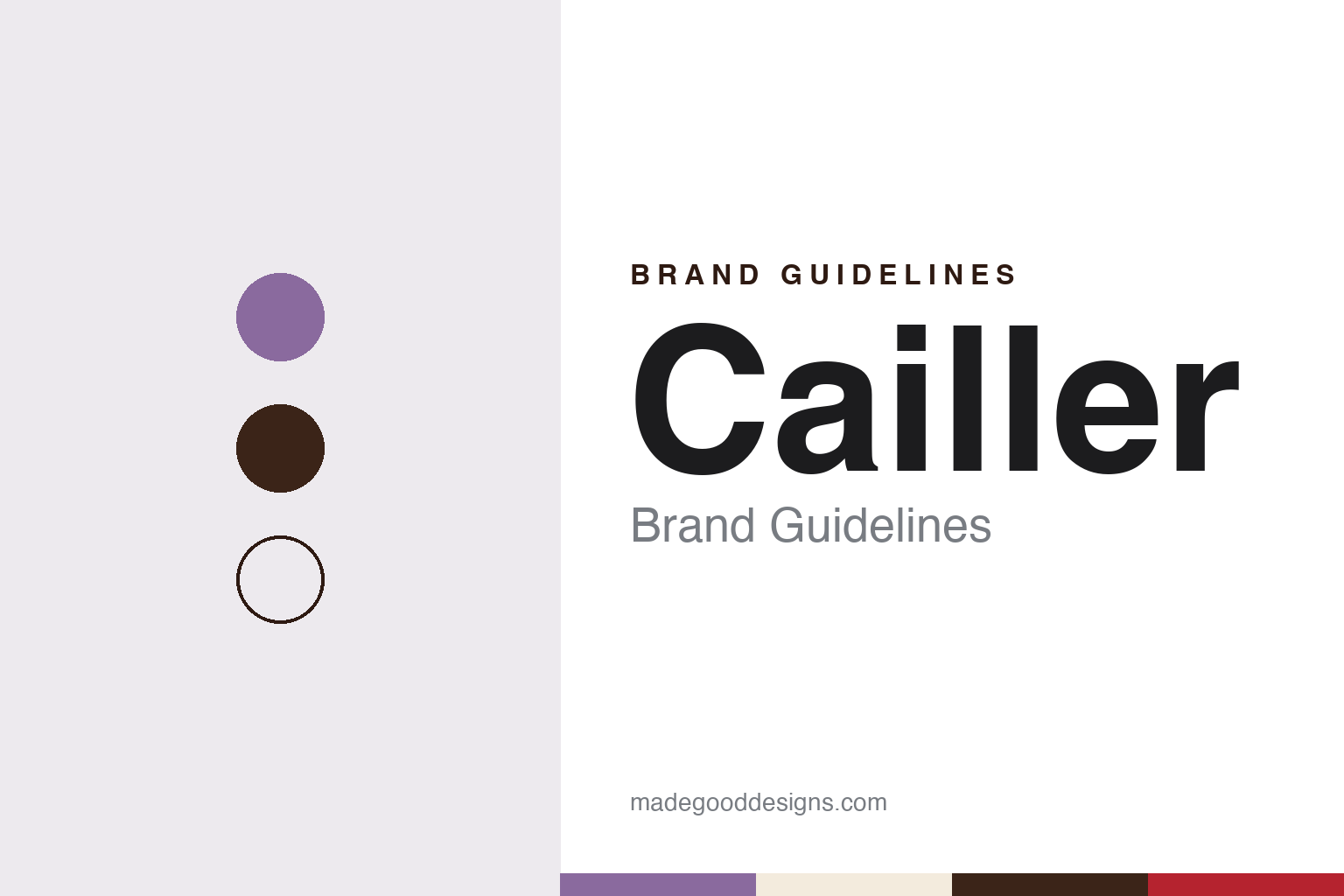
Cailler Brand Guidelines
Switzerland’s oldest chocolate brand, made at Broc since 1898.
Aa
Two constants: a Cailler mauve, cocoa and cream palette and a Heritage serif register. Abstract homage — not a Cailler product or mark; no wrapper, logo or signature is reproduced.
Vevey, 1819
A grocer’s chocolate and a factory by the lake.
Cailler is the oldest Swiss chocolate brand still in existence, according to English Wikipedia. It traces itself to 1819 and to François-Louis Cailler (1796–1852), a native of Vevey on Lake Geneva. English Wikipedia says he had opened a grocery shop in Vevey in 1818 with Abram L. C. Cusin, selling chocolate among other goods, and in 1819 set up his first chocolate factory in neighbouring Corsier-sur-Vevey; the Historical Dictionary of Switzerland (HLS) says simply that he began making chocolate in 1819. At the time chocolate was mostly drunk. Cailler’s mills, driven by water from the Monneresse canal, made it solid and moulded it into tablets and small blocks; within a few years, English Wikipedia says, he offered sixteen kinds, each in its own packaging.
The business did not grow in a straight line. Swissinfo, marking the bicentenary in February 2019, reported that it faced bankruptcy in 1826. More factories followed in Corsier and Vevey in 1832 and 1840. After François-Louis died in 1852 his widow and his sons Auguste and Alexandre carried on, and the HLS says the sons moved the business to the Rue des Bosquets in Vevey. A family link shaped Swiss chocolate beyond the firm: in 1863 Cailler’s daughter Fanny-Louise married Daniel Peter, who went on to develop milk chocolate, German Wikipedia says.
The move that defines the brand came in 1898, when the founder’s grandson, Alexandre Cailler, opened a new factory at Broc, in the Gruyère district of the canton of Fribourg. Swissinfo wrote that the site was chosen for its meadows, its water and its milk. A hydroelectric plant on the river Jogne followed in 1899, and a rail link to Bulle in 1912. English Wikipedia counts 76 workers in 1898 and 630 by 1901; German Wikipedia says that around 1900 Cailler had the highest turnover of any Swiss chocolate maker, and that it became a limited company that year to pay for its growth.
Colour
Peter, Kohler, then Nestlé.
Growth brought consolidation. In 1911 Cailler merged with the company formed by Daniel Peter and Charles-Amédée Kohler, as the HLS and both Wikipedias record. German Wikipedia says the First World War hit its export markets hard, though Cailler supplied chocolate to the Swiss army. In 1929 Peter, Cailler, Kohler, Chocolats Suisses S.A. merged with Nestlé. English Wikipedia says Nestlé used the three names together, as “PCK,” until 1951, and in the end kept Cailler as the name for the chocolate made at Broc. The family, German Wikipedia says, kept seats on the board but no longer steered the brand.
Several of the products still sold under the name date from around the Broc move, by English Wikipedia’s dating: the Ambassador praline box (1890), the plain milk Lait tablet (1898), wrapped in mauve paper, and the Fémina box (1902). The Branche, a rugged, branch-shaped bar of praline coated in milk chocolate and hazelnut pieces, has been made by Cailler since 1904; English Wikipedia says the recipe appears in Kohler’s recipe books from 1896, and that “branche” has become a generic French word for similar bars. The Frigor filled tablet followed in 1923 and the honey-nougat Rayon in 1937.
Packaging has been tested in public before. In 2006, under Nelly Wenger, who had run the Expo.02 national exhibition, Cailler moved its tablets into transparent plastic boxes designed by the architect Jean Nouvel. English Wikipedia, citing Le Temps, says the change drew criticism and, together with price increases, led some retailers to boycott the products; the plastic packs were dropped in 2007.
Typography
Swiss chocolate, documented.
The seven brands in this group all make chocolate, and they come from two neighbouring countries: Cailler, Frey, Teuscher and Halba from Switzerland, and Ritter Sport, Niederegger and Stollwerck from Germany. Between them they show how differently a chocolate name can be owned and run, even in two neighbouring countries.
Some chocolate makers belong to larger businesses, from food groups to retailers that make their own chocolate for their own shelves, and their brand has to work inside someone else’s system. Others are family firms, where the founder’s name is still on the door and the identity is handed down through generations. And Germany has its own specialities alongside the chocolate bar, such as marzipan, the almond-and-sugar paste that some makers have built a whole tradition around. Read together, the guides show how such different businesses present themselves — on the wrapper, in the shop and online.
Each guide separates what independent sources record from what the company says about itself — who founded it, who owns it now, where its cocoa comes from and where its chocolate is made — and marks plainly what rests only on the company’s own word.
Aa
A heritage serif — the register of a two-century-old name. (Specimen set in Playfair Display, a serif STAND-IN; NOT the Cailler logo or signature.)
Cailler
The factory at Broc.
Today Cailler is a Nestlé brand, and its chocolate is made at Broc. Swissinfo reported in 2019 that the factory employed about 300 people and that its milk was collected directly from regional producers by the company’s own trucks. The site also runs Maison Cailler, a visitor centre opened in 2010, with tours, a tasting room and workshops. German Wikipedia records 417,429 visitors in 2019, and SRF put the figure at about 480,000 a year in March 2026. The factory has its own station, Broc-Fabrique, on the line from Bulle, and since 2023 trains have run through from Bern, German Wikipedia says. Since 2022 Cailler has also been a licence partner of the Swiss Football Association.
The next step is larger. In March 2026 SRF reported that Nestlé Switzerland and the investment company Jogne Invest plan a chocolate park of about 30,000 square metres around the factory, with greenhouses of cacao trees, hotels, an underground car park and a cable car, at a total cost of around 400 million Swiss francs; the first phase is targeted for 2030, subject to approvals. The factory, in use since 1898, is listed in Switzerland’s federal inventory of protected sites, SRF noted.
For a design guide, Cailler shows how a single factory and a founder’s name can anchor a brand inside a global group for almost a century. Compare Frey, the Migros-owned maker long ranked first in the Swiss market, and Felchlin, a Swiss couverture house. For this guide we use mauve, cocoa brown and cream with a serif, an unofficial interpretation; no product or logo is reproduced.
Explore & save
Keep Cailler’s identity on hand — save it to a board in the Made Good inspiration library.
Cailler identity set
Pin the Cailler mauve, cocoa and cream palette and the Heritage serif register to your own board.