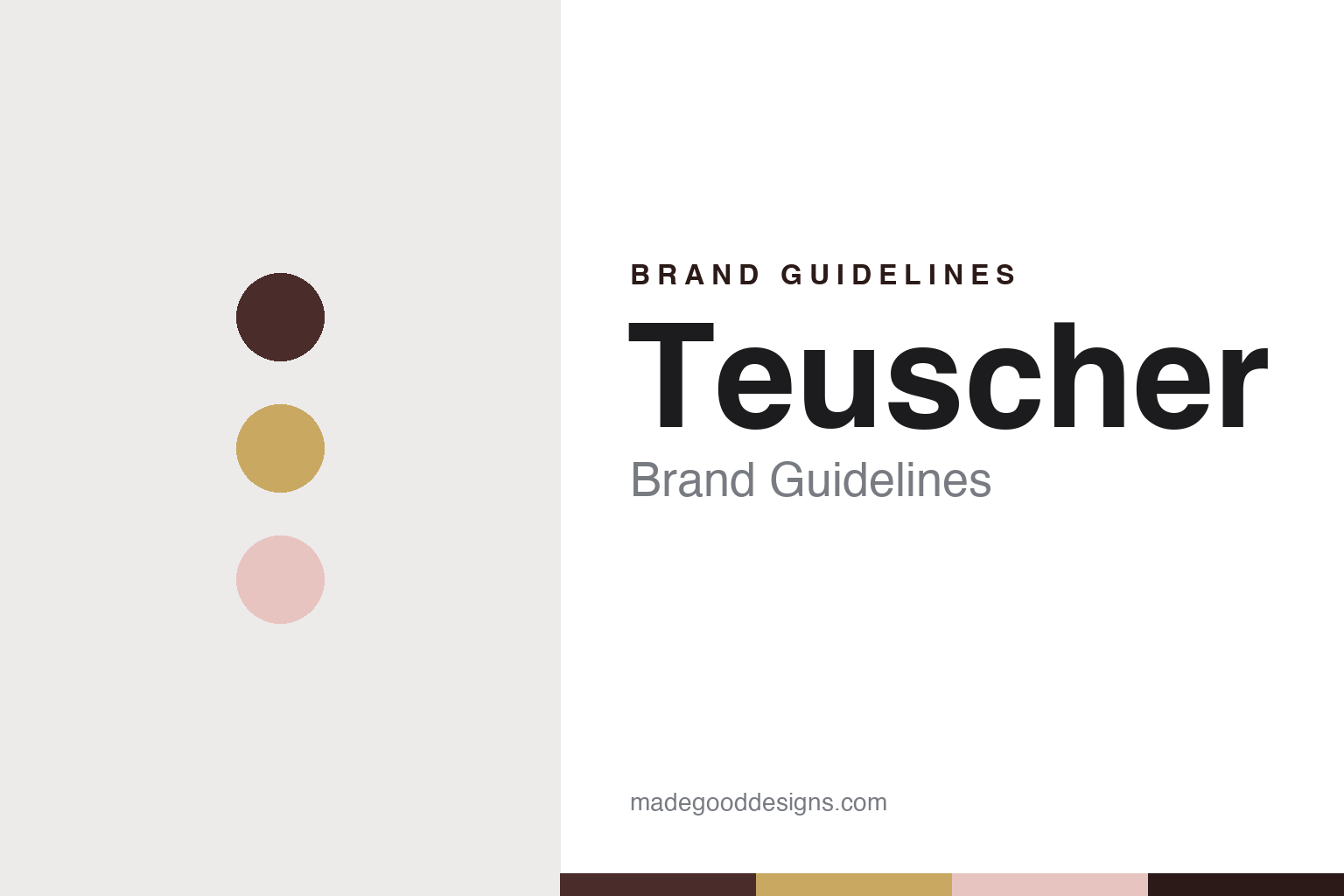
Teuscher Brand Guidelines
The Zürich confiserie built on the champagne truffle.
Aa
Two constants: a Teuscher cocoa, champagne and blush palette and a confiserie serif register. Abstract homage — not a Teuscher product or mark; no box, logo or packaging is reproduced.
Dolf Teuscher
A chocolate maker, a search for ingredients and recipes passed from father to son.
Teuscher is a Swiss chocolatier whose name is tied to one product, the champagne truffle. English Wikipedia says the house was founded in 1932 by Dolf Teuscher Sr.; the company’s own website also calls him Adolf Teuscher Sr., Dolf being the short form. Its account of the beginning is deliberately vague: “more than 80 years ago in a small town in the Swiss Alps, a master chocolate maker embarked on a path,” its About page says, without naming the town. The website of its Abu Dhabi shop is more specific, saying Teuscher opened his first chocolate workshop in Zürich in 1932, and English Wikipedia describes Teuscher as a chocolatier from Zürich, so we give both versions.
The founding story the company tells is about ingredients rather than machinery. Dolf Teuscher, it says, “searched throughout the world to locate the finest cocoa, marzipan, fruits, nuts, and other ingredients,” and after years of experimenting blended them into recipes that “have passed from father to son.” The same wording, with only the number of years updated, appears on archived versions of teuscher.com from the late 1990s (“more than 65 years ago”), from 2012 (“more than 70”) and today, which makes the story a stable part of the brand rather than a recent piece of marketing.
English Wikipedia lists Dolf Teuscher Jr. among the company’s key people. The Swiss commercial register lists the operating company as confiserie teuscher AG, based in Dübendorf, just outside Zürich, with the stated purpose of making and selling chocolate, confectionery, pastries and baked goods. Teuscher’s own store list gives Dübendorf as its corporate headquarters.
Colour
One truffle, many boxes.
The signature is the Champagne Truffle. English Wikipedia, citing a 1983 New York Magazine article by the food critic Gael Greene, calls it “the first of its kind,” and describes a centre of champagne and butter cream surrounded by a dark ganache made from 66 per cent dark chocolate, then enrobed in milk chocolate and dusted with confectioner’s sugar, or in dark chocolate dusted with cocoa powder. The Abu Dhabi shop’s website dates its introduction to 1947; we found no date on teuscher.com itself, so 1947 rests on that shop’s word. Several shops say the champagne used is Dom Pérignon — the Toronto shop’s website describes “a delicate Dom Pérignon cream center” — which we give as their claim.
Around the truffle sits a broad confiserie range. Wikipedia says Teuscher hand-makes more than 200 varieties of confections and pastries, including truffles, pralines and marzipan, and dark chocolate from 55 to 99 per cent; the company itself says its Zürich kitchens make “more than one hundred varieties,” with no additives or preservatives. As Wikipedia notes, Swiss confectioners have traditionally overlapped with patisseries, and Teuscher also sells biscuits and pastries in Zürich, where its shops are now combined with the Café Felix locations on Bellevueplatz and Bahnhofstrasse; its former flagship on the Storchengasse has been folded into them, Wikipedia says.
Packaging is the other half of the brand. Teuscher has long sold its chocolates in decorated “fantasy” boxes: an archived company page from 2001 describes “Flower Bouquets, Santa Claus, Easter Bunnies, Valentine Hearts, clowns, animals and loving characters, all filled with our chocolates.” Today its shops sell floral boxes, silk-covered boxes and figure boxes alongside plain ballotins, and the brand’s look leans on that theatrical gift-wrapping more than on any single colour or logo.
Typography
Swiss, German and Austrian chocolate.
The seven brands in this group all make chocolate, and they come from two neighbouring countries: Cailler, Frey, Teuscher and Halba from Switzerland, and Ritter Sport, Niederegger and Stollwerck from Germany. Between them they show how differently a chocolate name can be owned and run, even in two neighbouring countries.
Some chocolate makers belong to larger businesses, from food groups to retailers that make their own chocolate for their own shelves, and their brand has to work inside someone else’s system. Others are family firms, where the founder’s name is still on the door and the identity is handed down through generations. And Germany has its own specialities alongside the chocolate bar, such as marzipan, the almond-and-sugar paste that some makers have built a whole tradition around. Read together, the guides show how such different businesses present themselves — on the wrapper, in the shop and online.
Each guide separates what independent sources record from what the company says about itself — who founded it, who owns it now, where its cocoa comes from and where its chocolate is made — and marks plainly what rests only on the company’s own word.
Aa
A confiserie serif for a gift-box brand. (Specimen set in Cormorant Garamond, a serif STAND-IN; NOT the Teuscher logo.)
Teuscher
Made in Switzerland, flown out every week.
Teuscher’s reach comes from its own shops rather than supermarket shelves. Its New York store on Fifth Avenue, in the Channel Gardens at Rockefeller Center, opened in 1979, the company says, and the Abu Dhabi shop’s history names 1979 as the start of expansion beyond Zürich, including Geneva and New York, and 2004 as the year Teuscher opened in Abu Dhabi. In October 2026 the company’s store list showed shops in Zürich, New York, Chicago, San Francisco, San Diego, Beverly Hills, Corona del Mar, Toronto, Shanghai, Chongqing, Seoul and Abu Dhabi, plus a seasonal counter at the Takashimaya department store in Japan.
Production stays in Switzerland. The company says its confections “are prepared each week and flown immediately to our stores in Europe, America, Canada, Asia, and the Middle East,” and the Abu Dhabi website says each chocolate is made in “our Zürich kitchen”; beyond the Dübendorf headquarters in the commercial register, we have not seen independent confirmation of where the kitchens are. Many of the shops abroad run their own websites under the Teuscher name, and teuscher.com does not say how they are owned or licensed. We found no record of the business being sold to an outside group in the sources we checked, and it presents itself as a family firm.
For a design guide, Teuscher shows how a small confiserie can build an international name on one recipe and a box. Compare Neuhaus, the Brussels house credited with the praline and the ballotin, and La Maison du Chocolat, another shop brand built on truffles and ganache. For this guide we use cocoa brown, champagne gold and a blush pink with a serif, an unofficial interpretation; no product or logo is reproduced.
Explore & save
Keep Teuscher’s identity on hand — save it to a board in the Made Good inspiration library.
Teuscher identity set
Pin the Teuscher cocoa, champagne and blush palette and the confiserie serif register to your own board.