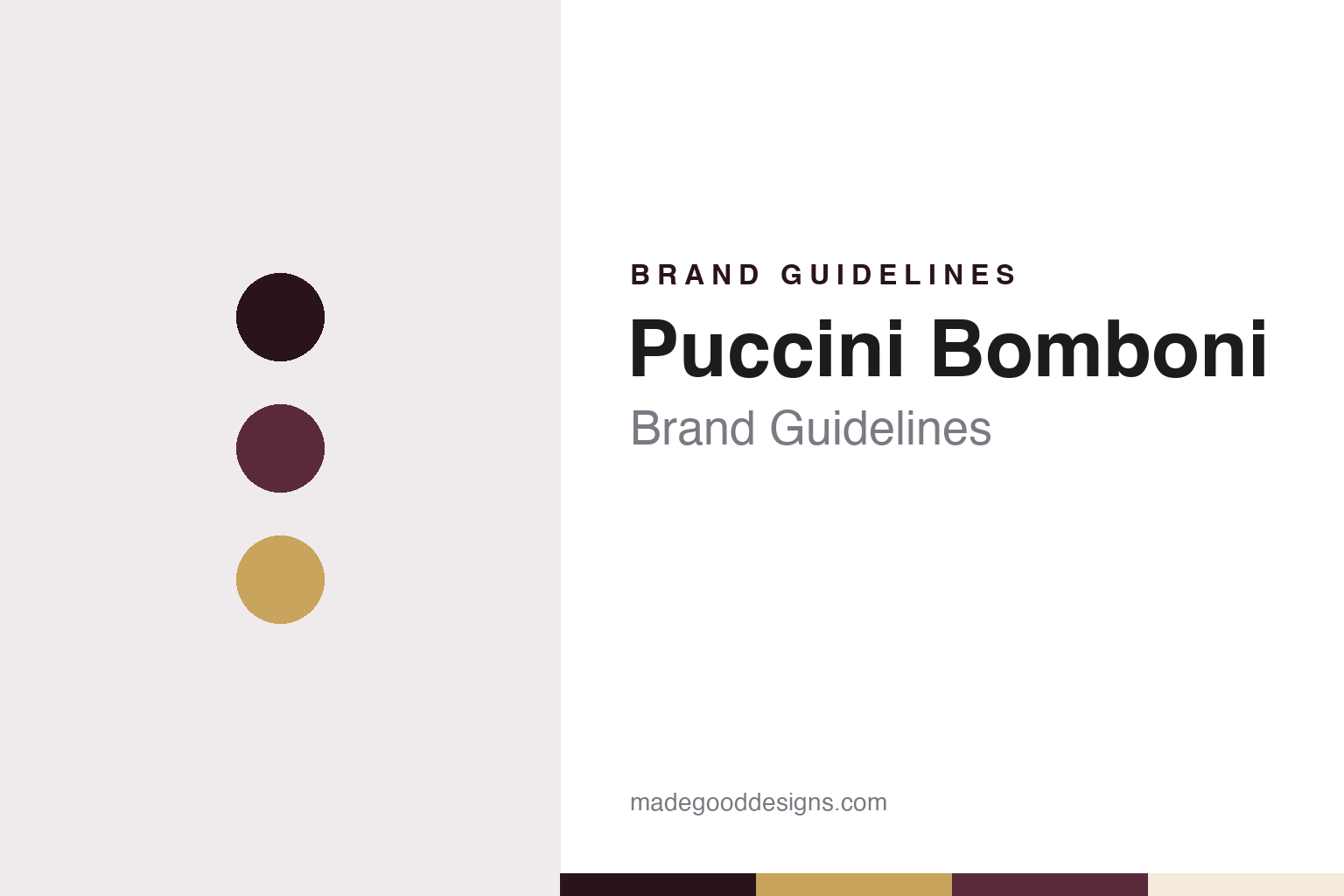
Puccini Bomboni Brand Guidelines
The family chocolatier of Amsterdam’s Staalstraat.
Aa
Two constants: a Puccini Bomboni plum, ganache and gilt palette and a theatre-bill serif register. Abstract homage — not a Puccini Bomboni product or mark; no bonbon, box, logo or photograph is reproduced.
A dessert shop on the Staalstraat
A mother, a daughter and five bonbons.
Puccini Bomboni is a chocolatier in Amsterdam, and it began as something else. The company says its founder, Ans van Soelen, opened a dessert shop in the city in 1987 with her daughter, Sabine van Weldam, and that what started with cakes, coffee and five bonbons of their own on the Staalstraat soon became a business devoted to chocolate. A 2016 profile in the magazine Discover Benelux gives the date of the first dessert shop as 1988; we give both years. The company’s website today describes Sabine van Weldam as its creative director and a founder, and Discover Benelux called her the house’s chief chocolatier.
The early shape of the business can still be read on the web. Captures of the company website held by the Internet Archive from 2003 already show two Amsterdam shops, on the Staalstraat and on the Singel, and list Ans van Soelen’s name among the site’s keywords. The English text on that early site said that Puccini Bomboni chocolates were “(un)traditionally handmade on the premises,” to the company’s own recipes and “using only the finest natural ingredients,” and that it tried to give each chocolate its own character by combining herbs and spices, unusual alcoholic drinks and fruits with chocolate.
The business has stayed with the family that started it. Its current recruitment page calls Puccini Bomboni a family business, and the sources we checked record no sale, outside investor or parent company. Its website now lists three shops: the original on the Staalstraat in Amsterdam’s old centre, the shop on the Singel, and a third on the Lijnmarkt in Utrecht. The company says each has “its own look and its own story,” and that visiting one is an experience in itself. Its recruitment page says its chocolatiers work in a professional atelier, though the sources we checked do not say where that atelier is.
Colour
Big bonbons and fresh cream.
Puccini Bomboni’s product is the filled bonbon, and the company is clear about what it thinks sets its version apart. It says its search for unusual creations and combinations has produced a category of its own, the Puccini Bomboni bonbon: large in format, rich in flavour and individually designed, each shape and detail meant to sharpen the experience of eating it. Its recipes, the company says, replace the butter and sugar usually found in fillings with pure cream, so that the filling is the star of each piece.
The flavours range widely. The company’s own summary runs from amaretto to anise, from pepper to poppy seed and from tea to thyme, and its online bonbon list includes calvados, hibiscus and rose, lemongrass, rhubarb and tamarind alongside more familiar marzipan, hazelnut and caramel. Many are made with spirits and liqueurs, and the website lets buyers filter for alcohol-free, nut-free, vegan or extra-dark pieces. A 2012 list of the world’s ten best chocolatiers, published by National Geographic and drawn from the travel book The 10 Best of Everything by Nathaniel and Andrew Lande, included the house and said that “you will actually have to visit Amsterdam to sample what may be the best chocolates in the Netherlands.”
Puccini Bomboni makes bonbons, not chocolate from the bean. On its sustainability page the company names Barry Callebaut, the Swiss-based chocolate and cocoa group, as its supplier, and says it supports Barry Callebaut’s Cocoa Horizons initiative, which it says benefits more than 25,000 cocoa farmers and their families in West African countries including Côte d’Ivoire, Nigeria and Burkina Faso. Its frequently asked questions add that it is a partner in the Cocoa Horizons programme, that its dark chocolate is 54 to 57 percent cocoa, its extra-dark 70 percent and its milk chocolate 33 percent. The company also says it uses no preservatives and works with fresh cream, and that for this reason it guarantees its bonbons for 14 days after delivery.
That freshness shapes how the bonbons are sold. The company says its webshop carries only the selections that travel well by post, because some bonbons are too fragile to be sure of arriving intact, and that the full range can be bought only in its three shops. It says it ships across most of Europe, to Switzerland and to North America.
Typography
Chocolatiers and chocolate houses.
The seven brands in this group all sell chocolate, and they come from three countries: Cémoi, Jeff de Bruges, Monbana and À la Mère de Famille from France, Summerbird and Peter Beier from Denmark, and Puccini Bomboni from the Netherlands. They sit at different points in the chocolate trade, from names found on supermarket shelves and in shopping-centre chains to single shops known mainly to the people who walk past their windows.
Some of these businesses are manufacturers, buying cocoa or chocolate in bulk and turning it into bars, drinks and seasonal shapes sold far from where they are made. Others are chocolatiers, who buy finished chocolate from a supplier and use it to make bonbons, truffles and filled pieces by hand, and whose identity rests on a shop, a recipe and a family name as much as on any wrapper. Many sit somewhere between the two, running workshops and shops at once.
Each guide separates what independent sources record from what the company says about itself — who founded it, who owns it now, where its cocoa comes from and where its chocolate is made — and marks plainly what rests only on the company’s own word.
Aa
A theatre-bill serif — opera titles on the box and a booklet in the bag. (Specimen set in Cormorant Garamond, a serif STAND-IN; NOT the Puccini Bomboni logo.)
Puccini Bomboni
A booklet in every box.
The brand’s name points to the opera, and so do some of its products. Several of the boxed assortments in its current shop carry the titles of operas by Giacomo Puccini, among them Tosca and Le Villi, alongside selections called Opera and Maestro. The sources we checked do not record why the founders chose the name, so we leave it there.
The most distinctive piece of print is small. The company says every purchase comes with a miniature booklet describing all of its bonbons, so that a buyer can choose the next one with more pleasure, and its answers on allergies say the booklet also carries general allergy information. In a range where each bonbon is large, individually shaped and built around a single unusual filling, the booklet does the work of a label: it names what the shape alone cannot. The company says it bases its approach on a philosophy that “consciously ignores hypes” and lets the product speak for itself.
For a design guide, Puccini Bomboni shows how a small chocolatier can build an identity on a shop, a format and a voice rather than on a factory: an oversized bonbon, a booklet and an operatic name carry the brand in place of an origin story. Compare La Maison du Chocolat, the Paris house built on ganache and cream, and Tony’s Chocolonely, another Amsterdam chocolate brand with a very different, louder look. For this guide we use plum, ganache brown and gilt with a serif, an unofficial interpretation; no product or logo is reproduced.
Explore & save
Keep Puccini Bomboni’s identity on hand — save it to a board in the Made Good inspiration library.
Puccini Bomboni identity set
Pin the Puccini Bomboni plum, ganache and gilt palette and the theatre-bill serif register to your own board.