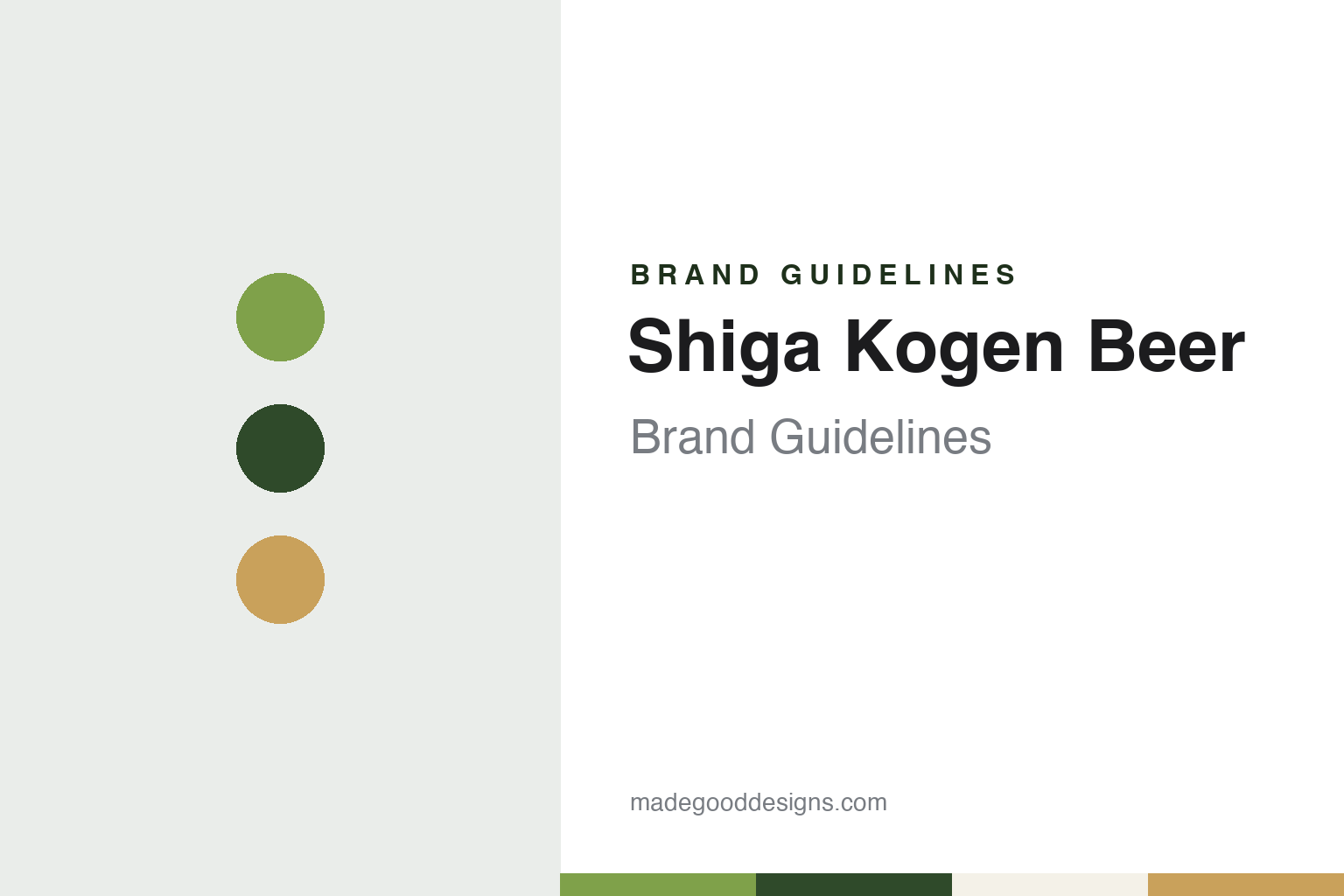
Shiga Kogen Beer Brand Guidelines
A Nagano sake house’s beer, brewed since 2004.
Aa
Two constants: a hop green, alpine pine and barley gold palette and a mincho serif register. Abstract homage — not a Shiga Kogen Beer product or mark; no label, logo or bottle is reproduced.
A sake house at the foot of the mountains
Two centuries of sake, then a beer of its own.
Shiga Kogen Beer is made by Tamamura Honten, a sake brewery in the town of Yamanouchi in northern Nagano Prefecture, at the foot of the Shiga Kogen highlands and close to the hot-spring villages of Yudanaka and Shibu. The company says its first head, Kisōji, founded the brewery in 1805, and that the house name Tamamura comes from Tamamura in old Jōshū, today Tamamura in Gunma Prefecture, where he had learned to brew. The guide BeerTengoku gives 1804 instead; the company’s own date is 1805.
Its sake has a story of its own. Tamamura Honten says its sake was once sold as Hoshi no I, that it was bought for the Imperial Household in 1907, and that after the enthronement of the Taishō Emperor the brand was renamed Engi, after the head of the family, Kisōji. The company still sells Engi sake today, alongside a newer line called NEW ENGI. Its overview page names Satō Eigo as president and Satō Kisōji, the seventh generation, as chairman.
The beer came out of a hard stretch for the sake trade. BeerTengoku wrote in 2014 that falling sake sales, partly because fewer skiers were coming to the area, pushed the company to change course, that it applied for a beer licence in May 2004 and began brewing in September 2004, and that it bought its first equipment from a recently closed brewery in Kyushu. The outdoor magazine BE-PAL reported in October 2025 that Satō Eigo, the eighth generation of the family business, took it over in 2003 after working at a foreign securities firm and at Uniqlo, and set out in 2004 to “make the beer we want to drink.” According to BE-PAL, the business already delivered big-brand beer to hotels and inns in Yudanaka and Shibu, and the first Shiga Kogen beers were a Pale Ale, an IPA and a Porter.
Colour
A place name, home-grown hops and the mountain monks.
The name is the first part of the identity: the beer is called after the highlands above the brewery rather than after the company. Shiga Kogen is in Nagano, not in Shiga Prefecture, and the brand sits on the company’s own site, tamamura-honten.co.jp, under the Tamamura Honten name.
The second part is farming. The company says it began brewing in 2004 and started growing hops in 2006, in an area that it says was Japan’s leading hop-growing district until the early 1960s. BE-PAL reported in 2025 that the Shinshu Wase hop variety was developed in the region in the 1910s, that the brewery’s hop field covers about 40 ares, and that it supplies roughly a tenth of the hops the brewery uses; BeerTengoku put the home-grown share at about 20 percent in 2014. The company calls its fresh-hop beers the Harvest Brew series and says the hops go into the kettle undried soon after picking. It also grows sake rice, wheat, buckwheat and berries, and BE-PAL reported that rice-polishing bran from the sake side finds its way into the beer.
The third part is a second brand inside the first. The company says its Yamabushi series grew out of its admiration for the variety of Belgian beer, and that it took the name from the yamabushi, the mountain ascetics of Japanese tradition, on the thought that “if Belgium has its monks, we are yamabushi.” The Yamabushi beers are saisons, bottle-conditioned with fresh yeast and a little sugar, the company says, and BE-PAL reported that they have been sold in 750 ml bottles since 2010. A wood-aged branch of the series spends time in wine and whisky barrels with wild yeasts; BE-PAL counted about 200 barrels ageing in 2025.
Typography
Design and documentation.
The seven brands in this group are all Japanese craft beers: Hitachino Nest, Yo-Ho, Coedo, Echigo, Minoh, Baird and Shiga Kogen. Most of them trace back to a single change in the law. Japanese Wikipedia records that a 1994 revision of the liquor tax law cut the minimum annual output needed for a beer licence from 2,000 kilolitres to 60, and that the small regional breweries that followed, known as “ji-bīru,” at one point numbered more than 300.
Several of the seven grew out of older drinks businesses. English Wikipedia says Kiuchi Brewery, the maker of Hitachino Nest in Naka, Ibaraki, was founded in 1823 as a sake producer and began brewing beer in 1996; Shiga Kogen Beer belongs to Tamamura Honten, a Nagano sake house that dates itself to 1805 and began brewing beer in 2004. Others sit inside larger companies: Japanese Wikipedia says Yo-Ho Brewing of Karuizawa was founded in 1996 by Yoshiharu Hoshino of Hoshino Resorts and entered a business and capital alliance with Kirin Beer in 2014, that Coedo is the beer division of Kyodo Shoji of Kawagoe, and that the confectioner Bourbon has owned all of Echigo Beer of Niigata since 2010. Minoh Beer is a family brewery in Minoh, Osaka, and Zoom Japan reported in 2020 that Baird Beer was founded in Numazu in 2000 by Bryan and Sayuri Baird and moved its headquarters to Shuzenji in 2014.
Each guide separates what independent sources record from what the company says about itself — its founding story, its owners over time, where its beer is brewed and how its labels and cans have changed — and marks plainly what rests only on the company’s own word.
Aa
A mincho serif for a mountain sake house’s beer. (Specimen set in Shippori Mincho, a serif STAND-IN; NOT the Shiga Kogen Beer logo.)
Shiga Kogen Beer
A brewery that also throws a festival and writes its own history.
Beyond the bottles, the brewery has built a following around music. The company says SNOW MONKEY BEER LIVE, a beer-and-music event at Shiga Kogen, has been held each March since 2012, with breweries and musicians it regards as kindred small-scale makers. The 2020 edition was cancelled just before it was due to open and the 2021 edition was called off because of COVID-19, the company says, and in place of the event it released an analog LP recorded by artists linked to the festival. BE-PAL reported that the event ran at Shiga Kogen from 2012 to 2019 and returned in 2024 at Shibuya CLUB QUATTRO in Tokyo, and that the first year’s brewers included Minoh Beer of Osaka.
For its twentieth anniversary Tamamura Honten published a 160-page book, SHIGA KOGEN BEER 20th Anniversary, which BE-PAL reported was released in September 2025. The company lists among its contents a full list of the brewery’s beers from 2004 to 2024, a conversation among brewers including those of Minoh Beer, and visits to Venture Whisky, the maker of Chichibu whisky, and the Obuse Winery. The company says its taproom THE FARMHOUSE reopened in July 2026, and its gallery in an old kura shows Japanese paintings collected by the family.
For a design guide, Shiga Kogen Beer shows how a beer brand can draw its identity from a place, a farm and a two-hundred-year-old sake house rather than from a single mark, carrying the highlands’ name on one side of the range and the mountain monks on the other. Compare Masumi, the Nagano sake of Miyasaka Brewing in Suwa, and Hitachino Nest, another Japanese beer made by an old sake brewery. For this guide we use hop green, alpine pine and barley gold with a mincho serif, an unofficial interpretation; no product or logo is reproduced.
Explore & save
Keep Shiga Kogen Beer’s identity on hand — save it to a board in the Made Good inspiration library.
Shiga Kogen Beer identity set
Pin the Shiga Kogen Beer hop green, alpine pine and barley gold palette and the mincho serif register to your own board.