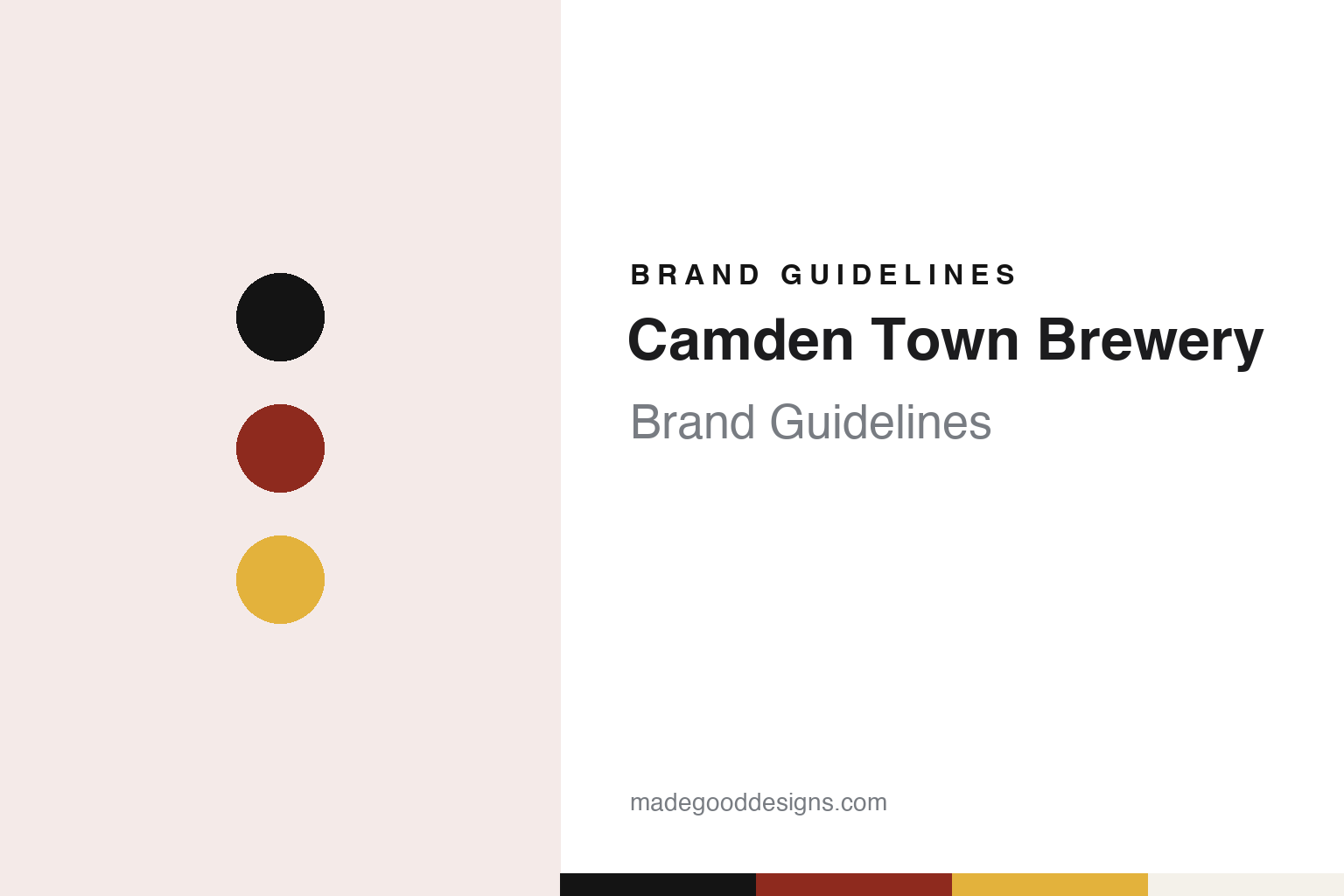
Camden Town Brewery Brand Guidelines
The Kentish Town arches brewery behind Hells Lager.
Aa
Two constants: an ink black, arch brick and lager gold palette and a condensed sign-writer sans register. Abstract homage — not a Camden Town Brewery product or mark; no can, label or logo is reproduced.
From The Horseshoe to the arches
A Hampstead pub, a grandfather’s recipe and five railway arches.
Camden Town Brewery began with a pub rather than a brewery. The company’s own history says its founder, Jasper Cuppaidge, missed a flight home to Australia, stayed in London collecting glasses in a pub, and later bought a run-down pub in Hampstead, painted it white and opened it in 2006 as The Horseshoe. In 2007, the company says, he brewed his first batch of beer there as a birthday present for his mother, Patricia, in honour of his grandfather Laurie McLaughlin, who had owned McLaughlin’s brewery in Rockhampton, Queensland; the cask ale, called Mac’s, was based on one of the grandfather’s old recipes. English Wikipedia, citing the Financial Times in 2013, gives McLaughlin’s years running the brewery as 1910 to 1960.
By 2009 Cuppaidge wanted to brew lager, which needed more room than a pub basement. The company says the Mac’s name had already been trademarked by another brewer, so he named the new business after the borough he lived in and bought the domain camdentownbrewery.com. He then rented five Victorian railway arches under Kentish Town West station, and the company says brewing officially began there in spring 2010. The trade site BeverageDaily reported in December 2015 that the brewery had started full production in 2010.
Its first lager arrived in autumn 2010. The company says it called the beer Hells because it is a cross between a German Helles and a Pilsner, brewed with malt and hops sourced from Germany, and that it still uses the same ingredients today. Hells has remained the brand’s lead beer: the brewery’s web shop in 2026 lists Hells Lager, Pale Ale, Eazy IPA and Stout as its core range.
Colour
A roundel, a borough emblem and sign-writer lettering.
The identity most drinkers know dates from June 2016. It’s Nice That reported on 13 June 2016 that the London design studio Studio Juice had refreshed the brewery’s identity to create branding “that screams from tap rooms to bottle shops,” with punchier, bolder colours and bespoke typography across the range. Each beer name — Hells, Pale Ale and Pils among them — was given its own type treatment to suit the beer’s character, the studio said, and the enlarged names carry a drop shadow inspired by sign writing, set against blocks of colour with heavy use of white.
The mark at the centre is a roundel. It’s Nice That reported that the studio simplified the roundel’s outer circle and made the central marque more unified and visible, and quoted its creative director, Ross Stirling, saying the aim was “a standalone icon that would be instantly recognisable even without the brand name attached.” The Camden lozenge was adjusted to match, with a sharper, more geometric form. Packaging Gateway reported on 12 June 2016 that the new logo was inspired by the emblem of Camden’s council, an oval symbol with four pairs of clasped hands — tying the brand to the borough whose name it carries.
The new look ran across packaging, tap badges and advertising, It’s Nice That reported, and Packaging Gateway said the design would extend the following year to more beers in small packs, including Unfiltered Hells and Ink in cans and bottles.
The arches remain part of the brand’s vocabulary. The company’s 2026 range includes an Arch 55 series, which it describes as beers brewed under the arches, and its beer hall in Kentish Town calls itself the original “Home of Hells.”
Typography
Design and documentation.
The seven brands in this group are all British craft brewers: Camden Town Brewery, Thornbridge, Magic Rock, Siren Craft Brew, Tiny Rebel, Harviestoun and Lost and Grounded. They began as small, founder-run businesses, but they have travelled very different roads since — some remain in their founders’ hands, while others have been sold, licensed or bought back.
Camden Town Brewery was founded in London in 2010 by Jasper Cuppaidge, in railway arches beneath Kentish Town West station, according to English Wikipedia; AB InBev has owned it since 2015, after a sale announced that December. Thornbridge brewed its first beers in 2005 in outbuildings at Thornbridge Hall in Derbyshire and opened a larger brewery in Bakewell in 2009, English Wikipedia says. Harviestoun was started by Ken Brooker in a farm barn near Dollar, in Clackmannanshire — in 1983, English Wikipedia says — and moved to Alva in 2004; Caledonian bought it in 2006, and in April 2008 long-standing shareholders bought it back to keep it independent, The Morning Advertiser reported.
Magic Rock was founded in Huddersfield in 2011 by Richard Burhouse. The Australian brewer Lion took full ownership in 2019, Lion’s UK business passed to Odyssey Inns in 2022, and in January 2025, after administrators were appointed and the Huddersfield brewery closed, Keystone Brewing Group took an exclusive licence to produce the brand, Just Drinks reported. Tiny Rebel was founded in Newport in 2012 by the brothers-in-law Brad Cummings and Gazz Williams and moved its brewing to Rogerstone, in Newport, in 2017. Siren Craft Brew was set up in 2013 by Darron Anley at Finchampstead in Berkshire, and in April 2026 Anley told Beer Today that it was “still independent.” Lost and Grounded was founded in Bristol by Alex Troncoso and Annie Clements and says it was established in 2016.
A brewery’s identity is carried by its pump clips, cans and labels as much as by its beer, and those can outlast changes of owner or even the brewery itself. Each guide separates what independent sources record from what the company says about itself — its founding story, its owners over time, where its beer is brewed and how its packaging has changed — and marks plainly what rests only on the company’s own word.
Aa
A condensed sans for sign-writer lettering. (Specimen set in Oswald, a sans-serif STAND-IN; NOT the Camden Town Brewery logo.)
Camden Town Brewery
A neighbourhood brewery inside a global group.
Growth brought a change of owner. On 21 December 2015 Camden Town Brewery announced that it was being bought by AB InBev; The Morning Advertiser reported that day that the deal was expected to close by 7 January 2016, making Camden a wholly owned subsidiary, and that the money would support a plan to build a second brewery in London. The sale followed a crowdfunding round earlier that year. It also drew a reaction: BrewDog’s co-founder James Watt said on Twitter that its bars “don’t stock ABInBev beers,” and BrewDog dropped Camden’s beer, The Morning Advertiser reported.
The second brewery opened in Enfield, north London, in 2017. City AM reported on 11 May 2017 that brewing there was about to begin and that the site would open to the public on 8 July; Cuppaidge, then founder and chief executive, said “the railway arches in Kentish Town will remain the heart and soul of Camden Town Brewery.” Integration went further in 2020. The German trade journal Brauwelt reported on 3 December 2020, citing The Grocer, that AB InBev planned to bring Camden fully into Budweiser Brewing Group, its UK business, that Cuppaidge would take a consultant role, and that chief executive Adam Keary would leave in March 2021.
The brand’s website in 2026 carries the copyright line of AB InBev UK Ltd, and the company still runs brewery tours and a beer hall under the original arches in Kentish Town.
For a design guide, Camden Town Brewery shows how a neighbourhood name, a borough emblem and sign-writer lettering can stay at the centre of a brand after it has joined a global group. Compare Goose Island, the Chicago brewery that also sold to AB InBev, and BrewDog, the Scottish brewer whose bars dropped Camden’s beer in 2015. For this guide we use ink black, arch brick and lager gold with a condensed sans, an unofficial interpretation; no product or logo is reproduced.
Explore & save
Keep Camden Town Brewery’s identity on hand — save it to a board in the Made Good inspiration library.
Camden Town Brewery identity set
Pin the Camden Town Brewery ink black, arch brick and lager gold palette and the condensed sign-writer sans register to your own board.


