Magic Rock Brand Guidelines
The Huddersfield brewery named after a crystal business.
Aa
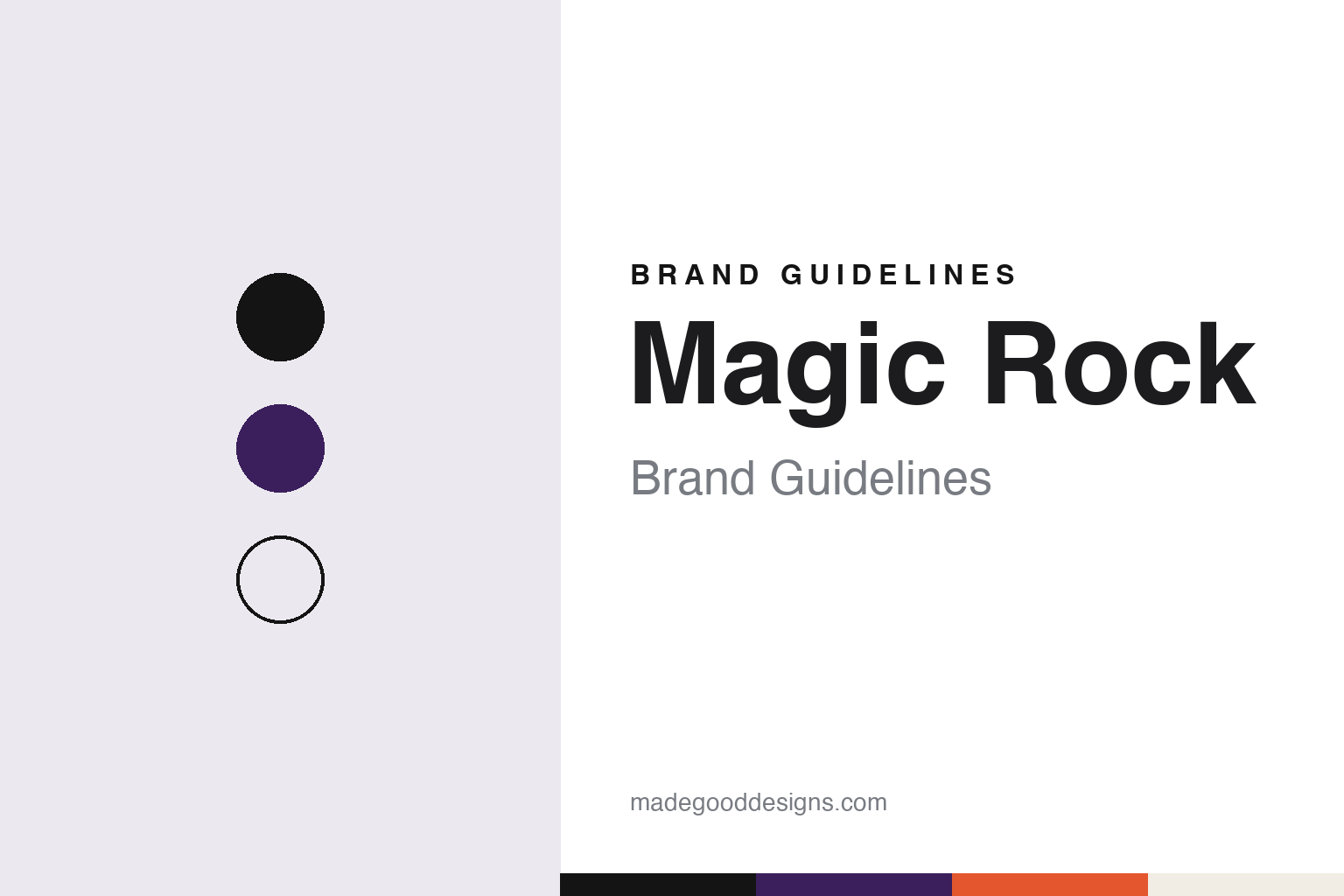
Two constants: a black, amethyst and orange palette and a heavy grotesque register. Abstract homage — not a Magic Rock product or mark; no can, label or logo is reproduced.
Crystals and hops
A brewery in a family firm’s outbuildings.
Magic Rock began in Huddersfield, West Yorkshire, in 2011. It was founded by Richard Burhouse, with Stuart Ross as head brewer, according to the Morning Advertiser in 2019 and English Wikipedia. An early introduction to the brewery by the beer writer Mark Dredge, still kept on Magic Rock’s own website, described the brothers Richard and Jonathan Burhouse as its investors and said that brewing would begin in March 2011.
The name came from the family. The same post explained that the brewery was set up in outbuildings belonging to the Burhouse family business, which had been importing and wholesaling crystals and natural gifts for some 40 years — “hence the name Magic Rock.” The aim, Richard Burhouse said then, was “modern flavour-forward beers inspired in part by US craft breweries,” sold mainly in cask to British pubs.
Dredge listed five beers: Curious, a pale ale; Rapture, a red hop ale; High Wire, a West Coast pale ale; Dark Arts, a stout; and Cannonball, an IPA. Good Beer Hunting called Cannonball the brewery’s flagship when it reported the sale of Magic Rock in 2019, and described the brewery as one of the earliest and most influential of the UK’s craft-beer scene.
Magic Rock grew out of its first home. English Wikipedia says it opened a new brewery on Willow Lane in Huddersfield in 2015, with its first taproom on the same site, and a second Magic Rock Tap in Holmfirth in December 2019. By 2019 the Morning Advertiser described a 4,000-square-foot taproom, an automated canning line, 45 staff and exports to more than 25 countries.
Colour
A circus without the clowns.
Magic Rock’s look was led by an in-house designer. In a question-and-answer piece, Richard Burhouse — who has said he worked in graphic design before brewing — called hiring the designer Rich Norgate rather than drawing the artwork himself probably the best decision he made. In the same interview, for the retailer Beer Hawk, he gave the brewery’s motto as “Same But Different,” which he said meant trying to exceed people’s expectations in everything it did.
The labels drew on the circus. In October 2014 The Next Web included Magic Rock in a round-up of beer label designs and described every beer sharing the same circus-themed artwork, with only the name and colour changing from one to the next.
Cans came in late 2015. Magic Rock’s own blog says the first 330ml cans used “colourful understated but recognisable character based designs” that Rich had drawn, and that the brewery thought them “some of the boldest designs around.”
The brewery later changed direction. In a post titled “Core cans re-design,” it explained that so much strong artwork had appeared in beer that it was time for a bolder look. The new style began with Fantasma, a gluten-free IPA, which used a pattern-based design and black lids; the post said eight new core designs were finished, that Saucery, a session IPA, would join the core range, and that Rapture would leave the core cans while staying on cask and keg.
The brewery also brewed with its home town. The Morning Advertiser named Hat Trick, a modern bitter, and Promised Land, a German-style lager, as beers made with Huddersfield Town football club.
Typography
Craft beer and its owners.
The seven brands in this group are all British craft brewers: Camden Town Brewery, Thornbridge, Magic Rock, Siren Craft Brew, Tiny Rebel, Harviestoun and Lost and Grounded. They began as small, founder-run businesses, but they have travelled very different roads since — some remain in their founders’ hands, while others have been sold, licensed or bought back.
Camden Town Brewery was founded in London in 2010 by Jasper Cuppaidge, in railway arches beneath Kentish Town West station, according to English Wikipedia; AB InBev has owned it since 2015, after a sale announced that December. Thornbridge brewed its first beers in 2005 in outbuildings at Thornbridge Hall in Derbyshire and opened a larger brewery in Bakewell in 2009, English Wikipedia says. Harviestoun was started by Ken Brooker in a farm barn near Dollar, in Clackmannanshire — in 1983, English Wikipedia says — and moved to Alva in 2004; Caledonian bought it in 2006, and in April 2008 long-standing shareholders bought it back to keep it independent, The Morning Advertiser reported.
Magic Rock was founded in Huddersfield in 2011 by Richard Burhouse. The Australian brewer Lion took full ownership in 2019, Lion’s UK business passed to Odyssey Inns in 2022, and in January 2025, after administrators were appointed and the Huddersfield brewery closed, Keystone Brewing Group took an exclusive licence to produce the brand, Just Drinks reported. Tiny Rebel was founded in Newport in 2012 by the brothers-in-law Brad Cummings and Gazz Williams and moved its brewing to Rogerstone, in Newport, in 2017. Siren Craft Brew was set up in 2013 by Darron Anley at Finchampstead in Berkshire, and in April 2026 Anley told Beer Today that it was “still independent.” Lost and Grounded was founded in Bristol by Alex Troncoso and Annie Clements and says it was established in 2016.
A brewery’s identity is carried by its pump clips, cans and labels as much as by its beer, and those can outlast changes of owner or even the brewery itself. Each guide separates what independent sources record from what the company says about itself — its founding story, its owners over time, where its beer is brewed and how its packaging has changed — and marks plainly what rests only on the company’s own word.
Aa
A heavy grotesque for a loud can. (Specimen set in Archivo Black, a sans STAND-IN; NOT the Magic Rock logo or lettering.)
Magic Rock
From Lion to a rescue deal.
Magic Rock did not stay independent. On 29 March 2019 the Morning Advertiser reported that Lion, the Australian beer and drinks company, had bought 100 per cent of the brewery, following its purchase of London’s Fourpure in 2018; Good Beer Hunting noted that Lion was itself owned by Japan’s Kirin. Richard Burhouse, the managing director, stayed on, and said the best way to build on the brewery’s legacy was “to introduce Magic Rock beers to a much wider audience.”
Three years later Lion sold up. English Wikipedia, citing Just Drinks in August 2022, says Lion sold its UK business, including Magic Rock; Just Drinks later described Magic Rock and Fourpure as owned from 2022 by In Good Company Brewing.
In January 2025 that business ran out of road. Just Drinks reported on 31 January 2025 that administrators had been appointed for Magic Rock, that brewing had stopped weeks earlier and that the Huddersfield brewery had closed. In the same report Keystone Brewing Group, owner of Black Sheep, said it had “secured an exclusive license with the brand owners” to take Magic Rock and Fourpure forward; its chief executive, Mark Williams, said “The Magic Rock brewery has unfortunately closed.”
Keystone did not last either. Place Yorkshire reported on 23 January 2026 that a notice of intention to appoint administrators had been filed for Keystone Brewing Group in November 2025, that administrators from FRP Advisory were appointed on 22 January 2026, and that they completed a pre-pack sale of the business to the newly formed Great British Drinks Company, backed by the entrepreneurs behind Paramount Retail Group, owner of Saltaire Brewery. The group sold included Black Sheep, Purity, Brew By Numbers, Brick, North, Fourpure and Magic Rock. Magic Rock now survives as a brand held by the Great British Drinks Company since January 2026, rather than as the Huddersfield company that created it, whose brewery closed in 2025.
For a design guide, Magic Rock shows how a single designer and a strong theme can make a small brewery’s range recognisable on a crowded shelf, and how a brand can outlast the brewery that built it. Compare BrewDog, the Scottish craft brewer founded in 2007, and Thornbridge, the Derbyshire brewery. For this guide we use black, a deep amethyst and a loud orange with a heavy sans, an unofficial interpretation; no product or logo is reproduced.
Explore & save
Keep Magic Rock’s identity on hand — save it to a board in the Made Good inspiration library.
Magic Rock identity set
Pin the Magic Rock black, amethyst and orange palette and the heavy grotesque register to your own board.