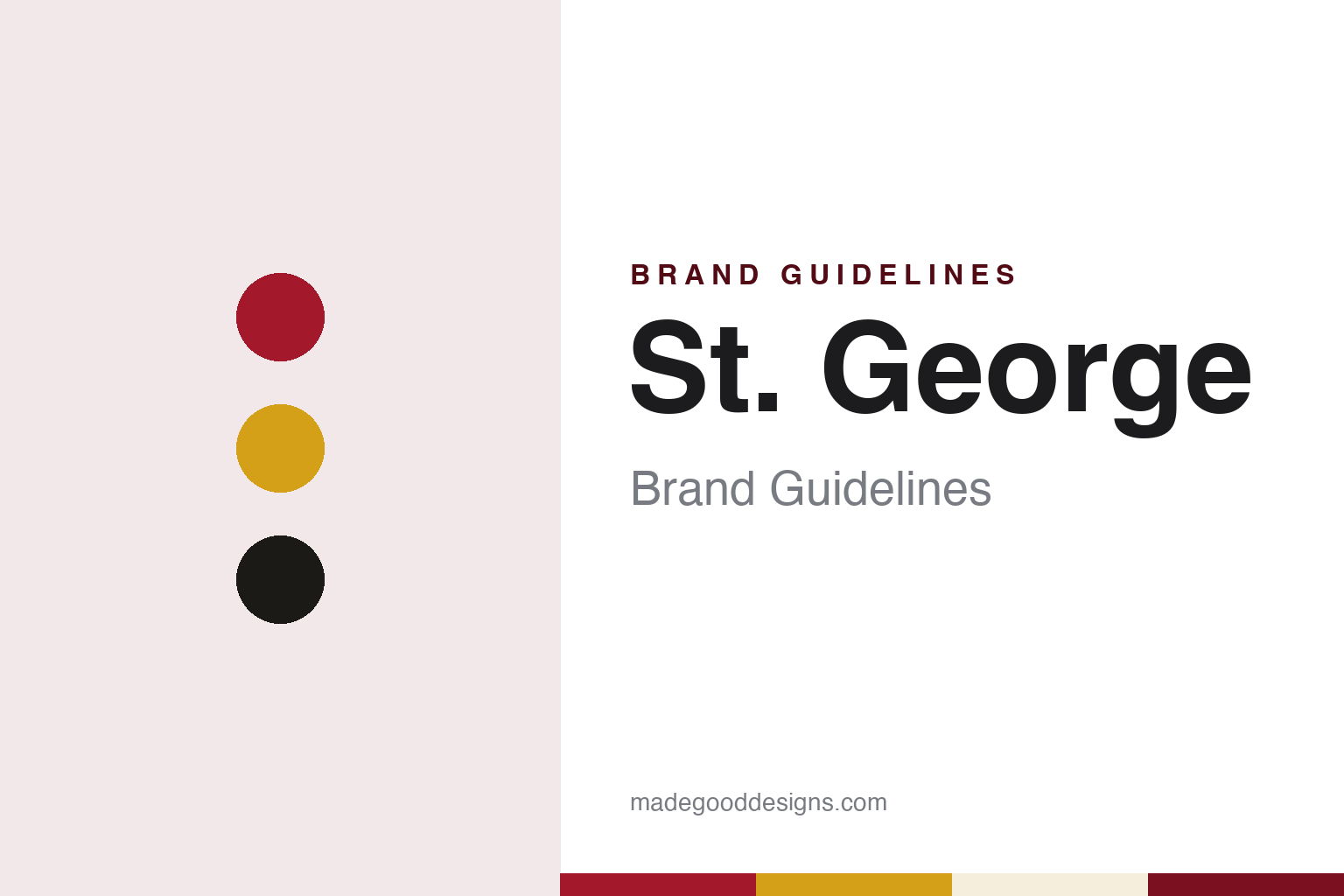
St. George Brand Guidelines
Ethiopia’s first brewery, a saint’s name and a century of changing owners.
Aa
Two constants: a saint red, lion gold and parchment palette and an inscriptional serif register. Abstract homage — not a St. George product or mark; no label, logo or bottle is reproduced.
A brewery near Mexico Square
Ethiopia’s first brewery, founded with imperial consent.
St. George is the lager of the St. George Brewery in Addis Ababa, which the researchers Getachew Senishaw and Ute Röschenthaler describe as Ethiopia’s first brewery. In a history of the country’s breweries published in the journal Brewery History (no. 185, 2020), they write that it was founded in 1922 in the empire’s new capital, during the reign of Empress Zewditu, who encouraged its construction because it provided jobs and income. The same article places Ethiopia, alongside Kenya, among the African countries whose first breweries opened in 1922.
The authors name the founder as Mussie Dawit Hale, whom they describe as either a Belgian or a German national of Ethiopian descent. They write that he bought 20,000 square metres of land near what is now Mexico Square, acquired the machinery, imported barley and hops from Europe and employed 137 workers, while the managers and leading technicians were foreigners. The process was at first carried out by hand, and in its first year the brewery produced about 200 to 300 half-litre bottles a day. Bottled beer was so new, the article says, that at the start St. George was sold simply as berra, the local word for beer; brand names came to matter only once other breweries arrived.
The brewery’s ownership followed Ethiopia’s turbulent politics. Hale ran the factory until the Italian invasion of 1935–36; the authors note that accounts differ on whether it closed during the occupation or was run by the Italians. In 1941 it became the property of Emperor Haile Selassie and several other shareholders from the ruling class. Hale appealed that his capital had been taken illegally, won his case, and then sold the brewery to the government on 1 August 1952, according to the article.
Colour
A saint’s name, lost for a time and then restored.
The name is the identity. English Wikipedia says the beer is named after Saint George, the patron saint of Ethiopia, and gives its Amharic name as ቅዱስ ጊዮርጊስ ቢራ. Getachew and Röschenthaler record a local legend that Saint George played an important role in the successful resistance against the Italian colonisers in 1896, and note that not only the brewery but also the capital’s main football club, a square and its cathedral are named after him.
For a while the name disappeared. When the military government known as the Derg overthrew imperial rule in September 1974, the authors write, St. George Brewery was nationalised immediately, and the Derg renamed it first Pilsner and later Addis Brewery. Under state ownership beer was distributed by quota rather than by brand preference, so that in most places only one beer was available, and the brewery began producing draught beer. The authors’ informants said the workers showed great commitment to keeping the beer popular through those years. After the Derg fell in 1991 and state companies were privatised, the original St. George name was reintroduced.
Advertising has since done much of the brand work. The article describes billboards across Addis Ababa showing oversized bottles and celebrities, and notes that Ethiopian brewers commonly advertise with footballers, dancers and musicians. The St. George Brewery supports St. George FC, the Addis Ababa football club that shares the saint’s name. That kind of visibility was curtailed in May 2019, when, the authors write, the government raised the tax on alcoholic drinks, restricted alcohol advertising on television and radio between 6 am and 9 pm, and banned it from billboards.
Typography
Design and documentation.
The seven brands in this group are all African beers: Star, Hansa Pilsener, Windhoek, St. George, Nile Special, Primus and Kilimanjaro. Each carries a national or local name — a city, a river, a mountain, a saint — yet almost all of them now sit inside one of a handful of international brewing groups, and the questions behind each label are the same: who brewed it first, who owns it now, and since when.
Three belong to AB InBev, through its takeover of SABMiller, which closed on 10 October 2016, BeverageDaily reported. Hansa Pilsener is a beer of South African Breweries, founded in 1895 as Castle Brewery, English Wikipedia says. Nile Special comes from Nile Breweries, which started in 1951 as a single brewery in Jinja, Uganda; South African Breweries took a stake in 1997 and full ownership in 2001, according to English Wikipedia. Kilimanjaro is made by Tanzania Breweries, half of which the Tanzanian government sold to South African Breweries’ international arm in 1993.
Two are Heineken names. Star is the beer of Nigerian Breweries, whose first bottle came off its Lagos line in June 1949 and whose leading shareholder is Heineken, English Wikipedia says. Windhoek is brewed by Namibia Breweries, where Heineken took over the shareholding of the Namibian group Ohlthaver & List in 2023, the Namibian Sun reported. Primus has a more recent twist: Bralima, its Congolese brewer since 1926, had been majority-owned by Heineken since 1986, but on 10 April 2026 Heineken announced it had sold its shareholding to ELNA Holdings of Mauritius, while keeping ownership of Primus and licensing it in the Democratic Republic of Congo.
The seventh, St. George, belongs to the French Castel group through BGI Ethiopia, which English Wikipedia says was established in 1998.
Each guide separates what independent sources record from what the company says about itself — its founding story, its owners over time, where its beer is brewed and how its labels have changed — and marks plainly what rests only on the company’s own word.
Aa
An inscriptional serif for a saint’s name. (Specimen set in Cinzel, a serif STAND-IN; NOT the St. George logo.)
St. George
From state brewery to a French-owned group.
St. George was the first Ethiopian brewery to be privatised. Getachew and Röschenthaler write that in 1998 it was sold to BGI Ethiopia, a subsidiary of the French Castel Group, which is active in many African countries; Castel, through BGI, has owned the brewery since 1998. BGI built an additional brewery at Kombolcha in 1998 and another at Hawassa in 2011 to serve southern Ethiopia; between 2011 and 2016, the authors write, BGI expanded from two production sites to six. The article lists Addis Ababa, Kombolcha and Hawassa as the three factories BGI owned in 2019, with St. George Amber among the brewery’s brands, and reports the company management’s own summary of its approach: good quality, reasonable prices and efficient promotion and distribution. English Wikipedia lists BGI’s other beers as including Castel and Raya, and notes that the company also makes wine at its Castel Winery.
The competition grew around it. The same article records that Heineken bought the Harar and Bedele breweries in 2011 and that Diageo acquired the Meta-Abo brewery in 2013, and it quotes a drinker who said that a Heineken advertisement starring a football star would not move his preference away from St. George.
The name needs care online. St. George is also the name of St. George Spirits, a California distillery with a guide of its own, and of unrelated breweries in Europe; the Ethiopian beer’s maker trades as BGI Ethiopia.
For a design guide, St. George shows how a saint’s name, taken away by one government and restored by the next, can carry a beer across a century of Ethiopian history. Compare Dashen, the Gondar beer, and Tusker, the Nairobi lager whose story also begins in 1922. For this guide we use saint red, lion gold and parchment with a serif, an unofficial interpretation; no product or logo is reproduced.
Explore & save
Keep St. George’s identity on hand — save it to a board in the Made Good inspiration library.
St. George identity set
Pin the St. George saint red, lion gold and parchment palette and the inscriptional serif register to your own board.