Primus Brand Guidelines
The Kinshasa lager that became a Central African standard.
Aa
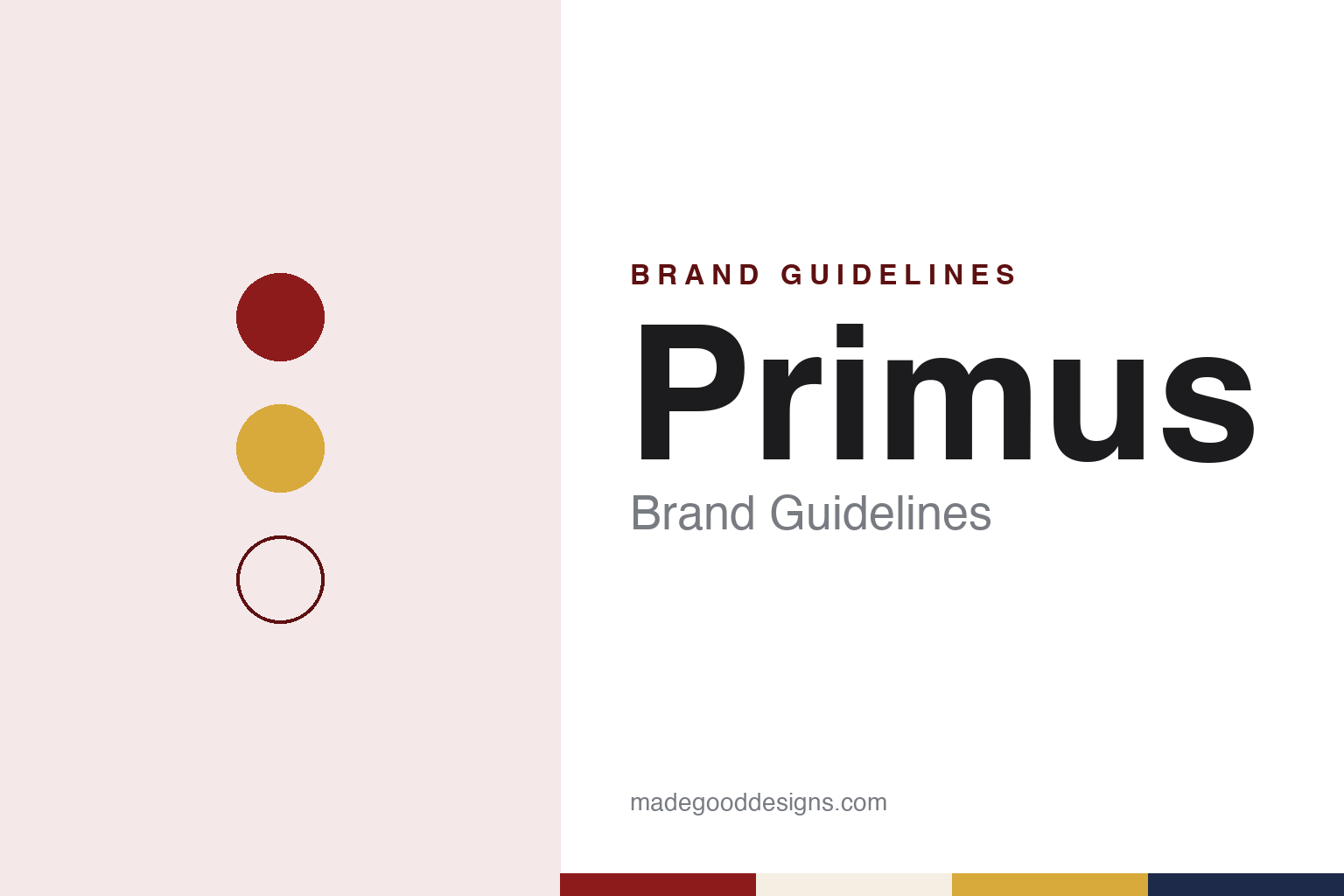
Two constants: a red, amber and blue palette and a heavy grotesque register. Abstract homage — not a Primus product or mark; no label, logo or bottle is reproduced.
Brasserie de Léopoldville
A Belgian-backed brewery on the Congo River.
Primus began in Kinshasa, then called Léopoldville, in the Belgian Congo. Its brewer, the Brasserie de Léopoldville, was founded on 23 October 1923 by Belgian investors with backing from the Société Congolaise de Banque, according to English Wikipedia; it soon took the name Brasseries, Limonaderies et Malteries, or Bralima. The trade publication just-drinks also dates Bralima to 1923.
The beer came three years later. English Wikipedia says the first Primus was produced on 26 December 1926; a company history reproduced in a 2008 thesis at the Université officielle de Bukavu gives the inauguration of the brewery, and its first bottle of Primus, as December 1926, though it gives two different days. That history says the early beer was not pasteurised, so it could be sold only in Léopoldville, and that it faced competition from imported German and Dutch beer until a later director improved its quality and introduced pasteurisation, allowing it to travel further.
English Wikipedia says Bralima became part of Heineken in 1986, when the Dutch brewer became its majority shareholder. Over the following decades the company ran breweries across the country; by 2026 Heineken described Bralima as operating three, in Kinshasa, Kisangani and Lubumbashi.
The expansion is dated differently by different sources. English Wikipedia lists branches opening at Bukavu in 1950, at Kisangani and Kigali in 1957, at Boma in 1958, at Mbandaka and Gisenyi in 1972 and at Lubumbashi in 1992; the company history in the Bukavu thesis gives Bukavu as 1951 and Lubumbashi as 2008. Alongside Primus, English Wikipedia lists Bralima’s beers as Mützig and Turbo King, and its soft drinks as including Coca-Cola, Fanta and Sprite.
Colour
One name across three countries.
Primus did not stay in Congo. In what is now Burundi, the Brasserie du Rwanda-Urundi — today Brarudi — began operating in Usumbura, now Bujumbura, on 23 December 1955, producing Primus, according to English Wikipedia. Heineken took a 60 percent stake in Brarudi in 1982, buying it from Banque Bruxelles Lambert, with the government of Burundi holding the rest.
In Rwanda, Bralirwa was founded in 1957 and its brewery at Gisenyi, on the northern shore of Lake Kivu, began operating in 1959. Primus was its first beer, and English Wikipedia says it was the only brand the brewery produced until 1987, when Mützig was introduced. Heineken acquired a 70 percent majority of Bralirwa in 1971; the company’s remaining shares were listed on the Rwanda Stock Exchange after an offering in December 2009.
French Wikipedia lists the Central African Primus as brewed under licence from Heineken by Bralima, by Brasco in the Republic of Congo, by Brarudi and by Bralirwa, and gives its strength as about 5 percent. The same name is thus brewed in at least four countries.
The biggest recent change came in the DR Congo. In November 2025 Heineken sold its brewery at Bukavu, in the east of the country, to the Mauritius-based Synergy Ventures Holdings; just-drinks reported that Bralima had halted operations there after the M23 rebel group seized Bukavu and Goma in January 2025. Then, on 10 April 2026, Heineken announced that it had sold its shareholding in Bralima to ELNA Holdings, also based in Mauritius, which would take over production, distribution and staff. Heineken said it would keep ownership of its brands and stay in the country through long-term trademark licences covering Heineken, Primus, Turbo King, Legend and Mützig.
Typography
Beer, place and ownership.
The seven brands in this group are all African beers: Star, Hansa Pilsener, Windhoek, St. George, Nile Special, Primus and Kilimanjaro. Each carries a national or local name — a city, a river, a mountain, a saint — yet almost all of them now sit inside one of a handful of international brewing groups, and the questions behind each label are the same: who brewed it first, who owns it now, and since when.
Three belong to AB InBev, through its takeover of SABMiller, which closed on 10 October 2016, BeverageDaily reported. Hansa Pilsener is a beer of South African Breweries, founded in 1895 as Castle Brewery, English Wikipedia says. Nile Special comes from Nile Breweries, which started in 1951 as a single brewery in Jinja, Uganda; South African Breweries took a stake in 1997 and full ownership in 2001, according to English Wikipedia. Kilimanjaro is made by Tanzania Breweries, half of which the Tanzanian government sold to South African Breweries’ international arm in 1993.
Two are Heineken names. Star is the beer of Nigerian Breweries, whose first bottle came off its Lagos line in June 1949 and whose leading shareholder is Heineken, English Wikipedia says. Windhoek is brewed by Namibia Breweries, where Heineken took over the shareholding of the Namibian group Ohlthaver & List in 2023, the Namibian Sun reported. Primus has a more recent twist: Bralima, its Congolese brewer since 1926, had been majority-owned by Heineken since 1986, but on 10 April 2026 Heineken announced it had sold its shareholding to ELNA Holdings of Mauritius, while keeping ownership of Primus and licensing it in the Democratic Republic of Congo.
The seventh, St. George, belongs to the French Castel group through BGI Ethiopia, which English Wikipedia says was established in 1998.
Each guide separates what independent sources record from what the company says about itself — its founding story, its owners over time, where its beer is brewed and how its labels have changed — and marks plainly what rests only on the company’s own word.
Aa
A heavy grotesque — direct and loud. (Specimen set in Bricolage Grotesque, a sans STAND-IN; NOT the Primus logo or label lettering.)
Primus
A brand without a brewery of its own.
The April 2026 sale makes Primus an unusual case in brand ownership. In the DR Congo, where the beer was born, the brand is now owned by one company and brewed by another: Heineken holds the trademark, while Bralima, under its new owner, operates the breweries in Kinshasa, Kisangani and Lubumbashi under licence. In Rwanda and Burundi, Bralirwa and Brarudi remain the brewers, with Heineken as their majority shareholder, according to English Wikipedia.
Heineken’s regional president for Africa and the Middle East, Guillaume Duverdier, said the step would ensure “that our brands remain available to consumers across the country,” just-drinks reported.
The name carries one trap. French Wikipedia notes that Primus is also the name of an unrelated Belgian pils brewed by Brouwerij Haacht at Boortmeerbeek, in Flemish Brabant, and named after Jan Primus, a medieval Duke of Brabant. The two beers share a Latin-sounding name — primus means “first” — but not a brewer or a history.
No designer or agency is documented for the Primus label, and no official colour values or typefaces are published.
For a design guide, Primus shows how a beer brand can outlast the breweries and owners behind it. Compare Star Lager, another Heineken-linked African lager, and Amstel, a Heineken brand that Brarudi also brews. For this guide we use brick red, amber and night blue with a sans, an unofficial interpretation; no product or logo is reproduced.
Explore & save
Keep Primus’s identity on hand — save it to a board in the Made Good inspiration library.
Primus identity set
Pin the Primus red, amber and blue palette and the heavy grotesque register to your own board.