Pilsen Callao Brand Guidelines
Peru’s green-bottle lager from the port of Callao, dated to 1863.
Aa
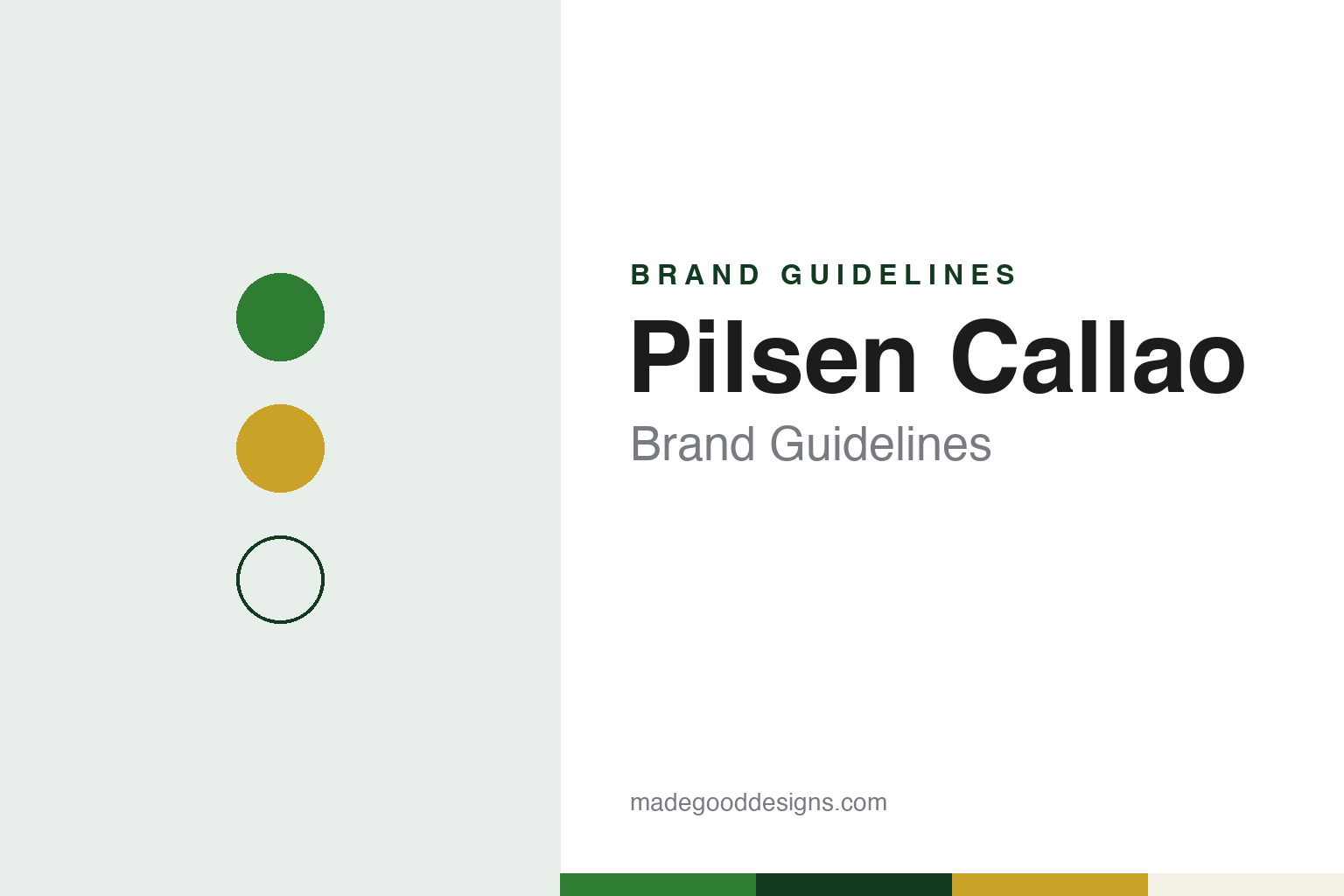
Two constants: a bottle green, forest and crown gold palette and a script-led serif register. Abstract homage — not a Pilsen Callao product or mark; no label, logo or bottle is reproduced.
A brewery in the port
From the Compañía Nacional de Cerveza to Backus and AB InBev.
Pilsen Callao takes its name from a beer style and a place. The second word is Callao, the port city next to Lima, and the brand dates itself to 1863: its own website says Pilsen Callao was born that year at the Compañía Nacional de Cerveza in Callao. English Wikipedia describes it as a pilsener of about 5% alcohol, and the company still prints its founding year in its messaging; in 2020 its brand head described it as the beer that has brought true friends together “since 1863.”
The early history comes mostly from the Peruvian marketing press. Infomercado, in an article by Gabriela Bárcena published in October 2022 and drawing on the trade magazine Mercado Negro, says the story begins on 15 October 1863, when the German brewer Federico Bindels founded a brewery called Cervecería Pilsen as his first business in Peru. About five years later, the same article says, the Frenchman Aloise Kieffer invested in the business and paid for the factory to be enlarged, and the company later passed to the founders’ children.
For most of the twentieth century Pilsen Callao was a rival to Backus. English Wikipedia says Backus and Johnston was founded in the Rímac district of Lima in 1879 by two Americans, Jacob Backus and J. Howard Johnston, and moved its incorporation from London to Peru in 1954. In 1994 Backus acquired a controlling interest in the Compañía Nacional de Cerveza, owner of the Pilsen Callao brand; Infomercado reports that the company sold 62% of its shares to Backus after a production batch reached the market in poor condition. Backus has owned the brand since then.
The owner kept growing around it. In 1996 four breweries merged to form the Unión de Cervecerías Peruanas Backus y Johnston, English Wikipedia says, and in 2000 the southern Peruvian brewer Cervesur joined, bringing Cusqueña into the same group. Backus was part of the SABMiller group from 2005, and when Anheuser-Busch InBev completed its takeover of SABMiller on 10 October 2016, as the company announced that day and BeverageDaily reported the next morning, Pilsen Callao became an AB InBev brand.
Colour
A green bottle, a crown and a word in script.
The brand’s visual codes are few and long-lived. Its own timeline says a crown was added to the Pilsen logo in 1980, and the name is written as calligraphy, which a 2020 redesign softened. Green is the other constant: on its website the brand calls its bottles and cans “las verdes de siempre,” the same old greens.
That green was once lost and then restored. In October 2010, at an event in Lima for the brand’s 147th anniversary, Pilsen Callao presented new packaging that returned its original beer to the traditional green bottle, Packaging Insights reported on 22 October 2010. The brand framed the change as a return to its roots, and Javier Fernández, then director of Pilsen Callao, said it had been made for the benefit of the brand’s drinkers. The company’s timeline marks the same year as the start of “Jueves de Patas,” a Thursday-night ritual for friends, or patas, as the brand calls them.
The next redesign was announced in February 2020. Exitosa Noticias reported on 12 February 2020 that, after seven years without a change, Pilsen Callao had updated its visual identity: the logotype was redrawn with a more stylised and softer calligraphy, and a dotted pattern modernised the label background. The brand kept what it called its most important codes, the green colour and the crown, which Carmen María Bell-Taylor, Head of Pilsen Callao, described as a symbol of the brand’s brewing excellence. The company’s own timeline dates the move to twist-off returnable bottles and the change of image to 2019.
The redesign came with a message. The same report said the brand would put 30% of its 2020 advertising budget into social campaigns under the platform “Amistades Sin Diferencias”, friendships without differences, which it had been building for three years and which questioned everyday attitudes that reinforce inequality between men and women. The brand acknowledged that it had once aimed its communication at a single gender.
Typography
Design and documentation.
The seven beers in this group come from Latin America and the Caribbean: Polar, Cusqueña, Pilsen Callao, Brahma, Medalla, Kalik and Banks. Several have long histories. Pilsen Callao was first brewed in 1863 at a brewery that Federico Bindels founded in the Peruvian port of Callao, Spanish Wikipedia says, and Brahma was first made by a Rio de Janeiro brewery founded in 1888, according to English Wikipedia. Cusqueña goes back to a branch of the Arequipa brewer Günther & Tidow opened in Cusco on 1 October 1908, Spanish Wikipedia says. Cervecería Polar began brewing at Antímano, west of Caracas, on 14 March 1941; Cervecería India, now the Compañía Cervecera de Puerto Rico, was founded in Mayagüez in 1937 by the Valdés Cobián brothers; and Banks (Barbados) Breweries opened at Wildey in September 1961, all according to English Wikipedia. Kalik is the newcomer: English Wikipedia dates the Bahamian lager to 1988.
Their ownership has gone in very different directions. Two are still made by companies based in their home markets: Polar belongs to Empresas Polar, the privately held Venezuelan group whose president is Lorenzo Mendoza, and Medalla Light, which English Wikipedia dates to 1980, is made by the Compañía Cervecera de Puerto Rico, run since 2017 by Grace Marie Valdés. Brahma has been part of Ambev since the company was created in 1999 from the merger of Brahma and Antarctica, and Ambev is now a subsidiary of Anheuser-Busch InBev, English Wikipedia says. In Peru, Backus and Johnston bought 62 per cent of the Compañía Nacional de Cerveza, the maker of Pilsen Callao, in 1994, and Cervesur, the maker of Cusqueña, joined the Backus group in 2000, Spanish Wikipedia says; Backus was part of SABMiller from 2005 and has belonged to AB InBev since AB InBev’s takeover of SABMiller in 2016, according to English Wikipedia. Kalik is brewed in Nassau by Commonwealth Brewery, which its 2011 financial statements describe as a subsidiary of Heineken; they record that Heineken’s purchase of the shares held by its Bahamian partner took effect on 17 May 2010, and that the company was listed on the Bahamas International Securities Exchange on 24 May 2011. Banks passed from Barbadian ownership to an Ambev subsidiary in December 2015, according to Ambev’s filing with the US Securities and Exchange Commission, and since 31 July 2025 KOSCAB Holdings, a Coca-Cola bottler, has held the majority of SLU Beverages, which controls Banks Holdings, Nation News reported.
A beer brand’s identity is usually carried less by a single bottle than by a label, a name and the place it promises, because the company behind the name may have changed hands or moved its brewing. Each guide separates what independent sources record from what the brewer says about itself — its founding story, its owners over time, where its beer is brewed and how its labels, cans and advertising have changed — and marks plainly what rests only on the company’s own word.
Aa
A script-led serif for a flowing wordmark under a crown. (Specimen set in Playfair Display italic, a serif STAND-IN; NOT the Pilsen Callao logo.)
Pilsen Callao
Friendship as a brand platform.
Friendship has become the brand’s organising idea, and its website now closes on the line “Por la amistad, todo,” everything for friendship. The company’s timeline lists the projects built on it: Enterpreters in 2022, an initiative the brand says was created to help deaf gamers; BCPilsen in 2023, which the brand describes as an alliance with the Peruvian bank BCP to help friends save for their plans; and in 2025 what it calls the brand’s first “spiritual home,” a space for music and friends. Its earliest community event on the same timeline is the Chim Pum Callao festival, which the brand says was first held in 1996.
The beer is made in Peru by its owner. Backus listed breweries in Ate in Lima, Motupe, Trujillo, Arequipa, Cusco and Pucallpa in 2007, according to the company pages cited by English Wikipedia; Ate is its main plant. The brand’s own site is pilsencallao.com.pe. The name needs care in searches, because Pilsen is also the German name of Plzeň, the Czech city that gave the pilsner style its name.
For a design guide, Pilsen Callao shows how a bottle colour, a small crown and a script name can carry a beer through more than a century and several owners, and how the same codes can be redrawn without being replaced. Compare Cusqueña, the Backus lager from Cusco, and Inca Kola, the golden Peruvian soda. For this guide we use bottle green, forest and crown gold with a serif, an unofficial interpretation; no product or logo is reproduced.
Explore & save
Keep Pilsen Callao’s identity on hand — save it to a board in the Made Good inspiration library.
Pilsen Callao identity set
Pin the Pilsen Callao bottle green, forest and crown gold palette and the script-led serif register to your own board.