Inca Kola Brand Guidelines
The golden soda that Peru calls its own.
Aa
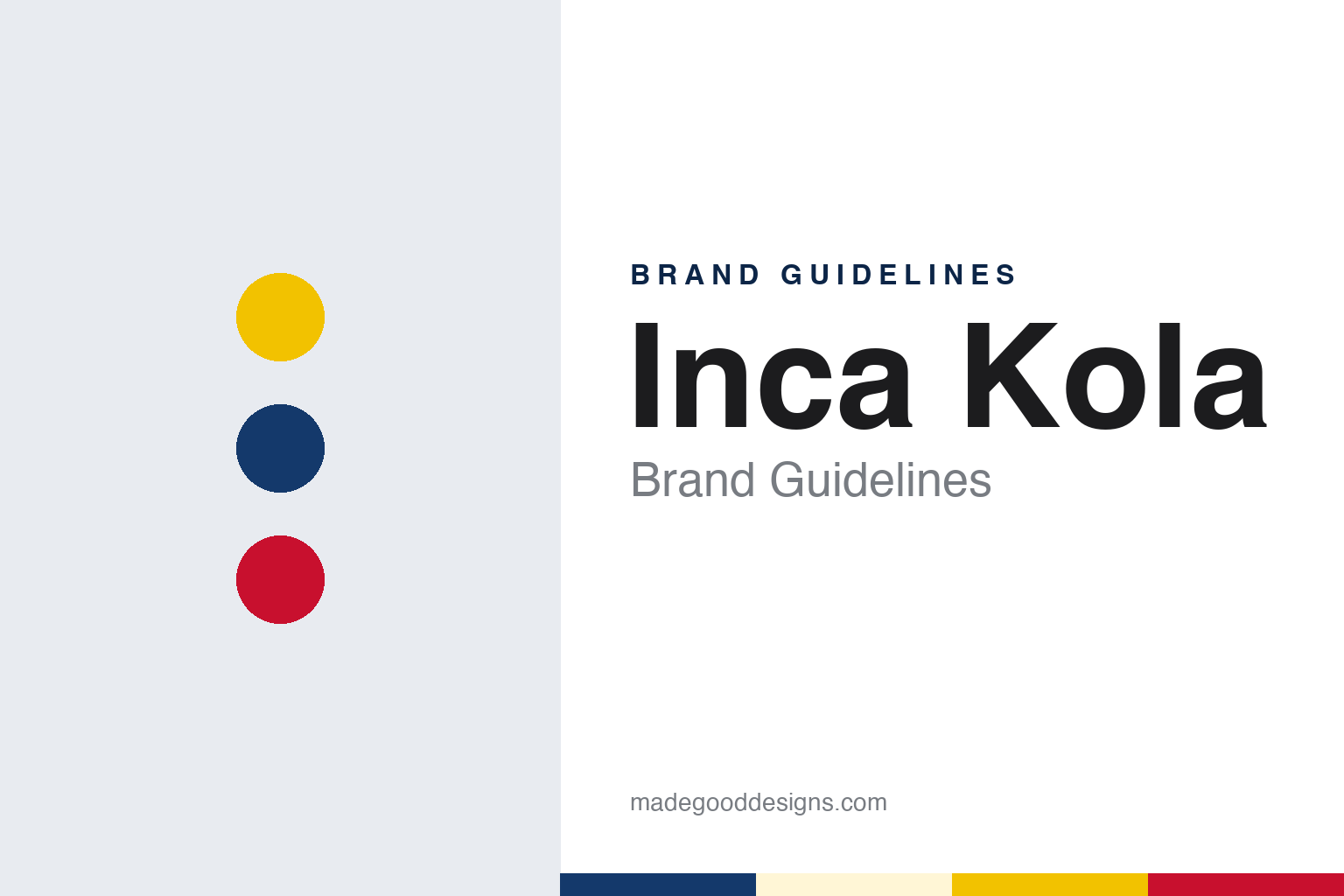
Two constants: an Inca gold, Andean blue and red palette and a heavy display sans register. Abstract homage — not an Inca Kola product or mark; no bottle, can or logo is reproduced.
La Santa Rosa
A British family, a Rímac soda works and Lima’s 400th birthday.
Inca Kola is the product of a family bottling business in Lima. Its maker, now called Arca Continental Lindley, dates its origins to 1910, when the Lindley family opened the Fábrica de Aguas Gaseosas La Santa Rosa in the Rímac district of Lima. Spanish Wikipedia credits the founding to Joseph Robinson Lindley, a British immigrant, and says the company bought its first semi-automatic bottling machine in 1918 and was incorporated in 1928 as Joseph R. Lindley S.A., under the management of his son, Joseph R. Lindley Stoppanie. English Wikipedia says that by the early 1930s the firm sold ten flavours of soda.
Inca Kola reached the market in 1935, timed to the 400th anniversary of the founding of Lima, the company says. English Wikipedia, citing a 1995 report by Calvin Sims in The New York Times, credits its invention to Joseph Robinson Lindley. Sources disagree on the day: the Peruvian business paper Gestión, in a 2023 history of the brand, gives 18 January 1935, the anniversary date itself, while Spanish Wikipedia gives 28 July 1935, Peru’s national day.
The drink is defined by its colour. Gestión describes its intense yellow, and Spanish Wikipedia calls it yellow-gold and names its main ingredient as hierba luisa, adding that the formula is kept as a strict industrial secret. English Wikipedia identifies the plant as lemon verbena, and notes that Americans tend to compare the taste to bubblegum or cream soda. Its first slogan, according to English Wikipedia, was “Inca Kola sólo hay una y no se parece a ninguna” — there is only one Inca Kola, and it is like no other.
The family stayed in charge for most of the century. In 1945, Spanish Wikipedia and Gestión say, Isaac Lindley took over the business.
Colour
A national drink, and a rival Coca-Cola could not beat.
Inca Kola’s marketing has long leaned on Peruvian identity. Coca-Cola arrived in Peru in 1936, a year after Inca Kola, brought in by the Barton family, according to Arca Continental Lindley’s own history. English Wikipedia says the Lindleys positioned Inca Kola as Peru’s drink, and that in the late 1970s and early 1980s the logo carried the line “¡De Sabor Nacional!” — of national flavour — later replaced by “El Sabor del Perú,” the taste of Peru. Spanish Wikipedia lists a long run of slogans, among them “La bebida del Perú” in the late 1990s and “El sabor del Perú” in the early 2000s, and notes that the cans are decorated with Inca-style illustrations.
The brand became known for pairing with Peruvian food. Spanish Wikipedia describes it as the usual companion to dishes from chifa, Peru’s Chinese-Peruvian cooking, and to ceviche and seafood. The New York Times reported in December 1995 that Inca Kola held 32.9 percent of the Peruvian soft drink market against Coca-Cola’s 32 percent, English Wikipedia says, and that the Peruvian burger chain Bembos had switched to serving Inca Kola that year. Gestión called it one of only two sodas in the world never overtaken by Coca-Cola in their home country; Spanish Wikipedia names the other as Scotland’s Irn-Bru.
The range has grown in fits and starts. Spanish Wikipedia records Inca Kola Diet from 1996, Light from 2005, Zero from 2012 and Sin Azúcar from 2018. A chicha morada flavour called La Moradita launched in October 2014 and was withdrawn within months, and a camu camu version called Inca Kola Power followed in 2021; in February 2023 the trade site Mercado Negro reported that Coca-Cola would stop making it. The drink has a place in literature too: the English journalist Matthew Parris called a travel book about Peru Inca-Kola.
Typography
Design and documentation.
The seven brands in this group all make food or drink, and they come from four South American countries — Argentina, Chile, Peru and Colombia: Arcor, Bagley, Havanna, Carozzi, Costa, Inca Kola and Colombina. South American food and drink brands in general sit at many different points in the trade, from family firms that still carry a founder’s surname to names that now belong to much larger food groups, and a single brand can be sold everywhere from a corner shop to a supermarket shelf.
A food or drink brand’s identity is usually carried less by a single product than by a pack, a name and the treat or staple it promises, because the company behind the name may have changed hands, moved its factory or grown far beyond the town where it started. That makes the questions behind each name worth asking plainly: who started it, who owns it now, and where its products are actually made and packed.
Each guide separates what independent sources record from what the company says about itself — its founding story, its owners over time, where its products are made and how its packaging has changed — and marks plainly what rests only on the company’s own word.
Aa
A heavy display sans for a loud, golden national soda. (Specimen set in Archivo Black, a sans STAND-IN; NOT the Inca Kola logo.)
Inca Kola
Coca-Cola abroad, a joint venture at home, and a Mexican bottler.
In February 1999 The New York Times and Colombia’s El Tiempo reported that The Coca-Cola Company had agreed to buy half of Inca Kola; Peruvian accounts since, including Gestión in 2023, have given a lower percentage for the stake. English Wikipedia says Coca-Cola also took a fifth of Corporación José R. Lindley, and that the deal made Coca-Cola the owner of the Inca Kola trademark outside Peru, while inside Peru the mark belongs to Corporación Inca Kola Perú, a joint venture between Coca-Cola and the Lindley family. As part of the arrangement, Spanish Wikipedia says, the Lindley company gained the right to bottle Coca-Cola and its sister brands in Peru, and it later bought control of Embotelladora Latinoamericana, the country’s main Coca-Cola bottler; a 2005 report in Latin Lawyer described the merger of Peru’s two largest bottlers.
The bottler then changed hands. Arca Continental Lindley says it has been part of Arca Continental, the Mexican Coca-Cola bottler, since 2015, and Gestión reported in September 2018 that Arca Continental’s subsidiary had bought a further 38.52 percent of Corporación Lindley, taking it to about 99.78 percent of the voting shares. The company says it runs six beverage plants in Peru; Spanish Wikipedia lists two in Lima and one each in Trujillo, Arequipa, Cusco and Iquitos. Outside Peru, English Wikipedia says, Inca Kola is produced by Coca-Cola bottlers, with the United States and Ecuador among its markets.
For a design guide, Inca Kola shows how a single colour, a national story and a name borrowed from Peru’s past can hold a market against a global rival. Compare it with Peru’s Cacaosuyo chocolate and Mexico’s Jumex juices. For this guide we use Inca gold, Andean blue and chili red with a heavy display sans, an unofficial interpretation; no product or logo is reproduced.
Explore & save
Keep Inca Kola’s identity on hand — save it to a board in the Made Good inspiration library.
Inca Kola identity set
Pin the Inca Kola gold, Andean blue and red palette and the heavy display sans register to your own board.