Osem Brand Guidelines
The 1942 pasta partnership behind Bamba, now owned by Nestlé.
Aa
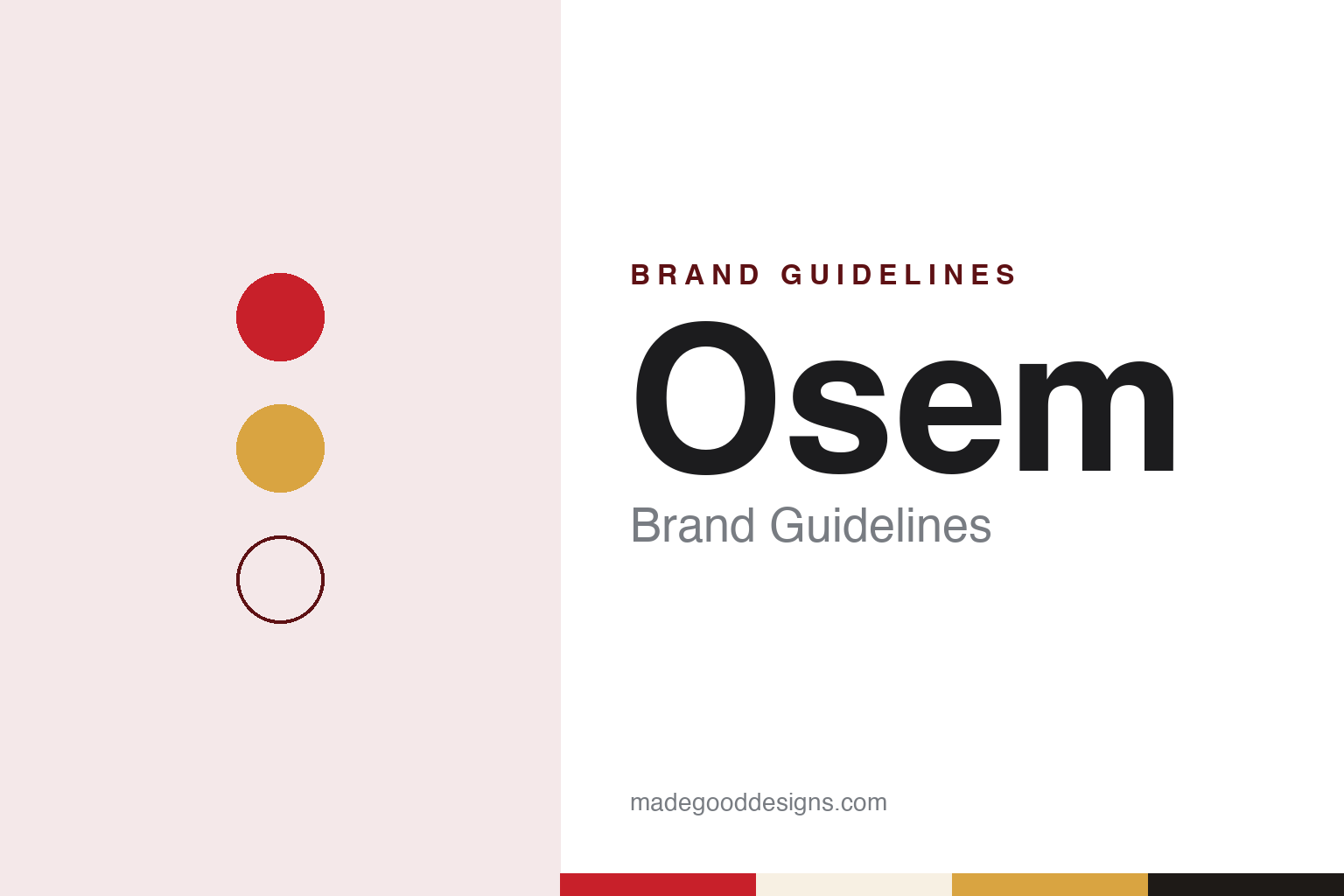
Two constants: an Osem red, wheat gold and cream palette and a heavy square sans register. Abstract homage — not an Osem product or mark; no pack, logo or product is reproduced.
A granary of factories
Five noodle makers, one sales company and a word from the Yom Kippur prayer.
Osem began in September 1942, in Mandatory Palestine, as a partnership of pasta makers. Hebrew Wikipedia, citing the newspaper HaMashkif of 29 September 1942, says it was set up as a joint marketing company for five noodle and pasta producers: Itriyot of Jerusalem, Asisit and Orient of Ramat Gan, and Hadagan and Zion of Tel Aviv. English Wikipedia tells the story more briefly, saying Eugen Propper and his partner merged Hadagan with two other factories to create Osem. Hebrew Wikipedia names seven founders: Eugen Propper, Franz Klein, Yaakov Lorsch, Azriel Weil, Shimshon Wilmersdorf, Moshe Katzman and Eliyahu Harpak.
The name is a Hebrew word for a granary or store of plenty, and Hebrew Wikipedia, citing a 1945 article in Mishmar, says it described the young company: a granary holding the output of several factories. Both Wikipedias trace the word to the prayer said by the High Priest on Yom Kippur, which asks that the coming year be a year of plenty.
Growth was quick. Another noodle factory, Keter, joined later in 1942; a Haifa branch opened in June 1943; and by August 1943 the company claimed to make 80% of the noodles in the country, according to HaMashkif as cited by Hebrew Wikipedia. Osem’s first factory of its own opened in Bnei Brak in 1946. After independence, with mass immigration, it developed ptitim, small baked pasta pellets shaped like rice, for newcomers used to rice and couscous. Hebrew Wikipedia says they were nicknamed “Ben-Gurion rice” and are sold in the United States and other countries as “Israeli couscous”; English Wikipedia dates the product to 1953 and says it was made at the request of the prime minister, David Ben-Gurion.
Colour
Soup almonds, a peanut puff and a red square.
Pasta and soup came first. Osem began making soup almonds, small crisp croutons for soup, in 1952, and in 1959 added a building for sauce and soup powders; that year it also began exporting and set up Osem UK in London, Hebrew Wikipedia says. Not everything worked: the same source lists a cake mix and “Agbaroni,” macaroni mixed with tomato paste, among late-1950s products that failed.
The most famous Osem product came from a snack factory opened in Holon in 1964, where development began of Bamba, a peanut puff. Hebrew Wikipedia says Dan Propper, Eugen Propper’s son, developed Bissli in 1968 to make better use of the plant’s pasta machines; English Wikipedia dates Bissli to 1970. Osem moved into baked goods in 1970 by buying the Lachmanu bakery, began making biscuits in 1972, opened a pasta plant in Yokneam Illit in April 1975 and built a sauce plant and head office in Petah Tikva from 1976. It bought the biscuit maker Froumine in 1981 and the Argal patisserie in 1982. Its best-remembered advertising line, sung in a radio jingle, was “Ze tov, ze tov, ze Osem!” — “It’s good, it’s good, it’s Osem!”
The logo has a documented history. Hebrew Wikipedia, citing a 1997 article in Globes, says the original mark of 1942 was drawn by the graphic designer Otte Wallish, with thick, stable, squared letters; an ear of wheat for the link to local farming and to flour; and a closed rounded frame standing for the union of the five founding factories. In 1984 the mark was updated by the London studio of Michael Peters with the designer Yitzhak Yarkoni, who put white letters inside a red square with rounded corners. A third update in 1997, by Osem’s own studio with Yossi Blum and Yarkoni, refined the proportions of the letters and brought them into line with the design language of Nestlé, by then Osem’s partner.
Typography
Design and documentation.
The seven brands in this group all make food, and they come from Israel, the United States and Saudi Arabia: Osem, Elite, Strauss, Bamba, Tnuva, Sadaf and NADEC. Food brands in general sit at many different points in the trade, from family firms that still carry a founder’s name to names that now belong to much larger food groups, and a single brand can be sold everywhere from a corner shop to a supermarket shelf.
A food brand’s identity is usually carried less by a single product than by a pack, a name and the meal or snack it promises, because the company behind the name may have changed hands, moved its factory or grown far beyond the town where it started. That makes the questions behind each name worth asking plainly: who started it, who owns it now, and where its food is actually made and packed.
Each guide separates what independent sources record from what the company says about itself — its founding story, its owners over time, where its food is made and how its packaging has changed — and marks plainly what rests only on the company’s own word.
Aa
A heavy square sans for a mark built on thick, squared letters. (Specimen set in Rubik, a sans STAND-IN; NOT the Osem logo.)
Osem
A stock-market listing, a Swiss partner and a full takeover.
Osem went public in 1992, floating 25% of its shares on the Tel Aviv Stock Exchange. In 1993 it bought 58% of Tivall, the vegetarian-food maker of Kibbutz Lohamei HaGeta’ot, taking it into frozen food, and it completed the purchase in March 2010, TheMarker reported. In 1997 it took control of the Israeli salad maker Salatei Tzabar, and in 2003 it bought Tnuva’s share of their joint ice-cream business, Hebrew Wikipedia says.
The partnership that defines Osem today followed the Madrid peace conference and the easing of the Arab League boycott, according to Hebrew Wikipedia. In 1995 Osem signed a cooperation agreement with Nestlé, under which it began bringing Nestlé products into Israel and shared research and food technology. Nestlé bought 10% of the group in 1996, raised its stake to 47% in 1998 and held 50.1% from 2000, the same source says, citing TheMarker; by 2014 its holding stood at 63.6%. Bloomberg reported in February 2016 that Nestlé would buy out the remaining shareholders, and on 20 April 2016 Osem left the stock exchange and became a private company wholly owned by Nestlé, Hebrew Wikipedia says, citing exchange filings.
Osem is still run from Israel. In June 2008 it opened a logistics centre in the Hevel Modi’in industrial zone near Shoham, which receives products from all eight of the group’s factories and also houses its management, Globes reported; English Wikipedia gives Shoham as the head office. Dan Propper led the company for many years and became chairman in July 2006, when Gazi Kaplan became chief executive; both Wikipedias name Avi Ben Assayag as chief executive today. In May 2023 Osem stopped making its flour products, including the Kemach Tofeach self-raising flour, ynet reported.
For a design guide, Osem shows how a mark of thick letters, a wheat ear and a red square can carry a pasta partnership from 1942 into a Nestlé subsidiary. Compare Buitoni, Nestlé’s Italian pasta name, and Bamba, Osem’s peanut puff. For this guide we use an Osem red, a wheat gold and a cream with a heavy square sans, an unofficial interpretation; no product or logo is reproduced.
Explore & save
Keep Osem’s identity on hand — save it to a board in the Made Good inspiration library.
Osem identity set
Pin the Osem red, wheat gold and cream palette and the heavy square sans register to your own board.