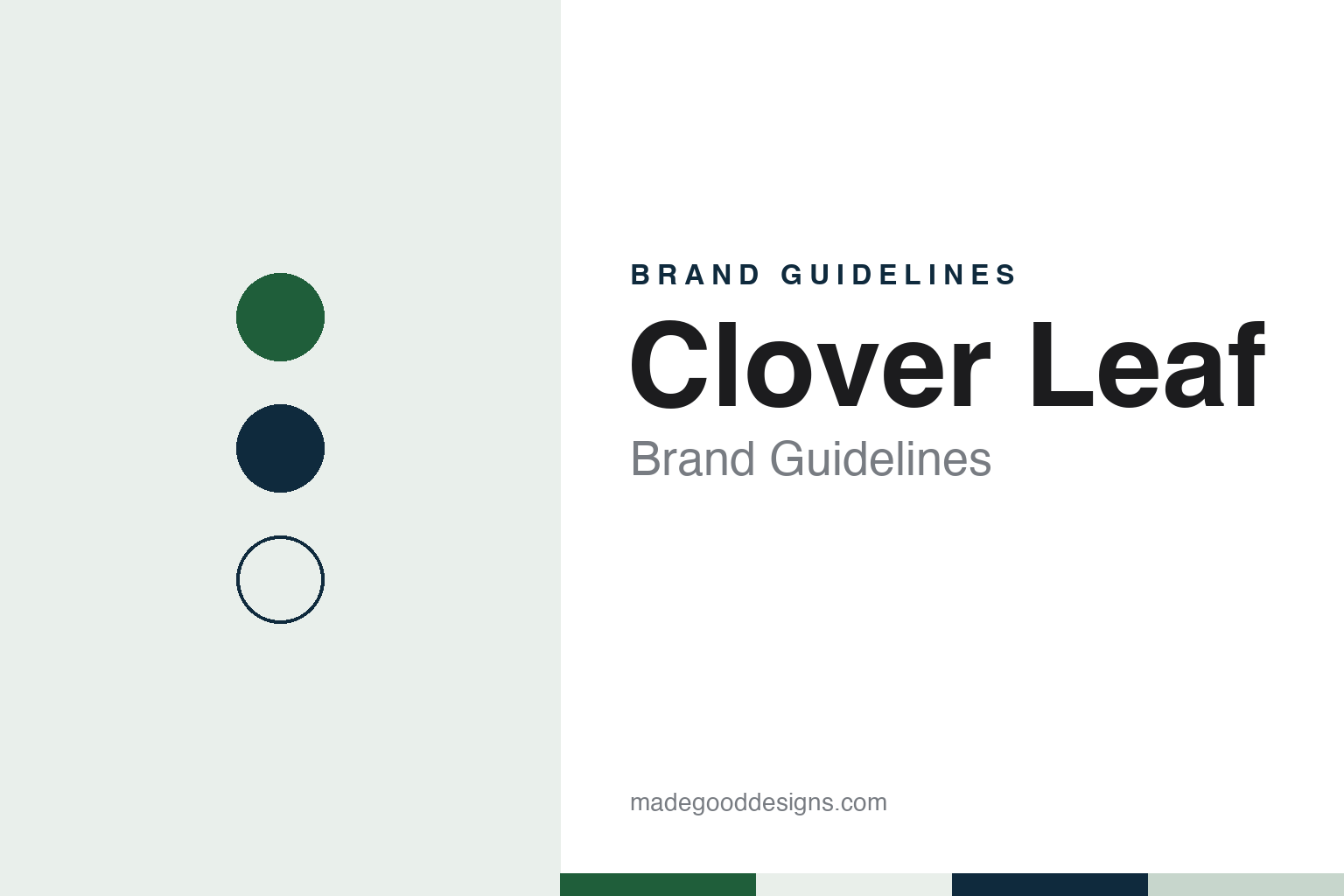
Clover Leaf Brand Guidelines
The 1889 canned-seafood name from British Columbia’s salmon canneries.
Aa
Two constants: a clover green and deep sea navy palette and a cannery sans register. Abstract homage — not a Clover Leaf product or mark; no can, label or logo is reproduced.
The Fraser River
A salmon cannery and a brand bought in 1908.
Clover Leaf is a Canadian canned seafood brand, and its history runs through two sets of dates. The brand itself has been used to market canned seafood in Canada since 1889, when it was introduced by the Anglo-American Packing Company, English Wikipedia says. The business that owns it traces its roots further back, to 1871, when Alexander Ewen and three partners founded Loggie & Company, the first commercial salmon cannery in British Columbia, on the south shore of the Fraser River opposite New Westminster, on a site that is now part of North Delta.
The company tells its story from that earlier date. Clover Leaf’s website says it “first captured the flavour of the sea way back in 1871,” when it founded the first cannery on the Fraser River in British Columbia, adding: “At the time, we were the only one.” It says it has since “expanded operations nationwide.”
Consolidation followed. In 1902 Loggie & Company merged with competitors to form the British Columbia Packers’ Association, and in 1908 the association bought the Clover Leaf brand, English Wikipedia says. In 1928 it merged with the Gosse Packing Company and was federally incorporated in Canada as British Columbia Packers Limited, known as BC Packers. The combined company comprised 44 canneries, three cold-storage facilities, five plants and shipyards, two salteries and more than 100 fishing boats, according to the article.
From 1908 until 1962, then, the Clover Leaf name belonged to BC Packers, a British Columbia fishing and canning group.
Colour
From Weston to private equity.
In 1962 George Weston Limited, the Toronto food group, acquired BC Packers and with it the Clover Leaf brand, English Wikipedia says. Five years later, in 1967, Weston also bought Connors Bros., the maker of Brunswick sardines — the two brands that are still sold side by side today. Weston kept Clover Leaf for more than three decades, until it sold the brand to International Home Foods in 1998; ConAgra bought International Home Foods in 2001.
The next two decades brought a series of financial owners. In 2003 ConAgra sold the business to its senior management, and Clover Leaf and the American tuna brand Bumble Bee were combined with Connors Bros., according to English Wikipedia’s Clover Leaf article; its Bumble Bee article dates the Connors merger to 2004. The private-equity firm Centre Partners acquired Connors Bros. in 2008 and sold it in 2010 to Lion Capital, the London-based investment firm. Within the combined business, Bumble Bee was the name used in the United States and Clover Leaf the name used in Canada, English Wikipedia’s Bumble Bee article says.
The American side of the business then ran into trouble. In August 2015 Bumble Bee was sued, accused of colluding with Chicken of the Sea and StarKist to fix prices, and in December 2019 its former chief executive was found guilty in the United States of conspiring to fix canned-tuna prices between November 2010 and December 2013, English Wikipedia says.
On 21 November 2019 Bumble Bee Parent and four affiliated companies filed for bankruptcy in the US District Court for the District of Delaware. In March 2020 FCF Co., Ltd., a privately held Taiwanese seafood company, bought Bumble Bee, and English Wikipedia lists that purchase in Clover Leaf’s own ownership history.
Typography
Design and documentation.
The seven brands in this group are all food brands, and all of them are Canadian: President’s Choice, Clover Leaf, Maple Leaf, Lantic, Christie, Neilson and Old Dutch. Canadian food brands in general sit at many different points in the trade, from family firms that still carry a founder’s name to names that now belong to much larger food groups, and a single brand can be sold everywhere from a corner store to a national supermarket chain.
A food brand’s identity is usually carried less by a single product than by a pack, a name and the meal or snack it promises, because the company behind the name may have changed hands, moved its factory or grown far beyond the town where it started. That makes the questions behind each name worth asking plainly: who started it, who owns it now, and where its food is actually made and packed.
Each guide separates what independent sources record from what the company says about itself — its founding story, its owners over time, where its food is made and how its packaging has changed — and marks plainly what rests only on the company’s own word.
Aa
A cannery sans — for a name printed on cans since 1889. (Specimen set in Archivo, a sans STAND-IN; NOT the Clover Leaf logo.)
Clover Leaf
A seafood family in Markham.
Today Clover Leaf Seafoods is headquartered in Markham, Ontario, English Wikipedia says — a long way from the Fraser River canneries where the business began. The article lists its products as tuna, salmon, sardines and a range of shellfish, sold under the Clover Leaf and Brunswick brands. The company’s website presents the two together as “The Clover Leaf Seafoods Family.”
The company describes Clover Leaf as the number-one seafood brand in Canada, and says it was rated the most trusted canned-seafood brand by Canadians in the 2025 BrandSpark Canadian Trust Study; those are its own claims. It says its products must pass “strict quality control measures before they earn the privilege of wearing the Clover Leaf label,” and that it aims to “respect the habitats we are involved in through sustainable partnerships and community outreach programs.” Among its community work it names the Toonies for Tummies campaign in 2024 and support for Food Banks Canada’s After the Bell programme, which the company says reaches more than 210 communities.
Since 1889 the Clover Leaf name has passed from a British Columbia packing company to a Toronto food group, an American food conglomerate, its managers, two private-equity firms and a Taiwanese seafood group.
For a design guide, Clover Leaf shows how a single pantry name can outlast more than a century of owners when it stays on the can. Compare John West, another canned-fish name with roots in Pacific salmon canning, and Century Tuna. For this guide we use clover green and deep sea navy with a sans, an unofficial interpretation; no product or logo is reproduced.
Explore & save
Keep Clover Leaf’s identity on hand — save it to a board in the Made Good inspiration library.
Clover Leaf identity set
Pin the Clover Leaf clover green and deep sea navy palette and the cannery sans register to your own board.