Hup Seng Brand Guidelines
The Batu Pahat cream cracker named after ping pong.
Aa
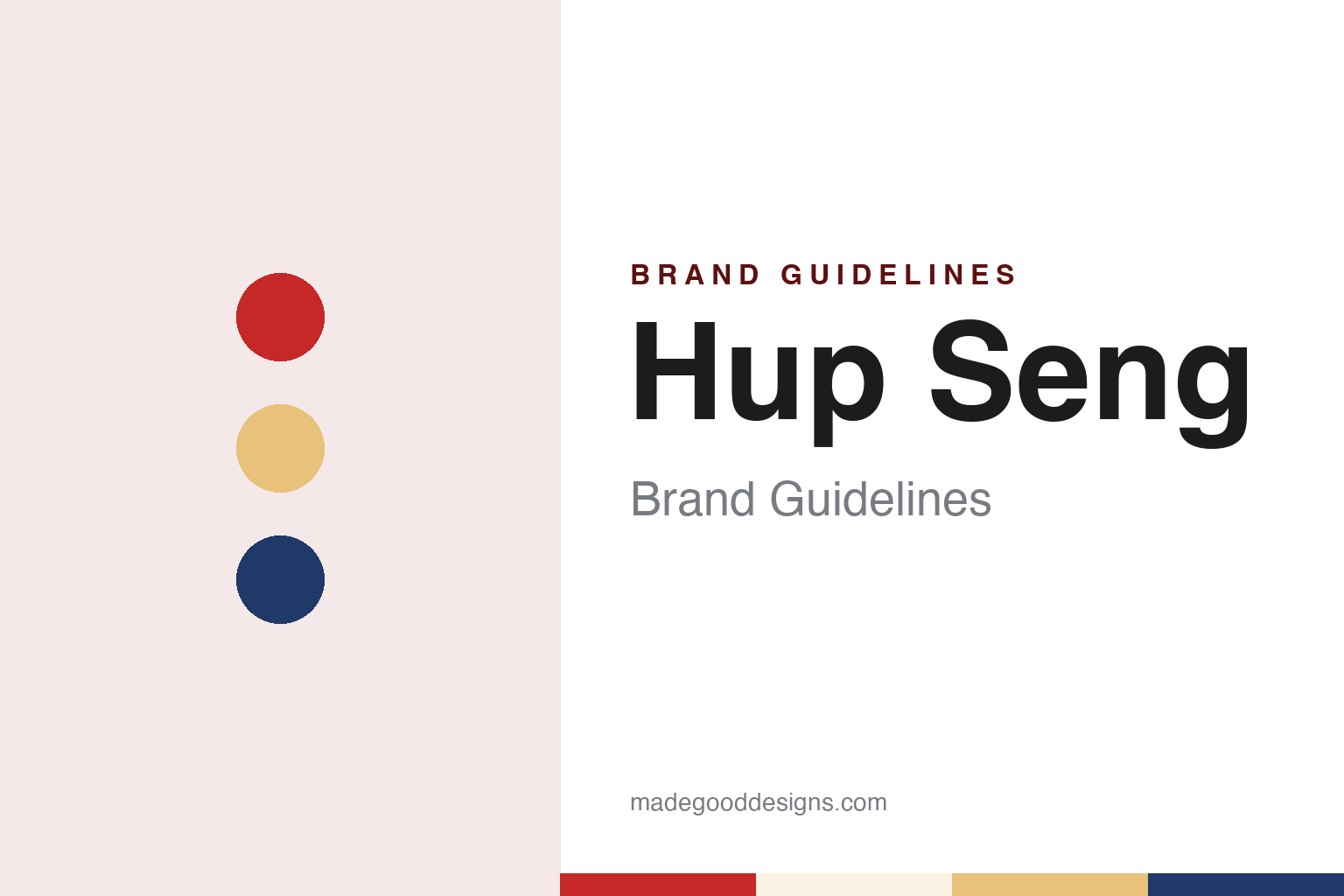
Two constants: a Ping Pong red, cracker gold and tin blue palette and a sturdy rounded sans register. Abstract homage — not a Hup Seng product or mark; no pack, logo or biscuit is reproduced.
Vans, a village and four brothers
A Malay village, a shared stake and a shop lot in Batu Pahat.
Hup Seng began on the road. In the late 1950s, The Star reported in 2015, four brothers of the Kerk family and another partner pooled their money to sell biscuits and other confectionery from vans that drove from town to town. They started out in Parit Linau Kecil, a Malay village at Bukit Pasir in Batu Pahat, Johor. The company’s own history goes back further, to 1950, when it says the Kerk family of Batu Pahat began selling crackers, cookies and biscuits by van.
The partnership itself was called Hup Seng (合成). The Star dates it to 1957 and says the brothers rented a shop lot in Batu Pahat the following year to start what they called research and development; the listed holding company’s website dates the partnership, Hup Seng Co., to 1958. The name is translated on the holding company’s website as “Success with Teamwork,” and The Star gave it as “unity is success.” The newspaper quoted the chairman of the operating company, Kerk Choo Ting, as saying that the village, home to more than a hundred Malay families and only seven Chinese ones, shaped how the business worked, and that its biscuits were halal from the first day.
Making its own biscuits came a few years later. Kerk Choo Ting told The Star that the company began to manufacture in 1964, testing different amounts of flour, sugar, palm oil and other ingredients until it had its first cream crackers, with recipes influenced by the kuih he had eaten at Hari Raya; the company’s own timeline also dates its first production plant in Batu Pahat to 1964. The crackers were sold to sundry shops, which sold them on to customers.
Colour
Cap Ping Pong and a table-tennis name.
Hup Seng’s best-known product is its Cap Ping Pong cream cracker. Both the company and The Star date the Ping Pong crackers to 1958, and both say the name came from table tennis: the company says it was taken from China’s success as champion of the World Table Tennis Championships, and the newspaper reported that the crackers were named after the year China became table-tennis world champions. The company says that by 1977 its Ping Pong cream crackers were being exported across Southeast Asia.
The range has since spread well beyond one cracker. Hup Seng Industries lists sugar, Corneo, wholemeal and deluxe crackers alongside the special cream crackers; Ping Pong Marie and sesame biscuits; sultana biscuits under the Kerk name; and oat cookies under Naturell, a brand it describes as homemade-inspired. The holding company says its special cream crackers have won gold and grand gold awards from Monde Selection, the Brussels quality institute, since 1994, and that the Naturell oat cookies have won a Monde Selection gold award.
Drinks joined in 2005, when Hup Seng Industries bought all of In-Comix Food Industries, which makes instant coffee and other beverage mixes, including an Ipoh white coffee and ginger tea, under the In-Comix name. The holding company calls the purchase a complementary business, and says In-Comix exports to more than ten countries.
Typography
Design and documentation.
The seven brands in this group all make food or drink, and all of them come from Indonesia, Singapore or Malaysia: SilverQueen, Garudafood, Nabati, F&N, Marigold, Hup Seng and Gardenia. Food and drink brands from the region in general sit at many different points in the trade, from family firms that still carry a founder’s name to names that now belong to much larger food groups, and a single brand can be sold everywhere from a corner shop to a supermarket shelf.
A food or drink brand’s identity is usually carried less by a single product than by a pack, a name and the everyday meal or drink it promises, because the company behind the name may have changed hands, moved its factory or grown far beyond the town where it started. That makes the questions behind each name worth asking plainly: who started it, who owns it now, and where its products are actually made and packed.
Each guide separates what independent sources record from what the company says about itself — its founding story, its owners over time, where its products are made and how its packaging has changed — and marks plainly what rests only on the company’s own word.
Aa
A sturdy rounded sans for a cracker named after a table-tennis ball. (Specimen set in Rubik, a sans STAND-IN; NOT the Hup Seng logo.)
Hup Seng
A partnership, a company and a listing.
The business changed its legal form as it grew. According to Hup Seng Industries, the Hup Seng Co. partnership was dissolved in 1974 because of expansion and the need for more capital, and its assets and liabilities passed to a new company, Hup Seng Perusahaan Makanan (M) Sdn Bhd, which makes the biscuits. A trading company, Hup Seng Hoon Yong Brothers, was incorporated in 1977 to handle sales and distribution; it now serves thousands of sales points in Peninsular Malaysia from branches in Kota Bharu, Kuantan, Ipoh, Butterworth, Alor Setar and the Klang Valley.
The biscuits are still made in Batu Pahat. The holding company says all of the operating company’s products come from a factory on 7.8 acres of industrial land in Batu Pahat, completed in 1981; The Star reported in 2015 that the factory, in the Tongkang Pecah industrial area, employed about 1,900 people. Building it was costly, Kerk Choo Ting told the newspaper, and the company came close to failing when commodity prices collapsed between 1985 and 1987, before it cleared its borrowing by around 1990.
The holding company, Hup Seng Industries Bhd, was incorporated on 4 October 1991 and listed on the Main Board of Bursa Malaysia on 2 November 2000. The Kerk family remains at the centre: The Star reported in 2015 that the listed company was headed by Kerk Choo Ting’s brother, Kerk Chu Koh, and that two generations of the family worked alongside hired professionals. Kerk Choo Ting is also a former deputy minister for agriculture and agro-based industry, who, the newspaper said, left politics in 2006. The company’s websites give its export reach variously as more than 20 countries and more than 60.
For a design guide, Hup Seng shows how a sporting name and a single cream cracker can carry a family company from a village van round to a listed group. Compare Munchy’s, another Batu Pahat biscuit maker, and Khong Guan, the Singapore biscuit maker. For this guide we use a Ping Pong red, a cracker gold and a tin blue with a rounded sans, an unofficial interpretation; no product or logo is reproduced.
Explore & save
Keep Hup Seng’s identity on hand — save it to a board in the Made Good inspiration library.
Hup Seng identity set
Pin the Hup Seng Ping Pong red, cracker gold and tin blue palette and the sturdy rounded sans register to your own board.