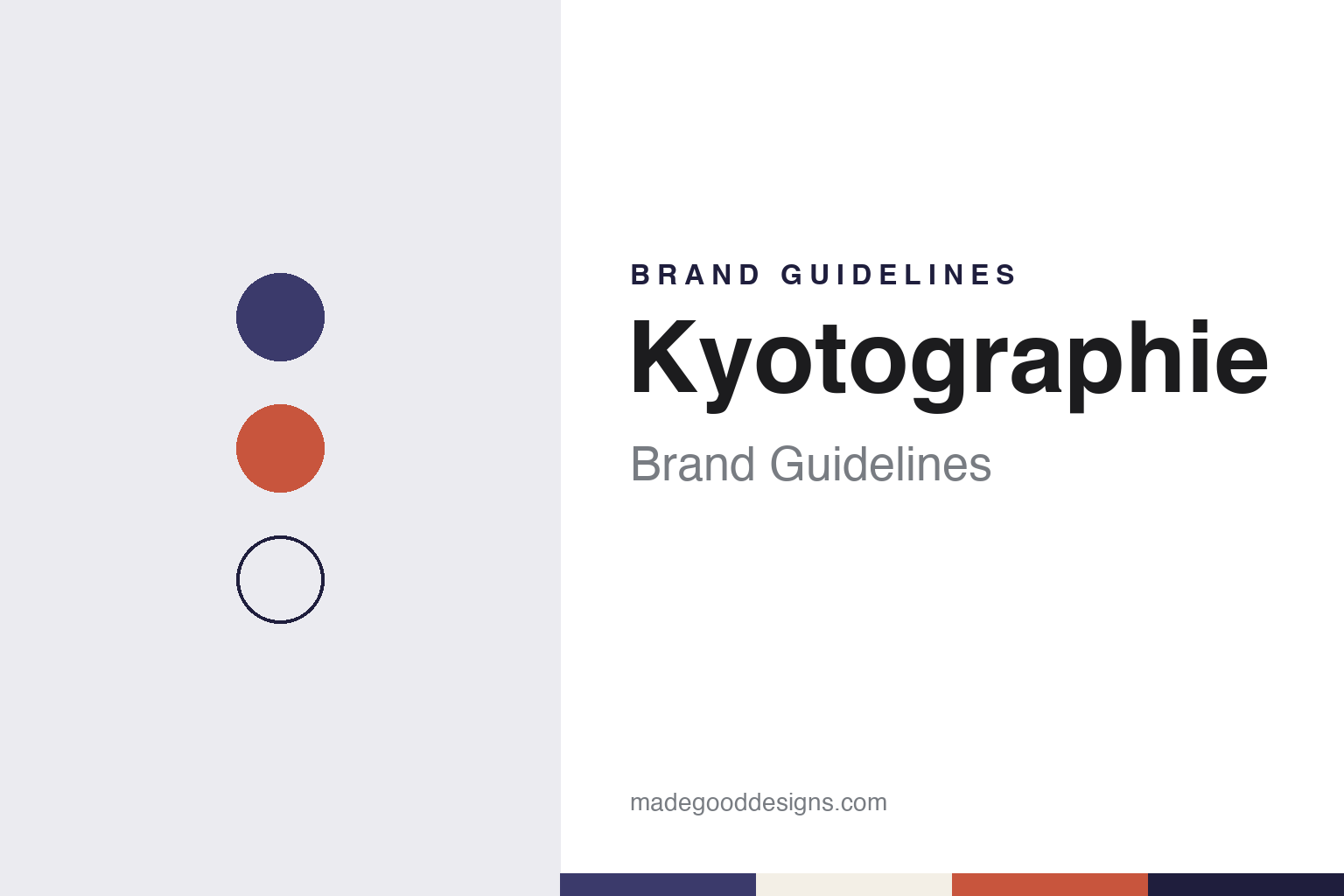
Kyotographie Brand Guidelines
A spring photography festival in the old buildings of Kyoto.
Aa
Two constants: an indigo, vermilion and washi white palette and a Mincho serif register. Abstract homage — not a Kyotographie asset; no logo, poster or photograph is reproduced.
A festival conceived by a photographer and a lighting designer
Conceived in 2012, first held in 2013.
Kyotographie, written KYOTOGRAPHIE by the festival and known in Japanese as the Kyoto International Photography Festival (京都国際写真祭), is an annual festival of exhibitions and events showing the work of photographers from around the world. Japanese Wikipedia describes it as held from April to May at several venues in Kyoto, among them historic buildings and modern and contemporary architecture, and dates it to an idea conceived in 2012 by the photographer Lucille Reyboz and the lighting designer Yusuke Nakanishi.
The first festival followed in 2013. Wallpaper*, reviewing the 2025 festival on 24 April 2025, described it as the event’s 13th edition and recalled that its writer had stumbled on the first edition thirteen years earlier while wandering the backstreets of Kyoto. The magazine described Reyboz and Nakanishi as a couple and collaborators, and Nakanishi as the festival’s co-director.
Exhibitions are installed in public and private buildings and public spaces around Kyoto, Wallpaper* reported, opening the city up to visitors and participants in a place known for tradition and the preservation of history.
Since its first editions Kyotographie has grown into a family of events. Wallpaper* listed an emerging-artists showcase, KG+; a European satellite event at the Rencontres d’Arles in France; and a sister music festival in Kyoto, Kyotophonie. Time Out described KG+ in April 2025 as a satellite festival championing emerging talent, with a selected group of artists presented under the name KG+ Select.
Colour
Temples, townhouses, a brewery and a station.
The venues are the festival’s signature. Time Out wrote in April 2025 that Kyotographie is set against Kyoto’s temples, teahouses, traditional machiya dwellings and modern landmarks, turning the city into an open-air gallery, and named venues ranging from a Meiji-era sake brewery to the steel face of Kyoto Station, where a monumental black-and-white mural made up of hundreds of local faces was pasted on the north wall in 2025.
Each space is designed for its exhibition. The festival draws on local expertise, from scenographers to artisans, to design and build the exhibition spaces, sometimes with sound and other sensory elements, and each space is individually curated with written statements, Wallpaper* reported. The founders avoid the white-cube look of a conventional gallery. “We talk with the artist and then the scenographer, and look at how we should show this artwork with the greatest impact for the audience and sum up its message,” Reyboz told the magazine, adding that the festival likes to keep a connection with craftsmanship and to support the city.
The 2025 festival, themed Humanity, ran from 12 April to 11 May 2025, Time Out reported. Wallpaper* described several of its installations. A retrospective of the Mexican photographer Graciela Iturbide, her first in Japan, was hung on hand-plastered temporary walls in a pink plaster that set off her black-and-white photographs. Another exhibition was installed in a 280-year-old former obi wholesaler, and another in a former townhouse of 1926, where panels of photographs replaced walls and doors and one image, printed on translucent material and facing the window, changed with the time of day.
The festival mixes established and emerging photographers. Reyboz told Wallpaper* that the festival tries to connect the underground with the mainstream, and Nakanishi said it shows work by photography’s great names alongside work on the environment and human rights.
Typography
Literary and photography festivals.
Literary and photography festivals usually announce themselves with a place and a season. Most take a town or city name plus “writers festival”, “book festival” or “photo festival”, and a few coin a word of their own: the Mantua festival joined “festival” and “letteratura” into Festivaletteratura, and the Kyoto photography festival folded the city’s name into Kyotographie. The name tells visitors where to go, and each edition adds a year or a number to it.
The organisations behind them vary. The Ubud festival is run by a not-for-profit Balinese foundation; the Singapore festival is organised by an arts company and commissioned by the national arts council; the Mantua festival grew out of a committee of local residents that became an association; Photoville in New York is produced by a non-profit set up by three founders; and PHotoEspaña in Madrid is a project of a private cultural company. The organiser often stays in the background while the town takes the title.
Most of these events are spread out rather than gathered in one hall. Literary festivals fill theatres, squares, churches, libraries and cafés with talks, readings, signings and long lunches; photography festivals hang exhibitions in museums, galleries, shipping containers, temples and townhouses, and visitors follow a map from one venue to the next. Many add free events, school days and satellite programmes alongside the ticketed core.
Each edition usually brings a theme, a programme booklet and a poster or campaign identity made anew, so the look of a festival changes from year to year while its name stays fixed. This guide records the dated facts about each festival, its organisers, venues and editions, and uses palettes and typefaces of our own; no official logo, poster or photograph is reproduced.
Aa
A Mincho serif for a coined name and a city of temples. (Specimen set in Shippori Mincho, a serif STAND-IN; NOT the Kyotographie logo.)
Kyotographie
A coined word and a city map.
Kyotographie’s identity rests on its coined name and on the buildings it borrows. The festival writes its name in capitals and pairs it with a yearly theme, such as Humanity in 2025, while the real image of each edition comes from the rooms it occupies: a temple, a merchant house, a brewery, a station wall. Because each space is designed afresh around its artist, as Wallpaper* described, the look of a venue changes from year to year even when the building is the same.
The buildings themselves are part of the festival’s concern. Wallpaper* noted in 2025 that the festival adds to the city’s visitor numbers, while Kyoto’s historic buildings face pressure from footfall and redevelopment, and Reyboz said the festival wants to support the city and its craftspeople through the way it builds its exhibitions.
The festival’s international links are built into its structure. It was founded by a photographer and a lighting designer working as a couple, it presents a satellite event at the Rencontres d’Arles in France, and its 2025 programme brought Mexican, British, Indian and Ivorian photographers to Kyoto alongside Japanese and Taiwanese artists, Wallpaper* reported. Its KG+ programme gives younger photographers a parallel route into the city during the same weeks.
For a design guide, Kyotographie shows how a photography festival can let historic architecture and bespoke exhibition design carry its visual identity, with the name and theme kept simple. Compare Rencontres d’Arles, the French festival where Kyotographie presents a satellite event, and PHotoEspaña, the Madrid festival that also showed Graciela Iturbide in 2025. For this guide we use an indigo, a vermilion and a washi white with a serif, an unofficial interpretation; no product or logo is reproduced.
Explore & save
Keep Kyotographie’s identity on hand — save it to a board in the Made Good inspiration library.
Kyotographie identity set
Pin the Kyotographie indigo, vermilion and washi white palette and the Mincho serif register to your own board.
Source & notes
Frequently Asked Questions
What font can I use to match the Kyotographie look?
This guide describes Kyotographie’s type as “A Mincho serif for a coined name and a city of temples”. Its type specimen is set in Shippori Mincho from Google Fonts as a stand-in; Shippori Mincho is not Kyotographie’s own lettering.
What colours are in the Kyotographie palette?
This guide’s Kyotographie palette is Indigo dye #3B3A6B, Lacquer night #1F1E3D, Vermilion gate #C8553D, Washi white #F3EFE6 and Paper #F8F7F3. The tones are the guide’s own unofficial interpretation, not official Kyotographie hex codes.
Who founded Kyotographie?
Kyotographie was founded by Lucille Reyboz and Yusuke Nakanishi.