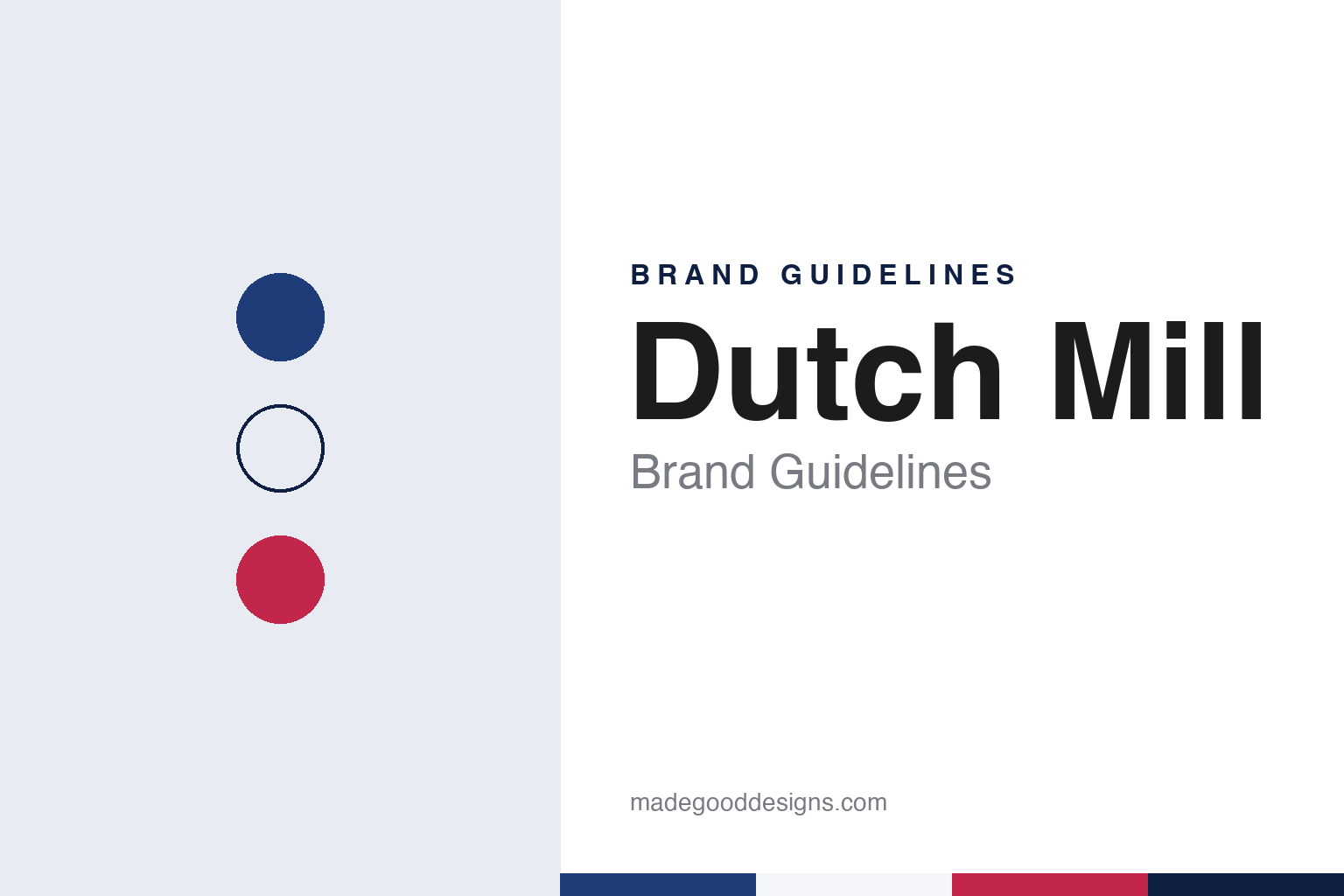
Dutch Mill Brand Guidelines
The Thai drinking yoghurt begun by Kasetsart food scientists in 1984.
Aa
Two constants: a blue, white and berry-red palette and a rounded sans register. Abstract homage — not a Dutch Mill product or mark; no pack, logo or label is reproduced.
Pro Food
Food scientists, a yoghurt and a factory west of Bangkok.
Dutch Mill began in 1984. The company says it was registered on 27 January 1984 under the name Pro Food Co., Ltd., set up by a group of food scientists from Kasetsart University in Bangkok, and describes itself as a business “established and managed by Thais.” Its own history names no individual founder. English and Thai Wikipedia give the same registration date and say the company took the name Dutch Mill Co., Ltd. in 1991; they place its head office in Bangkok.
The first products, the company says, were yoghurt and ready-to-drink yoghurt sold under the name “Dutch Mill” — ดัชมิลล์ in Thai — with a separate company, Pro Mart Co., Ltd., as distributor. As the name became known, it built its first factory on Phutthamonthon Sai 8 Road in Nakhon Chai Si district, in Nakhon Pathom province on the western edge of Bangkok, and went on to add pasteurised and UHT versions of its drinking yoghurt. The company does not give a year for that first factory in the versions of its history that are online.
The route out of the capital was direct selling. Once the Bangkok market was growing steadily, the company says, it took pasteurised Dutch Mill drinking yoghurt to the provinces through distribution centres staffed by saleswomen it calls the “Dutch Mill ladies” — สาวดัชมิลล์ in Thai — whose job was to introduce the products at customers’ doors around the country. In 1997, it says, it opened a second factory in Phayuha Khiri district, in Nakhon Sawan province north of Bangkok, and adopted management systems including MRPII, SAP, TQM and TPM.
Colour
Three companies, a cup yoghurt and a talent contest.
Dutch Mill today is a group of companies rather than one. According to its Thai website, Dutch Mill Co., Ltd. makes and sells pasteurised products — Dutch Mill drinking yoghurt, Dutchie yoghurt, Dutch Mill fresh milk and Delight cultured milk. A sister company, Dairy Plus Co., Ltd., makes UHT products, including Dutch Mill UHT drinking yoghurt, DNA soy milk and a chocolate malt drink called D-Malt. A third, DMDL Public Company Limited, handles distribution, sales channels and distribution centres for the group. An English version of the company’s background page, archived in January 2024, described the first two companies in the same way.
The group’s best-known piece of marketing was a talent contest. In 1996 it created “Dutchie Boy & Girl” to make the Dutchie cup yoghurt known among teenagers, at a time when yoghurt was still a new product to many Thai shoppers, the Thai business magazine Positioning reported in August 2009. The first year’s faces were appointed; from the following year they were chosen by contest. By 2009, Positioning reported, the contest had reached its 14th edition, was run for the brand by companies in the Waterleaf Group, and had launched actors including Off Chanapol Sattaya and Techin Chayuti — the latter named as Dutchie’s most recent presenter. Thai Wikipedia, citing the same article, dates Dutch Mill’s sponsorship of the contest from 1996 to 2012.
The contest changed with the times. In 2009 its organisers told Positioning that, as television talent shows grew, they had added reality-show elements and text-message voting, and had split the contest into acting and singing categories, briefly adding presenters as well before dropping that strand two years later.
Typography
Food and drink brands from the Philippines and Thailand.
The seven brands in this group are food and drink brands from the Philippines and Thailand: Jack ’n Jill, Ligo, Mega, Oishi, Goldilocks, Lactasoy and Dutch Mill. Food and drink brands in general sit at many different points in the trade, from family firms that still carry a founder’s name to names that now belong to much larger food groups, and a single brand can be sold everywhere from a neighbourhood store to a supermarket shelf.
A food or drink brand’s identity is usually carried less by a single product than by a pack, a name and the snack, meal or drink it promises, because the company behind the name may have changed hands, moved its factory or grown far beyond the town where it started. That makes the questions behind each name worth asking plainly: who started it, who owns it now, and where its products are actually made and packed.
Each guide separates what independent sources record from what the company says about itself — its founding story, its owners over time, where its products are made and how its packaging has changed — and marks plainly what rests only on the company’s own word.
Aa
A friendly rounded sans for a dairy brand. (Specimen set in Nunito, a rounded sans STAND-IN; NOT the Dutch Mill logo.)
Dutch Mill
Made in Thailand, sold across Asia.
The company is specific about where its drinks are made. It names two factories, both in Thailand: the first at Nakhon Chai Si in Nakhon Pathom, and the second, opened in 1997, at Phayuha Khiri in Nakhon Sawan. From there, it says, its dairy products are exported to markets across Asia and beyond, among them China, Taiwan, the Philippines, Singapore, Malaysia, Vietnam, Cambodia, Laos, Myanmar, Brunei and the United Arab Emirates; those are the company’s own lists, and the countries named have changed between the archived English page and the current Thai one.
In the Philippines, Dutch Mill reaches shops through Monde Nissin, the Philippine food group behind Lucky Me! noodles. English Wikipedia’s article on Monde Nissin, citing The Philippine Star, says the group entered distribution agreements with Dutch Mill Co. and Dairy Plus in 2006, becoming the exclusive Philippine distributor of Dutch Mill cultured milk and yoghurt products, and that in 2010 the partnership was widened to include marketing of Dutch Mill products by Monde Nissin. When Monde Nissin filed for its record stock-market listing in March 2021, The Philippine Star reported, the filing named Dutch Mill among its flagship brands, “for yogurt drinks,” alongside Lucky Me!, SkyFlakes and Fita.
The name itself is written two ways by the company: as “Dutch Mill” in English and as ดัชมิลล์ in Thai script, a transliteration of the English words. The cup yoghurt carries its own diminutive, Dutchie, and the contest that promoted it carried that name too.
For a design guide, Dutch Mill shows a dairy brand that grew from a university group’s yoghurt into a three-company group, using door-to-door saleswomen at home and a partner’s distribution network abroad. Compare Lactasoy, another Thai drink brand, and Yakult, the Japanese cultured-milk drink. For this guide we use a deep blue, milk white and a berry red with a rounded sans, an unofficial interpretation; no product or logo is reproduced.
Explore & save
Keep Dutch Mill’s identity on hand — save it to a board in the Made Good inspiration library.
Dutch Mill identity set
Pin the Dutch Mill blue, white and berry-red palette and the rounded sans register to your own board.