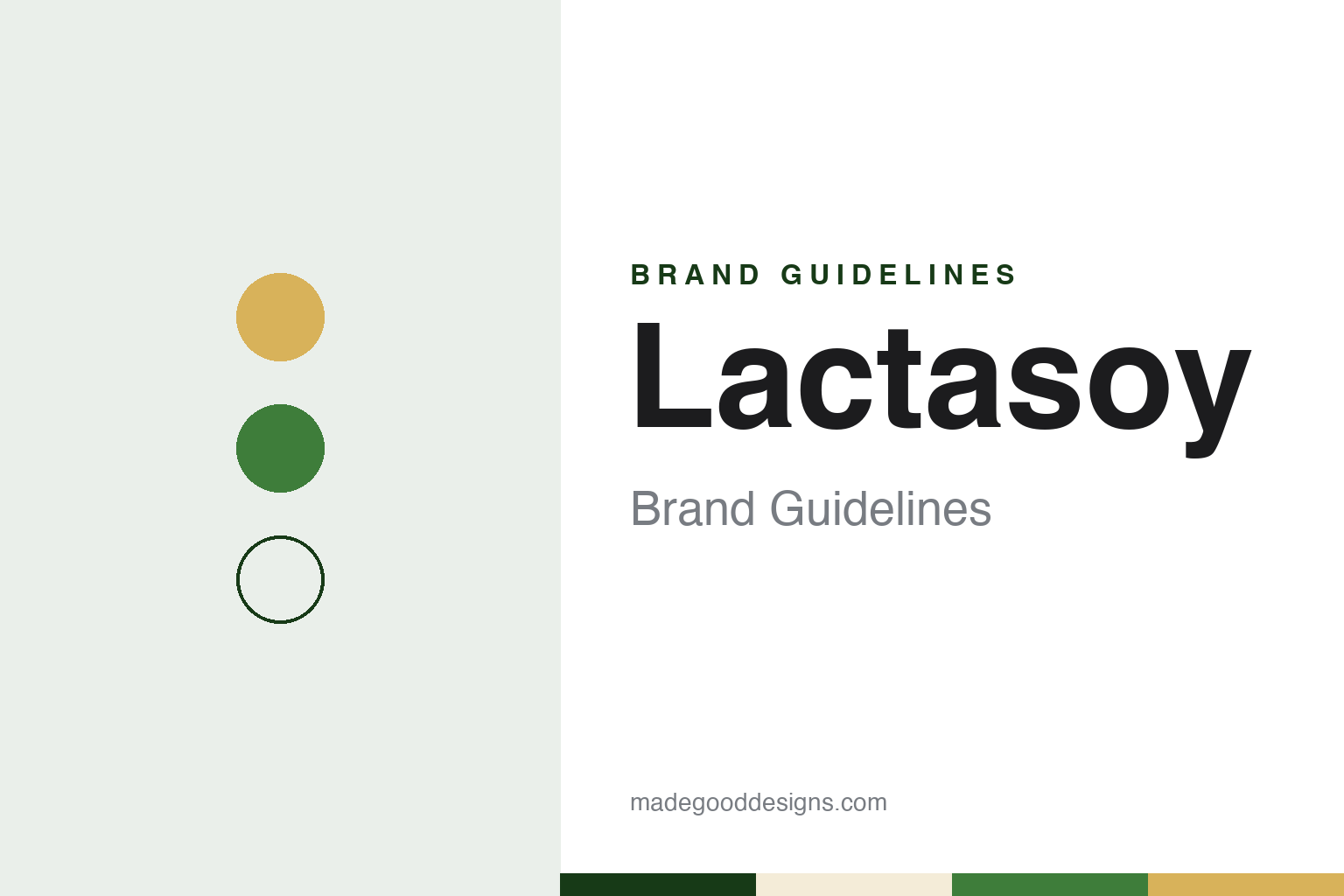
Lactasoy Brand Guidelines
The Bangkok soda maker’s 1981 UHT soy milk.
Aa
Two constants: a soy cream, bean gold and leaf green palette and a rounded Thai-Latin sans register. Abstract homage — not a Lactasoy product or mark; no carton, logo or advertisement is reproduced.
From sodas to soy
A Bangkok partnership, a licensed soda and a new drink.
Lactasoy grew out of a Bangkok soft-drink business. Thai Wikipedia and the company both date its roots to 1950 (2493 in the Thai calendar), when Viriya Jirapattanakul (วิริยะ จิรพัฒนกุล in Thai) set up the Kiang Hua limited partnership; Thai Wikipedia gives the date as 15 May 1950. The company says the business began with fizzy drinks, orange- and salak-flavoured sodas sold under the names Happy and Double Happy, and was sold at Yaowarat, Bangkok’s Chinatown market.
Licensed foreign drinks followed. The company says it later won the right to make foreign soft drinks, among them Kickapoo, and the firm took that name: Thai Wikipedia records that Kickapoo (Thailand) Co., Ltd. was set up on 21 June 1971.
It was this soda company that made the first Lactasoy. According to Thai Wikipedia, Kickapoo (Thailand) launched soy milk for the first time in 1981 (2524), under the brand name Lactasoy. The date matches a 2015 article in the Thai newspaper Post Today, headlined “34 years of Lactasoy,” which Thai Wikipedia cites, and the company itself now describes the drink as a soy milk that has been with Thai people for “more than 38 years.”
The brand name is written แลคตาซอย in Thai, a transliteration of the English name, and the company presents the Latin-letter “Lactasoy” and the Thai form side by side on its website. The new drink did not replace the sodas at once.
The company kept both trades for a while. On 18 June 1993 Kickapoo (Thailand) changed its name to Lactasoy Co., Ltd., Thai Wikipedia says, and in 1996 it stopped making soft drinks, leaving soy milk as its business.
Colour
UHT, a paper carton and a factory in Prachinburi.
Lactasoy’s design story is a packaging story. Thai Wikipedia says the company used ultra-high-temperature (UHT) sterilisation and was the first producer in Thailand to pack its products in paper cartons.
The company describes the process on its website. Raw soy milk is heated to about 137 to 140 degrees Celsius for between 4 and 15 seconds and then packed into cartons; the company says this lets the milk keep its colour, smell and taste for up to ten months without refrigeration or added preservatives.
Production moved out of the city. Thai Wikipedia says the Lactasoy factory was relocated in 1991 to Prachinburi province, east of Bangkok. The company’s head office is on Sukhumvit Road in the Bang Na district of Bangkok, according to its website.
The range has widened around the original. The company’s website lists an original soy milk alongside versions such as Hi-Calcium, unsweetened, green tea, chocolate and black sesame, plus the Lactasoy Prompt and Soyyo lines and a fruit drink called Mamemi.
The brand has also put its date on its mark. Thai Wikipedia says that since 2019 Lactasoy has used a logo carrying the words “SINCE 1981” at the lower right.
Typography
Design and documentation.
The seven brands in this group are food and drink brands from the Philippines and Thailand: Jack ’n Jill, Ligo, Mega, Oishi, Goldilocks, Lactasoy and Dutch Mill. Food and drink brands in general sit at many different points in the trade, from family firms that still carry a founder’s name to names that now belong to much larger food groups, and a single brand can be sold everywhere from a neighbourhood store to a supermarket shelf.
A food or drink brand’s identity is usually carried less by a single product than by a pack, a name and the snack, meal or drink it promises, because the company behind the name may have changed hands, moved its factory or grown far beyond the town where it started. That makes the questions behind each name worth asking plainly: who started it, who owns it now, and where its products are actually made and packed.
Each guide separates what independent sources record from what the company says about itself — its founding story, its owners over time, where its products are made and how its packaging has changed — and marks plainly what rests only on the company’s own word.
Aa
A rounded sans drawn for both Thai and Latin script. (Specimen set in Kanit, a sans STAND-IN; NOT the Lactasoy logo.)
Lactasoy
A family firm that changed its product and its name.
Lactasoy has stayed a Thai company. Thai Wikipedia describes Lactasoy Co., Ltd. as a limited company headquartered on Sukhumvit Road in Bangkok and gives Viriya Jirapattanakul as its founder; the company’s own history traces it to the Kiang Hua partnership he set up in 1950.
Its sequence of names tells the history in brief: a partnership named Kiang Hua, a company named after the Kickapoo soft drink it was licensed to make, and finally, from 1993, a company named after its own soy milk. Thai Wikipedia cites a January 2023 report on Sanook, which examined the company’s business after it raised its prices for the first time in 17 years, alongside the 2015 Post Today article.
The company presents itself in plain, family terms. Its stated policy is to make soy milk of good quality, to be sincere with customers and consumers, and to work with its distributors and customers “as one family.” Its listed promises are to run the business with sincerity to keep a reputation of more than 38 years, to keep Lactasoy’s quality, to seek modern production technology and to strengthen the organisation with a capable team and a code of conduct. The same values appear in the headline of the 2015 Post Today piece, which paired the brand’s 34 years with the words “honest, sincere.”
The company also says its soy milk is made from specially selected soybeans and that its production processes are certified to international standards.
Lactasoy sits alongside other Asian soy and dairy drinks. Vitasoy, the Hong Kong soy milk first sold in 1940, is sold in both bottles and cartons, and Thailand’s Dutch Mill is another Thai drink brand in this collection.
For a design guide, Lactasoy shows how a pack format can become a brand: a soda maker that turned to soy milk, sterilised it, boxed it in paper and, decades later, wrote its launch year into its logo. Compare Vitasoy and Dutch Mill. For this guide we use soy cream, bean gold and leaf green with a sans, an unofficial interpretation; no product or logo is reproduced.
Explore & save
Keep Lactasoy’s identity on hand — save it to a board in the Made Good inspiration library.
Lactasoy identity set
Pin the Lactasoy soy cream, bean gold and leaf green palette and the rounded Thai-Latin sans register to your own board.