Bikaji Brand Guidelines
The Bikaner bhujia brand launched by a Haldiram grandson.
Aa
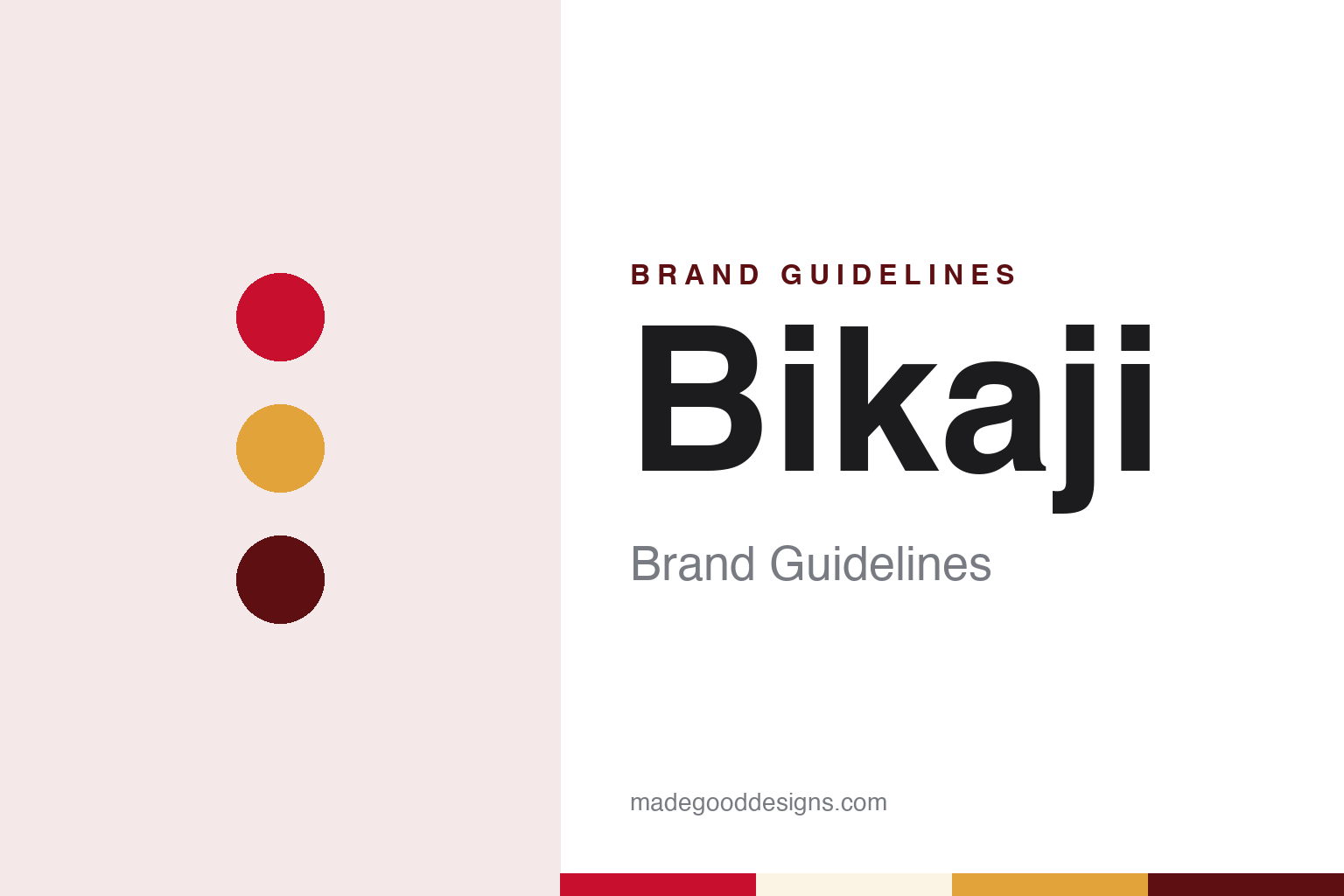
Two constants: a shield red, dune gold and deep maroon palette and a Devanagari-flavoured serif register. Abstract homage — not a Bikaji product or mark; no pack, logo or snack is reproduced.
Shivdeep
A Haldiram grandson, a partnership and a name taken from Bikaner’s founder.
Bikaji comes from Bikaner, the desert city in northern Rajasthan that gave its name to Bikaneri bhujia, the thin, crisp gram-flour snack. The company’s 2022 prospectus traces its lineage to Gangabishan Agarwal, founder of the Haldiram’s brand, and names his grandson Shiv Ratan Agarwal as Bikaji’s founder. English Wikipedia’s article on Bikaner lists Bikaji among the snack brands owned by the wider Agarwal family, alongside Haldiram’s, Bikanervala, Bikano and Prabhuji.
The business is older than the brand. According to the “history and certain corporate matters” section of the prospectus, it began in 1986 as a partnership called Shivdeep Food Products, and the Bikaji brand was launched in 1993. In October 1995 the partnership became a public limited company at Bikaner, Shivdeep Industries Limited, and in 2006 four related family companies were merged into it. The company took its present name, Bikaji Foods International Limited, by a shareholders’ resolution in September 2011.
The company tells the origin story in its own words. Its website says that in the late 1980s Shiv Ratan Agarwal set out to “create a new identity for himself,” at a time when bhujia was not yet made on a large scale, and that he travelled abroad to find, and help develop, machinery that could make it. The name, the company says, joins Bika, for Rao Bika, the fifteenth-century founder of Bikaner, with “ji,” a mark of respect in India — an easy name to remember that ties the brand to its city.
Exports came early. The prospectus dates the first shipments to the United Arab Emirates to 1994 and to Australia to 1996, and lists Rajasthan state awards for export excellence in 2008 and 2009. In the three months to June 2022, it says, Bikaji sold to 21 countries across North America, Europe, the Middle East, Africa and Asia-Pacific, though exports were a small share of sales.
Colour
Bhujia by the tonne, sweets in tins and a film star.
Bhujia gave the brand its start. The prospectus, citing an industry report by the consultancy Frost & Sullivan, calls Bikaji the largest maker of Bikaneri bhujia in the 2022 financial year, with output of about 29,000 tonnes from a largely automated line. The same report notes that Bikaneri bhujia received a geographical indication tag in 2010, and credits the company with moving bhujia into single-layer pouches and then into four-layer printed packs to keep it fresh.
The range has spread well beyond bhujia. The prospectus lists six main categories — bhujia, namkeen, packaged sweets, papad, western snacks and other snacks such as gift assortments and frozen food — and more than 300 products sold under the single Bikaji brand. Frost & Sullivan, as cited there, shows namkeen as Bikaji’s biggest category in the 2022 financial year, just ahead of bhujia, and ranks it as the second-largest maker of handmade papad and the third-largest player in organised packaged sweets, with tinned rasgulla, soan papdi and gulab jamun among its lines.
Bikaji makes most of what it sells itself. The company says it runs four plants in Bikaner, including a facility at the Karni Industrial Area commissioned in 2016, one in Guwahati in Assam and one in Tumakuru in Karnataka, held through Petunt Food Processors, which it acquired in 2021 to serve southern India; a contract manufacturer in Kolkata supplies parts of the east and north-east. In 2008 it opened its first restaurant, Bikaji Food Junxon, in Mumbai.
Advertising has leaned on a famous face. In 2019 Bikaji signed the actor Amitabh Bachchan as brand ambassador; the prospectus describes him as a celebrity whose appeal runs across all income groups in India and abroad, and lists print, television, social media, film placements and event sponsorship among its marketing. In the 2025–26 financial year the company added a campaign titled “Kya Baat Hai Ji!” with the actor Pankaj Tripathi, aimed, its annual report says, at consumers in Uttar Pradesh.
Typography
Design and documentation.
The seven brands in this group all make food, and all of them come from India: Bikaji, Lijjat, Mother Dairy, Nandini, Aashirvaad, Kissan and Ching’s Secret. Indian food brands in general sit at many different points in the trade, from family firms and cooperatives to names that now belong to much larger food groups, and a single brand can be sold everywhere from a neighbourhood kirana shop to a supermarket shelf.
A food brand’s identity is usually carried less by a single product than by a pack, a name and the meal or snack it promises, because the company behind the name may have changed hands, moved its factory or grown far beyond the town where it started. That makes the questions behind each name worth asking plainly: who started it, who owns it now, and where its food is actually made and packed.
Each guide separates what independent sources record from what the company says about itself — its founding story, its owners over time, where its food is made and how its packaging has changed — and marks plainly what rests only on the company’s own word.
Aa
A Devanagari-flavoured serif for a brand named after Bikaner’s founder. (Specimen set in Rozha One, a serif STAND-IN; NOT the Bikaji logo.)
Bikaji
Private equity, a 2022 listing and a shield-shaped logo.
Bikaji stayed a family company while bringing in outside investors. The prospectus records private-equity funding from India 2020 Maharaja in 2014, from funds managed by IIFL in 2018 and from Lighthouse India Fund III in 2021. Its initial public offering in November 2022 was an offer for sale, in which the founder’s family and several investors sold shares, and the company’s 2022–23 annual report says its shares were listed on the BSE and the National Stock Exchange on 16 November 2022. The Agarwal family remains in charge: the company’s 2025–26 annual report names Deepak Agarwal, Shiv Ratan Agarwal’s son and long-time managing director, as chairman and managing director from May 2026.
Growth since the listing has come partly through acquisitions and new markets. The 2025–26 annual report lists the purchase of Bhujialalji Private Limited, the full takeover of Petunt Food Processors, a subsidiary in the United States and, in July 2025, board approval for a 50:50 joint venture in Nepal with the Chaudhary Group, to make snacks and sweets there.
The same report describes a refreshed corporate logo, introduced in the 2025–26 financial year and rolled out across packaging and communications. The company says the new mark is built on a royal shield inspired by traditional Rajasthani insignia; that its upper curve echoes the silhouette of a Rajasthani turban; that its bold red stands for energy and the warmth of Indian flavours; and that its fluid lines recall the sand dunes of Bikaner. It presents the change as a way to look more contemporary while keeping the trust built over decades.
For a design guide, Bikaji shows how a city’s name, a single snack and a Rajasthani shield can carry a family brand from a Bikaner partnership to the stock exchange. Compare Haldiram’s, the Bikaner bhujia house founded by the same family, and Lijjat, the Mumbai papad cooperative. For this guide we use a shield red, a dune gold and a deep maroon with a Devanagari-flavoured serif, an unofficial interpretation; no product or logo is reproduced.
Explore & save
Keep Bikaji’s identity on hand — save it to a board in the Made Good inspiration library.
Bikaji identity set
Pin the Bikaji shield red, dune gold and deep maroon palette and the Devanagari-flavoured serif register to your own board.