Mother Dairy Brand Guidelines
The Operation Flood dairy that grew into a Delhi household name.
Aa
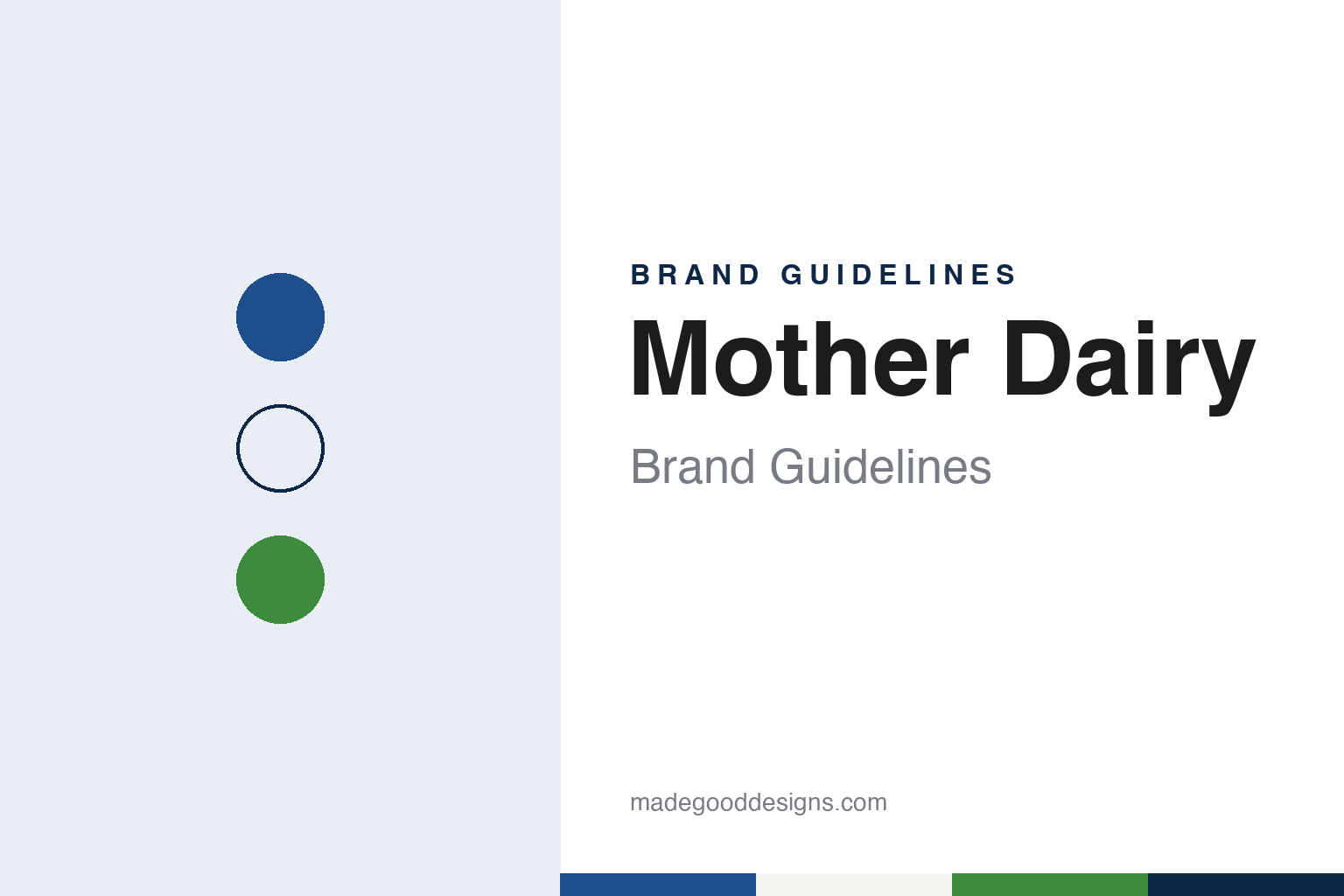
Two constants: a Mother Dairy blue, milk white and leaf green palette and a plain sans register. Abstract homage — not a Mother Dairy product or mark; no pack, booth or logo is reproduced.
Operation Flood
A national dairy board and a city dairy.
Mother Dairy is a product of national dairy policy rather than of a single founder. Its parent, the National Dairy Development Board (NDDB), was founded in 1965 by Verghese Kurien, English Wikipedia says, after the prime minister of the day, Lal Bahadur Shastri, asked for the success of the Kaira Cooperative Milk Producers’ Union — the co-operative behind Amul — to be repeated across India. The board’s main office is in Anand, Gujarat, and it is a statutory body under the Ministry of Fisheries, Animal Husbandry and Dairying.
The NDDB’s landmark project was Operation Flood, launched on 13 January 1970. English Wikipedia says its first phase was paid for by selling skimmed milk powder and butter oil donated by the European Economic Community through the World Food Programme, and that it linked 18 of India’s leading milk sheds with consumers in the four great cities — Delhi, Bombay, Calcutta and Madras — by establishing “mother dairies” in each of the four metros. The NDDB says the programme ran for 26 years, used a World Bank loan, and completed its third phase in 1996; by 1998, Wikipedia adds, India had overtaken the United States as the world’s largest milk producer.
Mother Dairy, Delhi, was commissioned in 1974 as a wholly owned subsidiary of the NDDB, both the company and English Wikipedia say, as an initiative under Operation Flood.
Colour
Milk from co-operatives, sold through the city.
The company does not run its own herds. It says it sources a significant part of the liquid milk it needs from dairy co-operatives and village-level farmer organisations, and that a significant portion of its income is ploughed back into that value chain. Under the Mother Dairy name it now sells milk, cultured products such as curd, ice creams, paneer and ghee, and English Wikipedia adds packaged sweets; in July 2020, Wikipedia says, it also began making bread.
Its home market has always been the capital. The company says it built a leading position in branded milk in Delhi and the National Capital Region through a network of its own booths and retail channels, and English Wikipedia reports that Delhi NCR accounted for more than 65 per cent of its sales in 2025. It has since widened its reach to other regions of India, the company says.
Two other brands sit alongside the milk. Safal is the fruit-and-vegetable arm: the company calls it the first business to organise the fruit and vegetable trade in India and the first Indian brand to launch frozen vegetables, in the mid-1990s — both its own claims. Safal runs stores across Delhi NCR and has a significant presence in Bengaluru, where it also has a plant making aseptic fruit pulp and concentrate that, the company says, supplies food and drink makers including Coca-Cola, Pepsi, Unilever and Nestlé; it says Safal exports fresh and frozen produce and pulp to about 40 countries. In January 2021, English Wikipedia says, Safal added packaged foods sourced from tribal communities in Jharkhand. The NDDB lists Mother Dairy Fruit & Vegetable Private Limited among its wholly owned subsidiaries.
Dhara is the company’s edible-oil brand. Mother Dairy says Dhara was launched under the NDDB’s Operation Golden Flow as a market-intervention programme meant to serve farmers and consumers alike.
Typography
Dairies and documentation.
The seven brands in this group all make food, and all of them come from India: Bikaji, Lijjat, Mother Dairy, Nandini, Aashirvaad, Kissan and Ching’s Secret. Indian food brands in general sit at many different points in the trade, from family firms and cooperatives to names that now belong to much larger food groups, and a single brand can be sold everywhere from a neighbourhood kirana shop to a supermarket shelf.
A food brand’s identity is usually carried less by a single product than by a pack, a name and the meal or snack it promises, because the company behind the name may have changed hands, moved its factory or grown far beyond the town where it started. That makes the questions behind each name worth asking plainly: who started it, who owns it now, and where its food is actually made and packed.
Each guide separates what independent sources record from what the company says about itself — its founding story, its owners over time, where its food is made and how its packaging has changed — and marks plainly what rests only on the company’s own word.
Aa
A plain sans — our register for a public-sector dairy name. (Specimen set in Mukta, a sans STAND-IN; NOT the Mother Dairy logo.)
Mother Dairy
Still owned by the dairy board.
More than half a century after it was commissioned, Mother Dairy remains a wholly owned subsidiary of the NDDB, which English Wikipedia describes as a public-sector dairy company; the board in turn sits under the Government of India’s ministry responsible for animal husbandry and dairying. The company describes itself as committed to institutional structures that empower milk producers and farmers through equitable processes.
The business has kept extending the name into new formats. On 17 January 2020, the Press Trust of India reported, Mother Dairy opened its first quick-service restaurant, Café Delights, in Sector 1 of Noida, inaugurated by Sanjeev Kumar Balyan, then the Union minister of state for animal husbandry, dairying and fisheries; the report quoted Sangram Chaudhary as managing director of Mother Dairy Fruit and Vegetable. The bread launch followed later that year and the Safal packaged-food range in 2021. The company’s current corporate line, from its latest brand campaign, is “Happy Food Happy People.”
One naming point is worth knowing. Because “mother dairy” began as a general Operation Flood term for a city dairy, the words appear outside the company too: the Karnataka Milk Federation, which sells under the Nandini name, listed a unit called “Mother Dairy” at Yelahanka, in Bengaluru, on its own website in 2016. The Delhi company is the NDDB subsidiary; the Bengaluru plant belongs to the Karnataka federation.
For a design guide, Mother Dairy shows how a name that began as a piece of planning vocabulary can become a consumer brand while its owner stays a public body. Compare Amul, the Gujarat co-operative whose model the NDDB set out to repeat, and Nandini, the Karnataka co-operative brand built on the same pattern. For this guide we use a dairy blue, milk white and leaf green with a sans, an unofficial interpretation; no product or logo is reproduced.
Explore & save
Keep Mother Dairy’s identity on hand — save it to a board in the Made Good inspiration library.
Mother Dairy identity set
Pin the Mother Dairy blue, milk white and leaf green palette and the plain sans register to your own board.