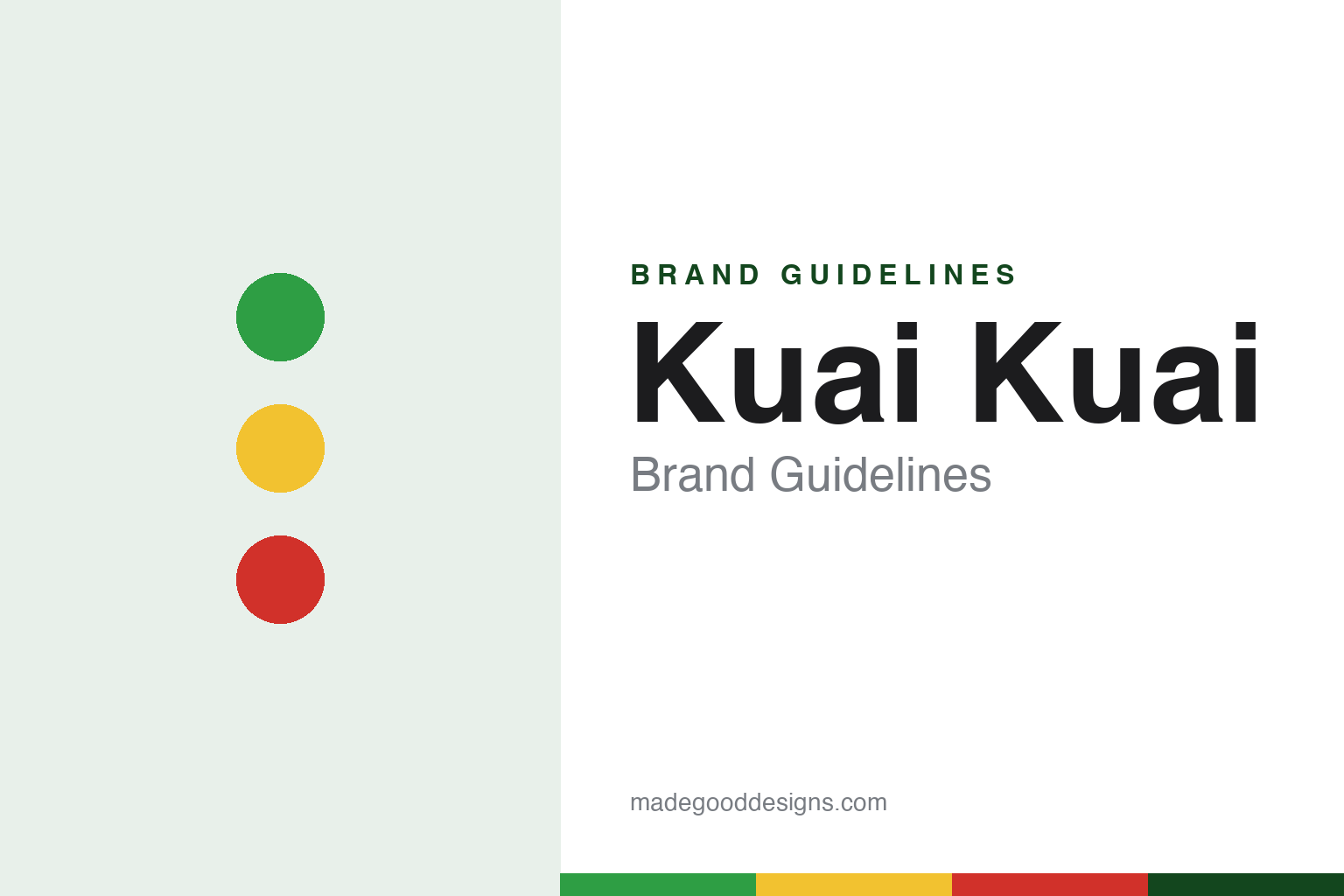
Kuai Kuai Brand Guidelines
The 1968 corn puff in the green bag Taiwan’s engineers trust.
Aa
Two constants: a Kuai Kuai green, yellow and red palette and a rounded sans register. Abstract homage — not a Kuai Kuai product or mark; no bag, mascot or logo is reproduced.
From pharmacy to snack
A drug company makes a children’s treat.
Kuai Kuai (乖乖) began as a sideline for a pharmaceutical business. The company’s own history says its founder, Liao Chin-kang (廖金港), set up a trading firm called Nan Fang Hang in Taipei’s Chengzhong district in 1956; Chinese Wikipedia describes it as an importer of Japanese medicines that later built a factory at Shulin and became Dongda Pharmaceutical. In 1968, the company says, it turned from medicines to food, building a snack plant to the GMP standards of a drug factory.
The BBC, in a 2021 feature, said the snack company was founded that year by Liao and his son Spencer, who needed to keep their main business busy during slow periods. “Kuai Kuai were specifically created to be sold to children. Back then, there was nothing like that on the market,” Spencer’s daughter Irene Liao, then the general manager, told the BBC. The name means “well-behaved” or “be good,” a word Taiwanese parents use to soothe a crying child, as the Taipei Times has explained.
English Wikipedia, citing the Taipei Times, says Kuai Kuai products have been on sale since 1969, and the company was registered under the Kuai Kuai name in 1974. A sister line, the Peacock (孔雀) biscuits, launched alongside it, the company says.
Colour
Green for go.
Kuai Kuai is a puffed corn snack sold in three classic flavours, each tied to a pack colour: coconut cream in green, five-spice in yellow and chocolate in red, as the BBC described them in 2021. Chinese Wikipedia says early bags came with small toys, stickers and comics, and that a jingle on Taiwan’s new television channels helped make it a children’s favourite from the 1960s to the 1980s.
The green bag has since taken on a second life. Placing an unopened green pack of Kuai Kuai beside a machine is a widespread workplace custom in Taiwan, meant to make the equipment “behave.” The Taipei Times reported in November 2020 on bags in the newspaper group’s own server room, in Academia Sinica laboratories, taped to hospital equipment and in police stations, and said the team behind Taiwan’s Formosat-5 satellite placed bags at the base of a model of its launch rocket before the August 2017 launch. The paper found a 2008 United Daily News report of engineers putting a bag inside an ATM as the earliest news item on the practice.
The rules are strict, according to the BBC: only green bags count, because green signals “go” while yellow and red suggest caution; the bags must not be past their expiry date; and they must not be eaten. Irene Liao told both papers that no one knows how the custom began, and the BBC reported that the company says it has not promoted the snack’s supposed protective powers. She told the Taipei Times the company does not track how many sales the custom drives. In January 2024 the Taipei Times reported that limited-edition bags made for TSMC and sold to its employees were being resold online for many times their price.
Typography
Design and documentation.
The seven brands in this group all make food or drink, and all of them come from China or Taiwan: Three Squirrels, Daoxiangcun, I-Mei, Kuai Kuai, Uni-President, Wei Chuan and C’estbon. Food and drink brands from China and Taiwan in general sit at many different points in the trade, from family firms that still carry a founder’s name to names that now belong to much larger groups, and a single brand can be sold everywhere from a corner shop to a supermarket shelf.
A snack or drink brand’s identity is usually carried less by a single product than by a pack, a name and the treat or refreshment it promises, because the company behind the name may have changed hands, moved its factory or grown far beyond the city where it started. That makes the questions behind each name worth asking plainly: who started it, who owns it now, and where its products are actually made and packed.
Each guide separates what independent sources record from what the company says about itself — its founding story, its owners over time, where its products are made and how its packaging has changed — and marks plainly what rests only on the company’s own word.
Aa
A rounded sans — the register of a children’s snack. (Specimen set in Fredoka, a rounded sans STAND-IN; NOT the Kuai Kuai logo.)
Kuai Kuai
From the Liao family to Sandi.
The company grew from Taipei to a factory at Zhongli in Taoyuan, opened in 1983 according to English and Chinese Wikipedia, and Chinese Wikipedia says it opened a plant in Tianjin, China, in 1993. Ownership later left the founding family. In December 2019 the Taiwanese weekly Mirror Media reported that control had passed to the Chung family of Sandi (三地), a property developer; the company’s own timeline records Sandi Group’s arrival in 2019 and says the founding family withdrew entirely in 2021, when professional managers took over.
Under its new owners Kuai Kuai has leaned on local ingredients and collaborations. The company says its first rice-based Kuai Kuai, made with the Guanshan farmers’ association in Taitung, came in 2017, and that it has since used produce such as Dahu strawberries and Donggang sakura shrimp. In November 2022 Focus Taiwan reported a grouper-flavoured rice puff made with the Pingtung County government after China halted grouper imports from Taiwan. Its 2023 “Kuai Kuai Shitang” line turned Taiwanese dishes such as braised pork rice into snack flavours. The company also lists a three-dimensional Kuai Kuai EasyCard transit card made in 2019.
In Taiwan the snacks are made at Zhongli. In July 2026 the Commercial Times reported that Kuai Kuai had secured land at a tropical-agriculture industrial park in Pingtung County for a second plant with a factory-tour area, its first production site in the south, while Zhongli continues to operate. The company also runs a Kuai Kuai story museum in Pingtung City. It says its coconut-cream and five-spice flavours won Monde Selection bronze medals.
For a design guide, Kuai Kuai shows how a pack colour can come to mean more than its flavour. Compare Want Want, another snack brand with Taiwanese roots and a child mascot, and I-Mei, the Taipei bakery-turned-food group. For this guide we use a bright green, a five-spice yellow and a chocolate red with a rounded sans, an unofficial interpretation; no product or logo is reproduced.
Explore & save
Keep Kuai Kuai’s identity on hand — save it to a board in the Made Good inspiration library.
Kuai Kuai identity set
Pin the Kuai Kuai green, yellow and red palette and the rounded sans register to your own board.