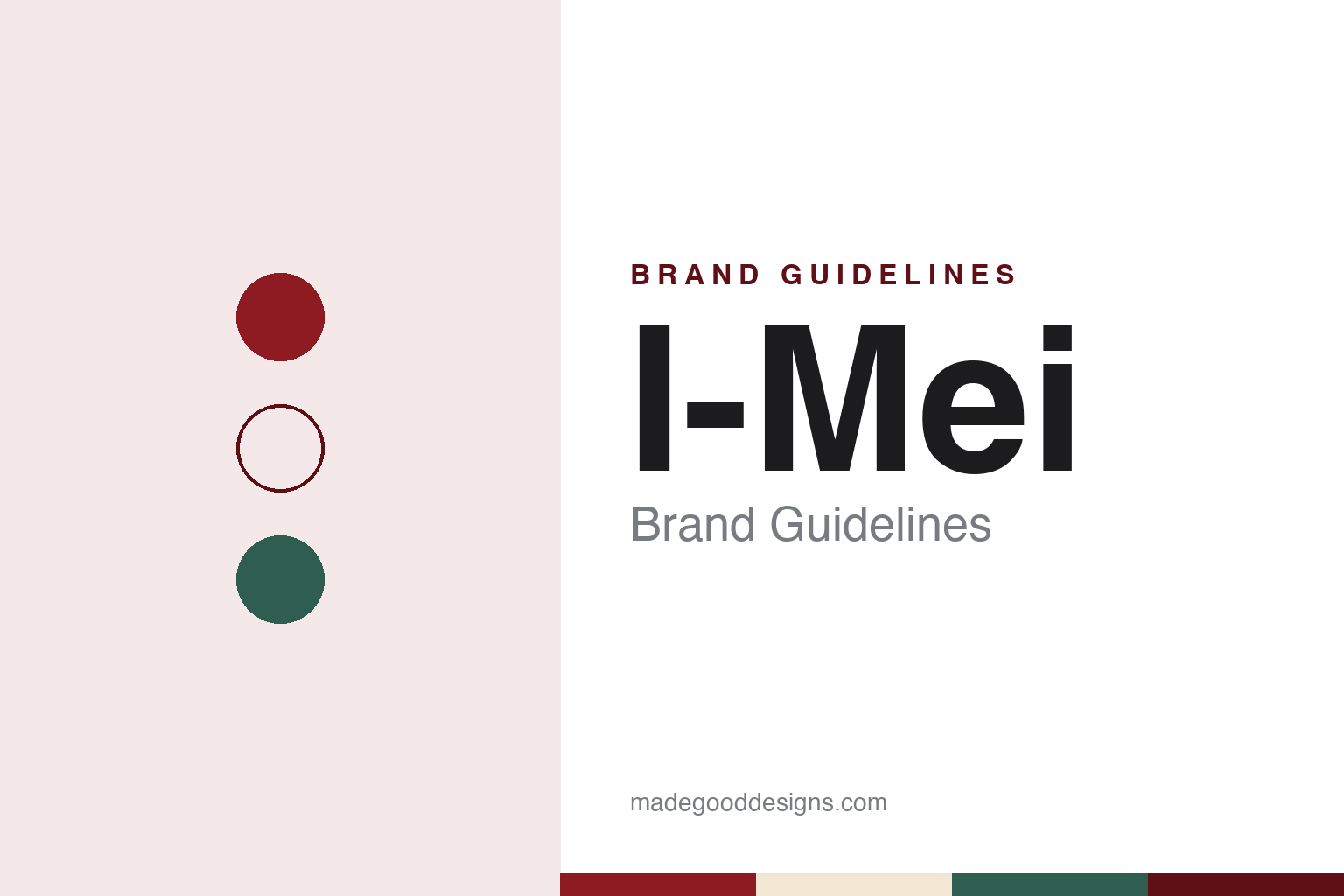
I-Mei Brand Guidelines
The Taipei bakery of 1934 named after a family dye shop.
Aa
Two constants: an I-Mei red, cream and green palette and a shop-sign serif register. Abstract homage — not an I-Mei product or mark; no pack, logo or shop sign is reproduced.
The I-Mei Store
A bakery on a doctor’s old address.
I-Mei is one of Taiwan’s oldest food names, and its story starts before food. According to a history on the company’s website, written by a member of the founding family, Kao Chih-kuei opened a fabric-dyeing shop called I-Mei (義美) in the spring of 1871 at Daqiaotou, in what is now Taipei’s Datong District. His son later worked in the shop, which kept going through the French attack on Tamsui in 1884 and the start of Japanese rule in 1895 before it closed in 1905.
Nearly three decades later the family used the name again. In early 1934 Kao Fan-wang and his wife Kao Chen Hsiu-ying opened a bakery, and when they could not settle on a name, the company says, Kao Fan-wang remembered his grandfather’s dye shop. The I-Mei Store (義美商店) opened on 30 March 1934, the sixteenth day of the second lunar month, in Dadaocheng, the old trading quarter by the Tamsui River. The company says the shop stood on the former site of the Daan Hospital, run by the doctor and activist Chiang Wei-shui, a founder of the Taiwan Cultural Association; I-Mei’s chief executive repeated that point at the company’s 85th-anniversary event in March 2019, as reported by Taiwan News, an English-language outlet that I-Mei owns.
The company says Kao Teng-chiao took charge of the business in November 1937, aged 16, working with his mother, aunts and uncles. He later served as chairman, and the company quotes him as saying that “the food industry is an honest profession for people of integrity.”
Colour
From pineapple cakes to fast-food buns.
The first I-Mei was a traditional Taiwanese bakery. The company’s English site says it specialised in Chinese-style cakes, pineapple cakes and mung bean cakes. After the Second World War it moved into dairy, offering fresh milk and other dairy products from what the company calls its own dairy farms; English Wikipedia credits a successful milk caramel with prompting that move and dates the start of the dairy business to 1955.
In the mid-1980s, according to both the company and Steven Crook and Katy Hui-wen Hung’s A Culinary History of Taipei (2018), I-Mei began supplying buns and dairy products to McDonald’s, Burger King, KFC and MOS Burger in Taiwan. Today the company says its range runs to more than 2,000 products across dry, chilled and frozen divisions, and Chinese Wikipedia lists sweets, biscuits, egg rolls, wedding cakes, ice products, frozen meals, drinks and dairy among its lines.
I-Mei also sells through its own shops. Its store finder listed 115 I-Mei shops across Taiwan in October 2026, including one on Yanping North Road in Dadaocheng, close to the founding address. The research firm Kantar ranked I-Mei Taiwan’s top fast-moving consumer goods brand for 2022, the ninth year in a row, Taiwan News reported in July 2023.
The anniversary itself was marked in the company’s own way. At the March 2019 tea party, Taiwan News reported, I-Mei invited customers born on the same day, month and year as the company, and Henry Kao spoke of a move into biotechnology alongside its cakes and biscuits. English Wikipedia lists an I-Mei biomedicine subsidiary and a catering arm, I-Mei Gourmet Supplier, which runs food courts at Taoyuan International Airport.
Typography
Design and documentation.
The seven brands in this group all make food or drink, and all of them come from China or Taiwan: Three Squirrels, Daoxiangcun, I-Mei, Kuai Kuai, Uni-President, Wei Chuan and C’estbon. Food and drink brands from China and Taiwan in general sit at many different points in the trade, from family firms that still carry a founder’s name to names that now belong to much larger groups, and a single brand can be sold everywhere from a corner shop to a supermarket shelf.
A snack or drink brand’s identity is usually carried less by a single product than by a pack, a name and the treat or refreshment it promises, because the company behind the name may have changed hands, moved its factory or grown far beyond the city where it started. That makes the questions behind each name worth asking plainly: who started it, who owns it now, and where its products are actually made and packed.
Each guide separates what independent sources record from what the company says about itself — its founding story, its owners over time, where its products are made and how its packaging has changed — and marks plainly what rests only on the company’s own word.
Aa
A shop-sign serif — the register of a 1930s Taipei bakery. (Specimen set in Noto Serif TC, a serif STAND-IN; NOT the I-Mei logo.)
I-Mei
Still a family company.
I-Mei remains a Kao family business, and Chinese Wikipedia describes it as an unlisted company. At the 2019 anniversary event the chairman was Henry Kao (高志尚) and the chief executive Luis Ko (高志明), Taiwan News reported. The family’s interests reach beyond food: English Wikipedia, citing a 1999 Reuters report, says I-Mei Foods took a half share in the English-language China News that year and renamed it Taiwan News, with Luis Ko as publisher.
Where I-Mei’s food is made is documented through its own plants. Its main factory is at Nankan in Taoyuan, part of which the company has turned into a visitor “tourism factory” with guided tours by reservation; Chinese Wikipedia also records a plant at Longtan and says production moved from Keelung to Nankan in 2002. At the 2019 anniversary the company announced an automated factory at Douliu in Yunlin County, using European equipment, Taiwan News reported. Chinese Wikipedia lists investments in Vietnam, including a sugar venture set up in 1994 with Taiwan Sugar and King Car. The company says its in-house laboratory has been accredited to ISO/IEC 17025 by the Taiwan Accreditation Foundation since 2008.
The company also presents itself as a patron of Taiwanese culture: it says it sponsors Taiwanese opera and traditional glove-puppet performances, and that its environmental foundation has supported the Jane Goodall Institute and the Taiwan Black Bear Conservation Association.
For a design guide, I-Mei shows how a name can carry a family’s history across two trades and more than 150 years. Compare Uni-President, the Tainan food group, and Wei Chuan, another long-established Taiwanese food maker. For this guide we use a deep red, pastry cream and a tea-shop green with a serif, an unofficial interpretation; no product or logo is reproduced.
Explore & save
Keep I-Mei’s identity on hand — save it to a board in the Made Good inspiration library.
I-Mei identity set
Pin the I-Mei red, cream and green palette and the shop-sign serif register to your own board.