Koon Chun Brand Guidelines
The 1928 Kowloon City sauce works that still brews in Hong Kong.
Aa
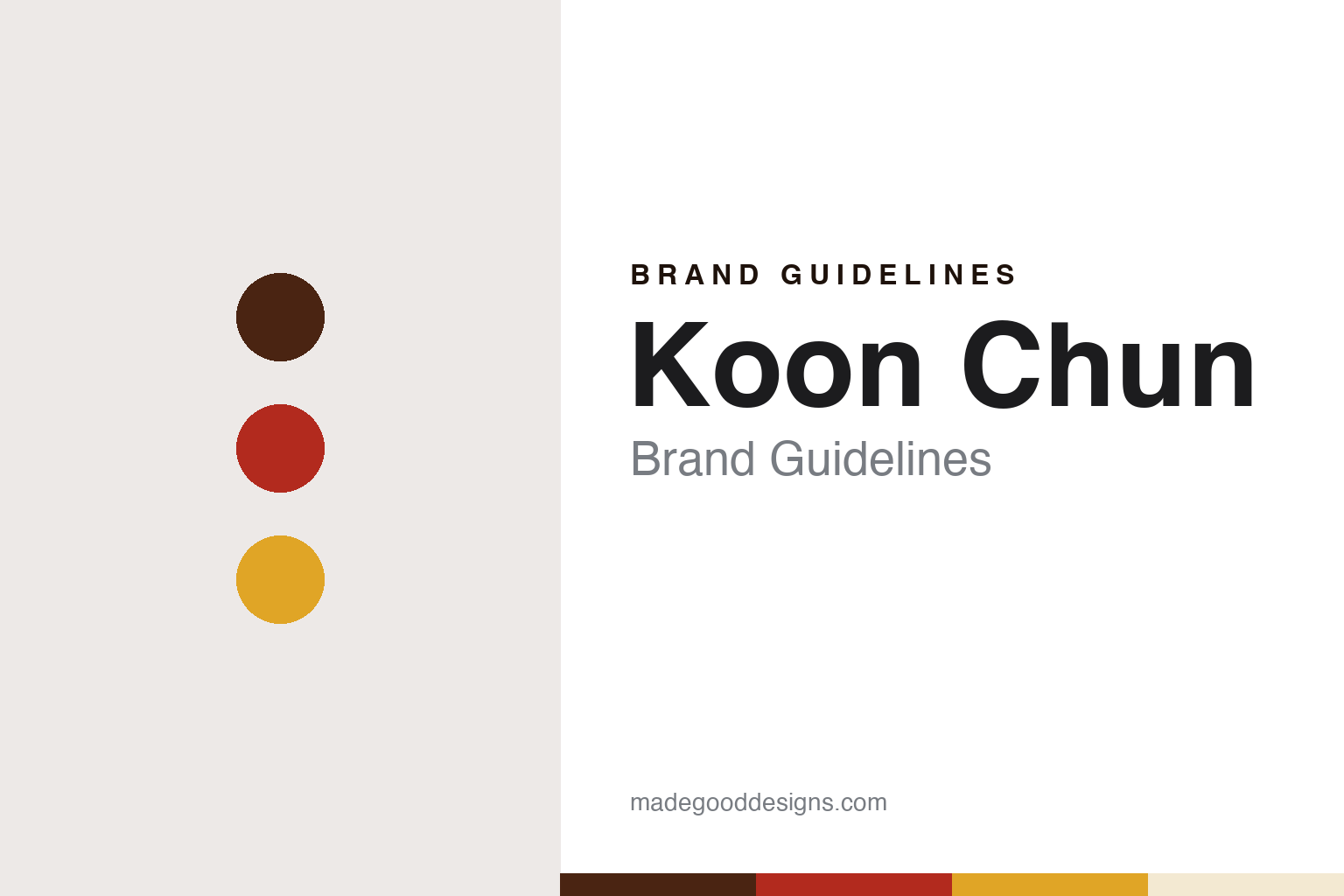
Two constants: a Koon Chun soy brown, chili red and sun gold palette and a sauce-label serif register. Abstract homage — not a Koon Chun product or mark; no bottle, jar, label or logo is reproduced.
Kowloon City, 1928
A sauce works on the main street, a war and a move to the New Territories.
Koon Chun is the brand of Koon Chun Hing Kee Soy & Sauce Factory (冠珍興記醬園), a Hong Kong maker of soy sauce and Cantonese condiments. Its everyday Chinese name, 冠珍醬園, ends in 醬園, literally a “sauce garden.” The company dates itself to 1928, and the Hong Kong Brand Development Council gives the same founding year in its profile of the brand.
According to the company’s own history, the sauce works began on 九龍大街, the main street of Kowloon City, in what was then the British colony of Hong Kong. During the Second World War its fermentation site was taken over, and the business moved to nearby Ta Tit Street (打鐵街) to keep brewing. After the war the government set about redeveloping Kowloon City, and in 1967 Koon Chun moved its factory to Yuen Long in the New Territories, at Au Tau, where it still makes its sauces today. The company also runs a flagship shop in Sheung Wan, on Hong Kong Island.
The business has stayed in the family across four generations. In December 2017 the Hong Kong Economic Times marked Koon Chun’s 90 years under a headline about the fourth generation’s push for renewal, about bringing its products back to Hong Kong, and about a packaging redesign meant to give the range a more contemporary feel. In June 2019 the Hong Kong radio station Metro Finance interviewed 陳天佑, introduced as the fourth-generation heir of Koon Chun, about the sauce works’ history and about how a local brand could hold its ground, and sell abroad, in the face of Hong Kong’s high labour and land costs.
Colour
Sun, Canadian soybeans and a first extract.
Koon Chun’s brand story rests on method, and the company spells it out. It says it uses only non-genetically-modified soybeans from Canada for its bean-based products, and that its soy sauces are fermented naturally under the sun for at least six months. It says every soy sauce it sells is a first extract, never a second or third draw from the same batch, and that it adds no monosodium glutamate, preservatives or chemicals to speed fermentation. After brewing, the company says, the sauces are pasteurised and packed on automated lines.
The English home page compresses this into a three-part line: “Made in Hong Kong, Fermented in the sun, First extract soy sauce.” The Chinese pages go further, promising 百分百香港製造, “100% made in Hong Kong,” at the company’s own works in Yuen Long. That “made here” claim is the company’s; the Yuen Long factory itself is the address the company and the Hong Kong Brand Development Council both give. The company even tells buyers how to judge the result: it says a naturally brewed soy sauce of its kind should look translucent and red-brown, cling to the inside of the bottle like red wine, and hold a fine layer of foam for several minutes after the bottle is shaken.
The range is broad. Koon Chun sells several grades of soy sauce, among them a premium, a double dark and a mushroom dark soy; bean-based sauces including hoisin, chee hou and ground bean sauce; and fruit and chili sauces, vinegars, oyster-flavoured sauce, sesame oil and lye water. It splits the catalogue into retail, food-service and industrial lines. The Hong Kong Brand Development Council lists its categories as soy sauce, convenience sauces, vinegar, oyster sauce and seasoning sauces.
Recognition has come from local schemes. In 2017 the council gave Koon Chun its Hong Kong Top Brand award, covering soy sauce and convenience sauces. The company also lists HACCP, ISO 22000:2018 and halal certification for the factory.
Typography
Design and documentation.
The seven brands in this group all make food, and all of them come from Hong Kong or Singapore: Garden, Kee Wah, Maxim’s, Bee Cheng Hiang, Koon Chun, Kowloon Dairy and Wing Wah. Food brands from the two cities in general sit at many different points in the trade, from family firms that still carry a founder’s name to names that now belong to much larger groups, and a single brand can be sold everywhere from a neighbourhood shop to an airport counter.
A food brand’s identity is usually carried less by a single product than by a pack, a name and the meal, gift or festival it promises, because the company behind the name may have changed hands, moved its kitchens or grown far beyond the street where it started. That makes the questions behind each name worth asking plainly: who started it, who owns it now, and where its food is actually made and packed.
Each guide separates what independent sources record from what the company says about itself — its founding story, its owners over time, where its food is made and how its packaging has changed — and marks plainly what rests only on the company’s own word.
Aa
A sturdy book serif for a sauce works that sells on method and age. (Specimen set in Noto Serif, a serif STAND-IN; NOT the Koon Chun logo or label lettering.)
Koon Chun
A chili sauce campaign that won at the Kam Fan Awards.
Koon Chun’s best-documented design moment is in advertising. At the 2013 Kam Fan Awards, Hong Kong’s advertising-industry prizes run by the Association of Accredited Advertising Agencies of Hong Kong, a print campaign for Koon Chun chili sauce by Leo Burnett Hong Kong won bronze awards in the food print categories, both for single executions and as a campaign, according to the results list the company publishes. The three executions, titled “Chicken,” “Fish” and “Lamb” and entered together as “Animal Tragedies,” also took a Best Work award for English copy, for “Fish,” and merits for copy and illustration. Chinese Wikipedia’s entry on the illustrator 何國威 also records a 2013 advertising award for Koon Chun work.
The packaging redesign, as the Hong Kong Economic Times headline put it in 2017, was part of the fourth generation’s renewal. Online, the company presents itself as Koon Chun Sauce Factory, gathering recipes, recipe videos and press coverage on its own blog, and its English and Chinese pages repeat the same points: the 1928 date, the Yuen Long works, the sun and the Canadian soybeans.
For a design guide, Koon Chun shows how a small family sauce works can make its method, its age and its Hong Kong address into the whole brand story. Compare Lee Kum Kee, the oyster-sauce house of 1888, and Amoy, the 1908 Xiamen soy sauce maker run from Hong Kong. For this guide we use soy brown, a chili red and a sun gold with a serif, an unofficial interpretation; no product or logo is reproduced.
Explore & save
Keep Koon Chun’s identity on hand — save it to a board in the Made Good inspiration library.
Koon Chun identity set
Pin the Koon Chun soy brown, chili red and sun gold palette and the sauce-label serif register to your own board.