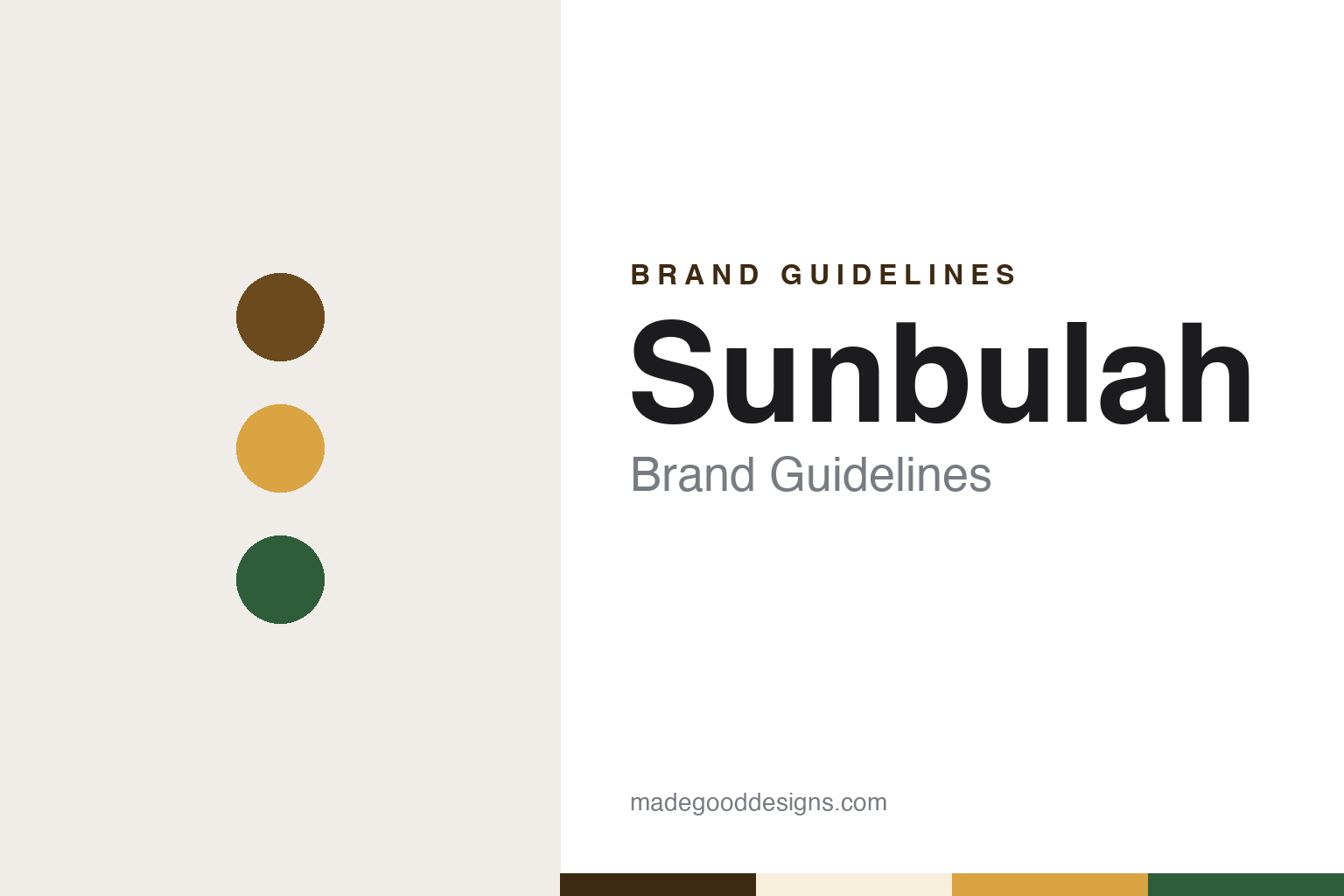
Sunbulah Brand Guidelines
The Jeddah pastry plant named for an ear of grain.
Aa
Two constants: a harvest brown, wheat gold and field green palette and a warm bookish serif register. Abstract homage — not a Sunbulah product or mark; no pack, logo or product is reproduced.
A pastry plant in Jeddah
Three friends, consultants and a shock freezer.
Sunbulah takes its name from the Arabic word for an ear of grain, the same word that, as as-Sunbulah, gave the bright star Spica its Arabic name. The company behind it, whose formal name is Food & Fine Pastries Al Sunbulah Manufacturing Co., is based in Jeddah, on Saudi Arabia’s Red Sea coast, and trades as Sunbulah Group.
Its own history dates the business to 1980. The company says its story can be traced back to that year and to a 6,000-square-metre start-up pastry plant, set up by three local Saudi friends who recruited experienced business and technical consultants to help them build what they saw as a world-class fine-foods and pastry manufacturer, the first of its kind in the country. Within two years, the company says, major construction had begun and machinery had been installed, including what it describes as the first shock freezer in the Middle East. A message from the chairman on its websites gives two dates: the company’s origin in 1980, and the start of its business activities in 1983. Arab News, in a 2022 profile of the chairman, also gave 1980 as the year the group was established.
Pastry came first, and it is still the core of the range. Sunbulah says it has offered pastry products since 1980 and today makes puff pastry dough in several sizes and flavours, samosa dough, konafa dough, spring-roll dough and baklava filo. Samosa leaves were added in 1988, the company says. A frozen convenience range followed, made up of ready-to-bake items such as pizza, filled samosas and spring rolls that the company says go from freezer to oven in twenty minutes or less.
Colour
Honey, meat, vegetables and four brands.
Sunbulah grew by adding categories. In 1988, its history says, the company bought a modern dry-ice plant and Al Shifa, a honey-bottling company, and expanded the honey business under its own management. Its first meat-production line was installed in 1992, and by 1993 it was making products in several separate categories. Exports followed in the mid-1990s to the other Gulf states, Jordan, Lebanon and Indonesia, with direct distribution of its own across Saudi Arabia. In 1998, the company says, it completed a “green line” warehouse and production plant for frozen vegetables, introduced French fries as a commercial product and became the leader in frozen pastries, a claim that is its own.
The 2000s brought systems and a brand department. Sunbulah says it set up its first marketing department in that decade, building brand images and identities and running seasonal media plans. In 2009 it added a bakery line to the pastry plant and acquired a meat plant, and in 2010 it opened its first group head office. It exhibited at SIAL in Paris and, from 2011, at Anuga in Cologne, and in 2014 it opened a branch office in Dubai.
The group now sells under four brands. Sunbulah carries the frozen range: pastry and dough, vegetables, fruit, ready meals, meat, chicken, seafood and a chilled cheese line of mozzarella, cheddar, labneh and feta. Al Shifa is its main honey brand, which the company says holds the quality mark of the Saudi Standards organisation and is sourced from regions including South America, Australia and the Alps; Sary is a value honey brand sold in plastic and glass for shops and caterers; and Walima is a value range of frozen vegetables, fruit, fries and cheese aimed at food service. The company says its brands are sold in 35 countries. Its current consumer site, in Arabic and English, leads with recipes from “the Sunbulah kitchen” and credits the agency Beyond Creation.
Typography
Design and documentation.
The seven brands in this group all make food and drink, and they come from the United Arab Emirates, Saudi Arabia and Oman: Al Kabeer, Sunbulah, Al Rawabi, Mazoon, Lacnor, Al Ain and Rani. Gulf food and drink brands in general sit at many different points in the trade, from family firms that still carry a founder’s name to names that now belong to much larger food groups, and a single brand can be sold everywhere from a corner grocery to a hypermarket aisle.
A food or drink brand’s identity is usually carried less by a single product than by a pack, a name and the meal or refreshment it promises, because the company behind the name may have changed hands, moved its factory or grown far beyond the town where it started. That makes the questions behind each name worth asking plainly: who started it, who owns it now, and where its products are actually made and packed.
Each guide separates what independent sources record from what the company says about itself — its founding story, its owners over time, where its products are made and how its packaging has changed — and marks plainly what rests only on the company’s own word.
Aa
A warm bookish serif for a brand named after an ear of grain. (Specimen set in Lora, a serif STAND-IN; NOT the Sunbulah logo.)
Sunbulah
A Jeddah group, still made in Jeddah.
Sunbulah’s manufacturing is concentrated in its home city. The company says its modern factories are located in Jeddah, where it lists its address in the industrial city, and that they operate to Saudi standards and ISO 22000 with a halal guarantee. The chairman’s message says the group now runs four factory complexes producing more than 250 products, with a capacity twenty times what it had at the start, and the company says it employs more than 1,000 people.
Its chairman is Samer Ibrahim Kurdi. Arab News reported in March 2022 that Kurdi had chaired the board since 2018; from September 1998 to December 2017 he had been a partner and vice-chairman of the group, and from 2000 to 2005 he also served as its marketing director. The same profile described Sunbulah as one of the largest food manufacturers in Saudi Arabia and the Middle East, the description the company uses for itself. Kurdi signs the chairman’s message on the group’s consumer website, which speaks of the brand as something that began as “a grain of wheat” and has lasted 40 years across 35 countries.
The same grain runs through the company’s values page, which lists sustainability, civility, community building, diversity, excellence, strength and trustworthiness, and creativity. Under community building it says the group’s people “rejoice as the fruits of our labor are multiplied,” and under diversity it speaks of reaping “the fruits of unions formed from diversity.”
For a design guide, Sunbulah shows how a factory brand can borrow its whole identity from one word, an ear of grain, and carry it from pastry dough to honey. Compare Al Kabeer, the UAE-rooted frozen-food maker, and Americana, the Kuwaiti food maker behind Koki. For this guide we use a harvest brown, a wheat gold and a field green with a serif, an unofficial interpretation; no product or logo is reproduced.
Explore & save
Keep Sunbulah’s identity on hand — save it to a board in the Made Good inspiration library.
Sunbulah identity set
Pin the Sunbulah harvest brown, wheat gold and field green palette and the warm bookish serif register to your own board.