Americana Brand Guidelines
The Kuwaiti food maker that went regional.
Aa
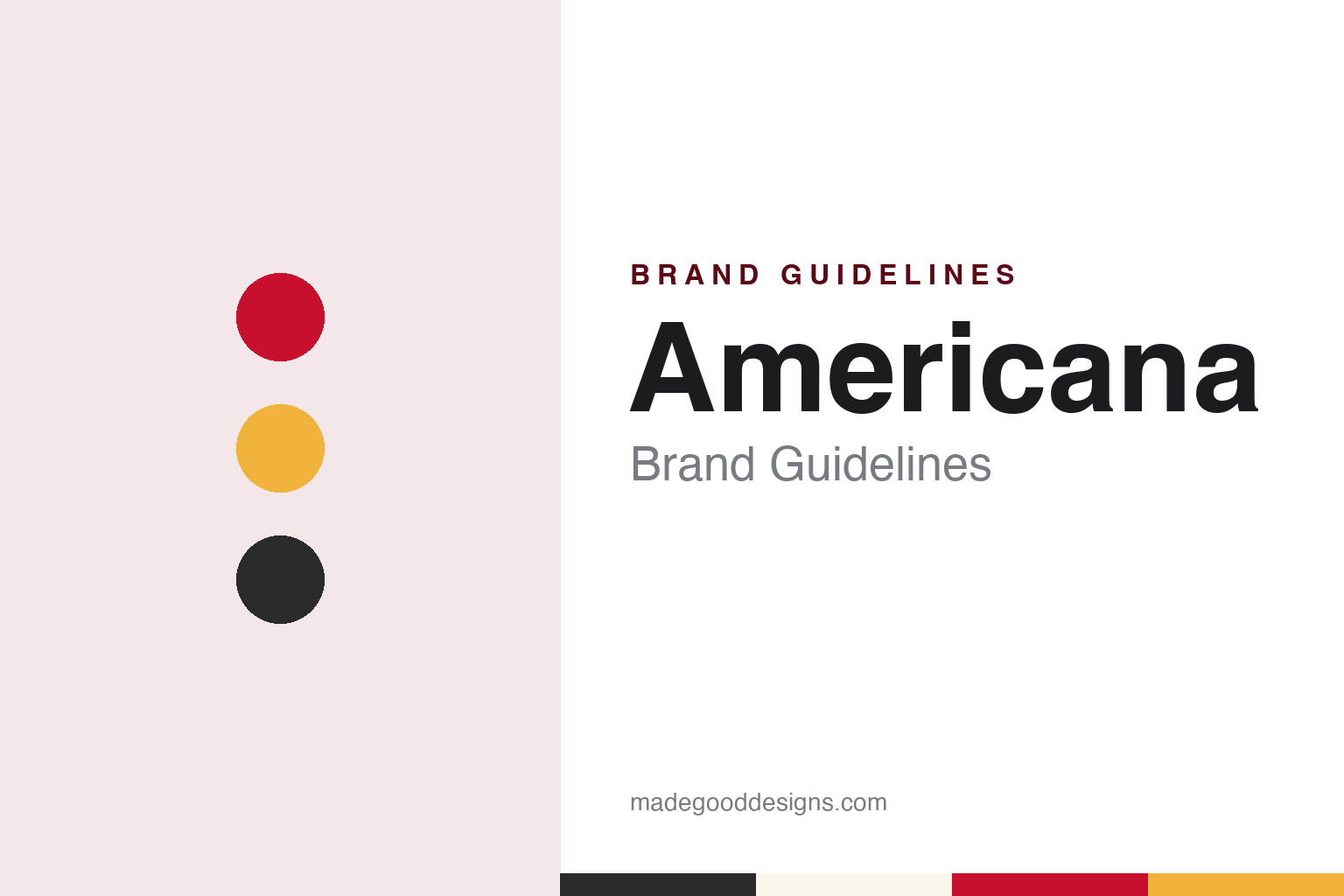
Two constants: an Americana red, golden fry and charcoal palette and a bold grotesque sans register. Abstract homage — not an Americana product or mark; no pack, logo or product is reproduced.
Kuwait, 1964
A Kuwaiti company, a Wimpy bar and a burger plant.
Americana began in Kuwait in 1964, the year given by the company and by both English and Arabic Wikipedia. For most of its life its formal name was the Kuwait Food Company, trading as Americana, as Elaph and Al Arabiya both describe it. Al Arabiya reported in 2018 that it became a public shareholding company in 1969 and that its shares were listed on the Kuwait Stock Exchange from 1984.
Restaurants are the best-known part of its early story. English Wikipedia, citing a 2013 book published by Emerald, says Americana opened a Wimpy hamburger restaurant in Kuwait in 1970, and over the following decades the group became the regional franchisee for international chains including KFC, Pizza Hut, Hardee’s, Costa Coffee and Baskin Robbins, Arabic Wikipedia says. Food manufacturing grew alongside the restaurants. The company’s own timeline says its first processing plant opened in Kuwait in 1972, making frozen beef burgers and minced meat, and English Wikipedia, citing Bloomberg, says that during the 1970s Americana Meat products such as chicken nuggets, hamburgers and chicken fillets went on sale.
From there, the company says, its factories spread across the region. It lists a poultry operation in Egypt in 1977; a bakery in Kuwait for croissants and other baked goods in 1985; a French fries plant in Egypt set up in 1988 as a joint venture with Farm Frites International; a canned-food plant in the UAE in 1989; and a cakes-and-cookies plant in Saudi Arabia in 1991. Farm Frites remains one of the brand names in the company’s portfolio today.
Colour
Koki, frozen vegetables and 19 sites.
Alongside its own name, the brand most closely tied to Americana’s factories is Koki, which the company says it launched in 1992, the year it opened a protein-processing plant in Egypt. Its timeline then records a move into agribusiness in 2004, with frozen fruit and vegetable processing in Egypt and a second protein factory in Saudi Arabia; a snacks factory in Egypt in 2007; and the acquisition of a third protein factory, in the UAE, in 2017.
Today the food business presents itself as Americana Foods, with its head office in Dubai. On its website it calls itself one of the largest fast-moving consumer-goods companies in the Middle East and North Africa and says it runs 19 production sites across the UAE, Saudi Arabia, Kuwait and Egypt, with products sold in more than 50 countries and territories. The company says it has its own direct distribution network in seven Gulf and North African markets: the UAE, Saudi Arabia, Kuwait, Egypt, Qatar, Bahrain and Oman. Its categories, as the company lists them, run from frozen and chilled protein products to frozen fruit and vegetables, French fries and pastry, canned food and sweet snacks, and its brand names include Americana, Koki, Farm Frites and Americana Bakery.
The company says it is still building. In 2023 it set up the Alinea Distribution Company to handle route-to-market in the UAE, and in 2024, it says, it began a greenfield French fries plant in Riyadh, with completion targeted for the first quarter of 2026.
Typography
Design and documentation.
The seven brands in this group all make food, and they come from Saudi Arabia, Kuwait, Lebanon, the United States and Turkey: Almarai, Americana, Al Wadi Al Akhdar, Cortas, Ziyad, Tamek and Eti. Middle Eastern and Turkish food brands in general sit at many different points in the trade, from family firms that still carry a founder’s name to names that now belong to much larger food groups, and a single brand can be sold everywhere from a neighbourhood grocer to a supermarket shelf abroad.
A food brand’s identity is usually carried less by a single product than by a pack, a name and the meal or snack it promises, because the company behind the name may have changed hands, moved its factory or grown far beyond the town where it started. That makes the questions behind each name worth asking plainly: who started it, who owns it now, and where its food is actually made and packed.
Each guide separates what independent sources record from what the company says about itself — its founding story, its owners over time, where its products are made and how its packaging has changed — and marks plainly what rests only on the company’s own word.
Aa
A bold grotesque sans for a Kuwaiti food maker with an American-sounding name. (Specimen set in Archivo, a sans STAND-IN; NOT the Americana logo.)
Americana
From a Kuwaiti family holding to Adeptio.
For decades Americana was controlled from Kuwait. Arabic Wikipedia says its largest shareholder before 2016 was Al-Khair National Company for Stocks and Real Estate, wholly owned by the Kharafi group, with 58.69% of the shares. In 2016 that controlling stake was sold to Adeptio, an investment company led by the Emirati businessman Mohamed Alabbar. The news site Elaph, reporting the transfer in October 2016, put the stake changing hands at 66.8%; Al Arabiya, looking back in 2018, described it as 67% and dated the purchase to November 2016. Elaph reported that the shares changed hands in an auction on the Kuwait bourse, one of the largest there in recent years, and headlined the deal as Americana taking “Emirati nationality.”
Saudi Arabia’s sovereign wealth fund, the Public Investment Fund, holds 50% of Adeptio alongside investors led by Alabbar, Al Arabiya reported. Adeptio later raised its holding to 93%, and on 23 April 2018 Americana voluntarily left the Kuwait bourse after 34 years of trading, Al Arabiya reported that day.
The next stock-market listing was for the restaurant business. Americana Restaurants International PLC, based in Sharjah, listed on the Abu Dhabi Securities Exchange on 11 December 2022 and on Tadawul on 12 December 2022, Arabic Wikipedia says, citing Asharq Business with Bloomberg; Arabian Business reported in September 2022 that the Public Investment Fund held 50% of that company. The food-manufacturing side presents itself separately, as Americana Foods, from Dubai.
For a design guide, Americana shows how one name, born in Kuwait in 1964, can stretch from a Wimpy bar and a burger plant to frozen vegetables, fries and canned food made in four countries. Compare McCain, the New Brunswick fries maker, and Birds Eye, the frozen-food name. For this guide we use an Americana red, a golden fry and a charcoal with a bold grotesque sans, an unofficial interpretation; no product or logo is reproduced.
Explore & save
Keep Americana’s identity on hand — save it to a board in the Made Good inspiration library.
Americana identity set
Pin the Americana red, golden fry and charcoal palette and the bold grotesque sans register to your own board.