Cortas Brand Guidelines
The Brummana jam maker behind Lebanon’s flower waters.
Aa
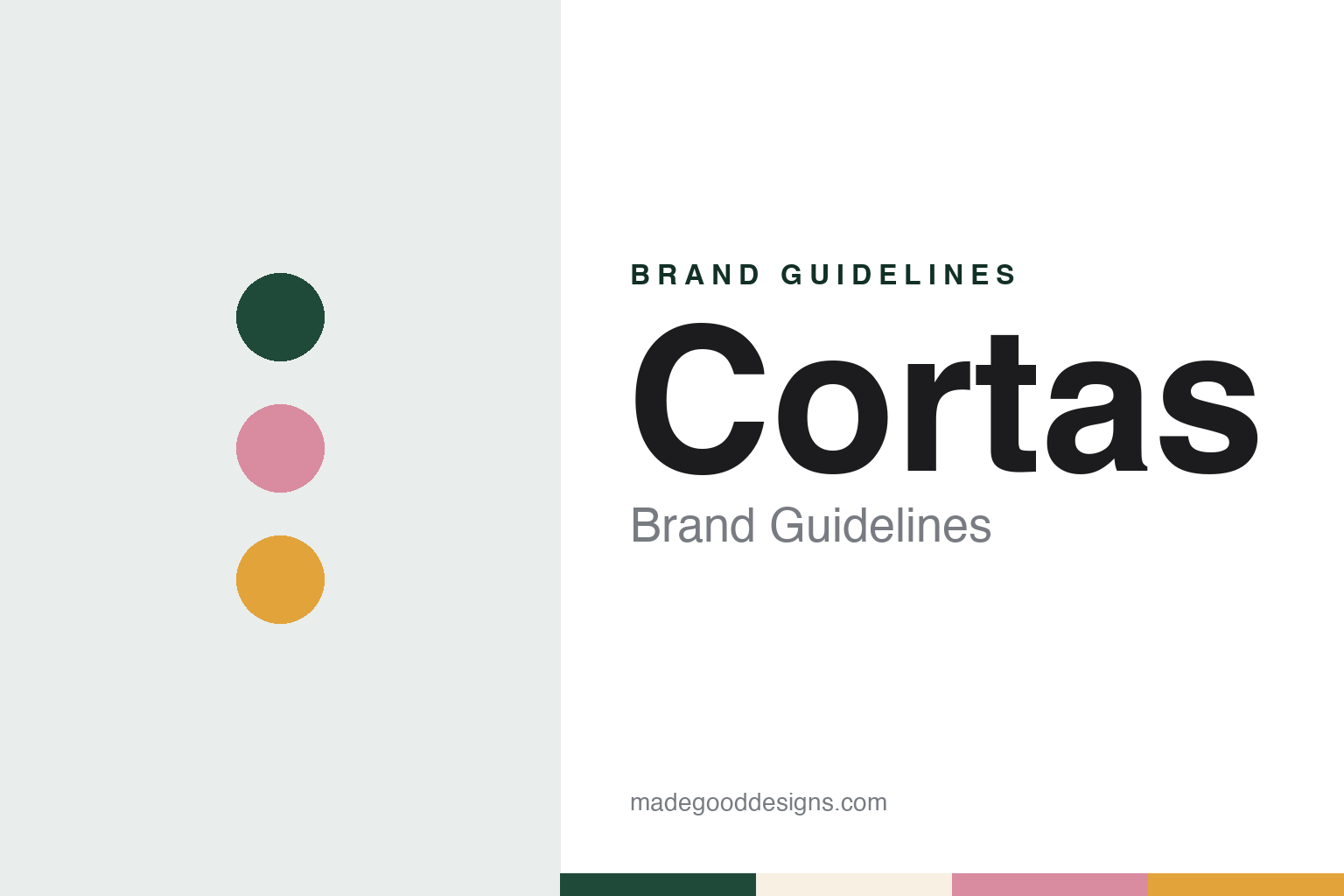
Two constants: a cedar green, rose pink and orange-blossom gold palette and a warm book serif register. Abstract homage — not a Cortas product or mark; no bottle, jar, label or logo is reproduced.
Apricot jam in Brummana
A mother’s jam, a university graduate and a Dublin apprenticeship.
Cortas began with a jar of jam. The company says its story starts in Brummana, a town in the pine-forested hills of Mount Lebanon, and its current website dates that beginning to 1925, though the same site’s header carries the line “Since 1930.” What began the business, it says, was an apricot jam that became a local sensation. The company’s earlier website, archived in 2017, told the story in more detail. It says that Emile Cortas, a graduate of the American University of Beirut who had gone to work in the university’s alumni office, was given a couple of jars of his mother’s home-made apricot jam to pass on to a professor and friend. The professor was so impressed that he advised Emile to go into business. That summer mother and son preserved the apricot crop together and packed it for friends and prospective customers. The experiment brought in orders, and Emile left his university post to build a factory of his own.
The same company history says that in 1926 Emile served an apprenticeship in Dublin with the Lamb family, jam makers and old friends of the Cortas family. Back in Lebanon he imported the first of many machines from Britain and started the Cortas Canning Company. A few years later his younger brother Michel Cortas, who held a chemistry degree from the American University of Beirut, joined him. Emile ran the business affairs while Michel took over production in the factory. As the firm grew it became known as Cortas Bros. and began distributing its products in Lebanon, Syria and Palestine, the company says, while the range widened beyond jam to tomato paste, vegetables and fruit-based syrups.
The family name also appears in the history of Lebanese letters. English Wikipedia’s article on the educator and writer Wadad Makdisi Cortas (1909–1979) says she married Emile Cortas, a businessman from Brummana who founded the canning company that bears the family name.
Colour
Marmalade for an army, a tin factory and flower waters.
The Second World War brought the company its largest customer. According to its 2017 history, Cortas had earned such a reputation that the British Army commissioned Cortas Bros. to supply marmalade to British troops stationed in the region, and the factory put its workers on a three-shift schedule to meet demand. In the years after the war the product line grew again, and Cortas opened a tin factory so that it could make its own cans rather than buy them in, the company says.
The products that carry the name abroad today are rooted in the Lebanese pantry rather than in British jam-making. The current Cortas range, as listed on its website, runs to eleven categories: flower waters, molasses, tahini and halva, beans and dips, jams, canned vegetables, olives and olive oil, pickles, syrups, ready-to-eat dishes and easy mixes. The flower waters are distilled from rose petals and orange blossoms, and the company says that in its fully automated factory this distillation, like the mechanical decortication of sesame seeds for its tahini, is carried out without the use of chemicals.
Cortas presents quality control as something that extends to the design of its buildings and equipment. Its stated principles are to maintain the grade of its products, to comply with national and international food regulations and to minimise the possibility of spoilage. The company says Cortas Canning and Refrigerating Company is certified to the ISO 22000:2005 food-safety management standard for the production of tahini and halva. On its website it describes Cortas as having become “a vital necessity for the Lebanese diaspora and other diverse communities,” and says it has reimagined and reintroduced recipes for that audience, with the stated purpose of helping people “find goodness through food.”
Typography
Design and documentation.
The seven brands in this group all make food, and they come from Saudi Arabia, Kuwait, Lebanon, the United States and Turkey: Almarai, Americana, Al Wadi Al Akhdar, Cortas, Ziyad, Tamek and Eti. Middle Eastern and Turkish food brands in general sit at many different points in the trade, from family firms that still carry a founder’s name to names that now belong to much larger food groups, and a single brand can be sold everywhere from a neighbourhood grocer to a supermarket shelf abroad.
A food brand’s identity is usually carried less by a single product than by a pack, a name and the meal or snack it promises, because the company behind the name may have changed hands, moved its factory or grown far beyond the town where it started. That makes the questions behind each name worth asking plainly: who started it, who owns it now, and where its food is actually made and packed.
Each guide separates what independent sources record from what the company says about itself — its founding story, its owners over time, where its products are made and how its packaging has changed — and marks plainly what rests only on the company’s own word.
Aa
A warm book serif for a century-old family jam maker. (Specimen set in Lora, a serif STAND-IN; NOT the Cortas logo.)
Cortas
Wars, a new management and a board of shareholders.
Conflict has tested the business more than once. The company’s 2017 history says that over a fifteen-year period civil strife badly damaged both Lebanon’s economy and the Cortas factory. Its current website names the Second World War and the Lebanese civil war as the hardest of the difficult events it came through, and says that, true to its Lebanese identity, Cortas “rose like the Phoenix from the ashes.”
The 1970s brought the first change of management, according to the company. Emile Cortas, by then in his seventies, became chairman, and the long-serving sales manager Fadlo Khauli became general manager. Khauli set out to open new markets in the United States, Canada and Australia, where many Lebanese displaced by war had emigrated. By 2017 the company described itself as a publicly held company with a board of directors and regional shareholders. It said then that Emile’s son Ramzi Cortas, who had been sales and marketing manager for Cortas in the United States since 1997, was elected chairman of the board in November 2005 and took on the role of general manager as well in 2006.
Today the business trades as Cortas Canning & Refrigerating Company sal. Its website gives its base as the Cortas Building in Hosrayel, Lebanon, far from the Brummana hills where the story began, and lists a separate North America sales division alongside its export sales team.
For a design guide, Cortas shows how a family jam born in the hills above Beirut can grow into a pantry of flower waters, molasses and tahini that travels with a diaspora. Compare Al Wadi Al Akhdar, the Lebanese pantry brand launched in 1979, and Soom, the American tahini brand. For this guide we use a cedar green, a rose pink and an orange-blossom gold with a serif, an unofficial interpretation; no product or logo is reproduced.
Explore & save
Keep Cortas’s identity on hand — save it to a board in the Made Good inspiration library.
Cortas identity set
Pin the Cortas cedar green, rose pink and orange-blossom gold palette and the warm book serif register to your own board.