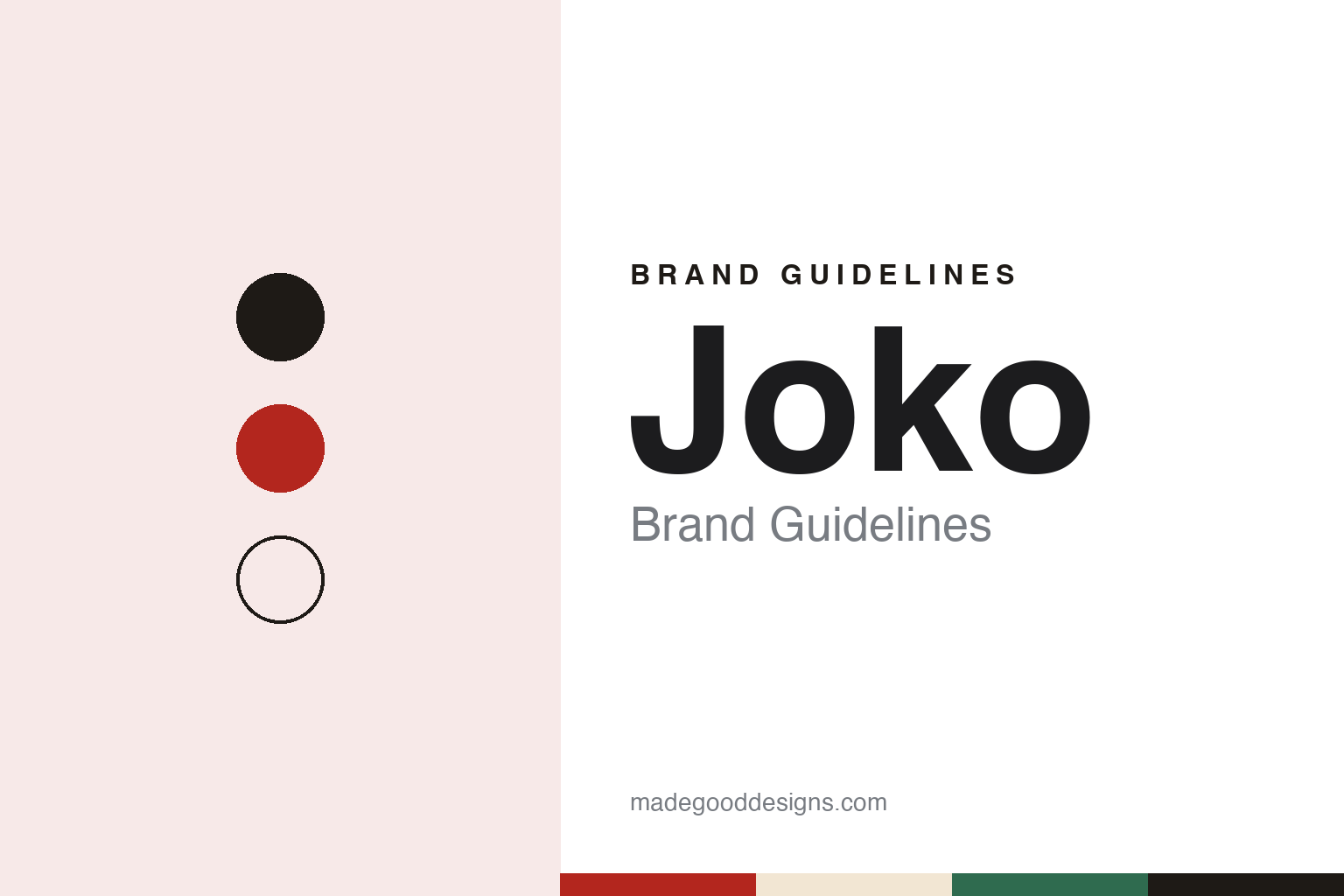
Joko Brand Guidelines
The Durban tea that starred in South Africa’s first sound advertisements.
Aa
Two constants: a red, black and leaf green palette and a sturdy grotesque register. Abstract homage — not a Joko product or mark; no pack, logo or label is reproduced.
Tea on the soundtrack
A tea brand at the start of the talkies.
Joko is a South African tea brand with an unusual claim to history: it was one of the first products in the country to be advertised on film with sound. The studio behind those films was African Film Productions, the company set up by the Johannesburg entertainment magnate I.W. Schlesinger, whose Killarney Film Studios, established in Johannesburg in 1915, is described as the first motion-picture studio in Africa. Schlesinger, a New Yorker, had arrived in South Africa in 1894 after reading about the gold discoveries on the Witwatersrand, English Wikipedia says. African Film Productions had produced the weekly newsreel African Mirror since 1913, and made feature films, documentaries and industrial-safety films as well; it made 43 films between 1916 and 1922 alone.
According to the timeline of South African film published by South African History Online, African Film Productions “made the first sound advertisement films in South Africa for Joko Tea and Pegasus products.” The two sources differ on the year: the current timeline places the films in 1931, while English Wikipedia’s article on Killarney Film Studios, citing an earlier version of the same timeline, gives 1930. Either way, Joko was already being advertised, on film and with sound, by the start of the 1930s.
The same timeline sets those advertisements in a busy moment for South African cinema. In 1931 Parliament passed a National Censorship Act, followed by an Entertainment Act that required all cinematic material to be cleared before it was shown, and the first film society was formed in Cape Town. African Film Productions’ own 1930 output included In the Land of the Zulus, described as the first sound film of Black traditional life.
Colour
A Durban tea, and the people who made it.
Joko was made in Durban. The clearest record of that comes from the biography of Johannes Phungula, a former member of South Africa’s Parliament. According to a National Assembly motion of 18 August 2009, and English Wikipedia’s account drawn from it, Phungula joined the African National Congress in 1952, at the height of the Defiance Campaign, which he joined as a volunteer while working at Joko Tea in Durban. He became a union organiser at his workplace, before the ANC sent him back to his home district near Ixopo in 1959.
That detail places the brand’s production in the port city in the 1950s, and it ties a household tea to one of the defining political campaigns of the apartheid years. AVI, which owns the rival Five Roses brand, also lists a tea factory in Durban in its 2024 annual report.
Television kept the brand in view in later decades. English Wikipedia’s biography of the actor Bongo Mbutuma says that in the late 2000s, around his leading role in the SABC1 drama Divers Down, he appeared in several television commercials for Joko Tea, alongside work for Momentum, BP and Nedbank.
Brooke Bond, now a sister brand of Joko, the British tea founded by Arthur Brooke in Manchester in 1869, had its own South African history: English Wikipedia records that three series of its collectable picture cards were issued in South Africa between 1965 and 1967.
Typography
South African food and drink.
The seven brands in this group are all food and drink brands, and all of them come from South Africa: Mrs Ball’s, Ouma, Jungle Oats, All Gold, Five Roses, Joko and Iwisa. South African food and drink brands in general sit at many different points in the trade, from names that still carry a founder’s or a family’s story to names that now belong to much larger food groups, and a single brand can be sold everywhere from a corner shop to a supermarket shelf.
A food or drink brand’s identity is usually carried less by a single product than by a pack, a name and the meal or cup it promises, because the company behind the name may have changed hands, moved its factory or grown far beyond the town where it started. That makes the questions behind each name worth asking plainly: who started it, who owns it now, and where its products are actually made and packed.
Each guide separates what independent sources record from what the company says about itself — its founding story, its owners over time, where its products are made and how its packaging has changed — and marks plainly what rests only on the company’s own word.
Aa
A sturdy grotesque — the register of a mainstream everyday tea. (Specimen set in Archivo, a sans STAND-IN; NOT the Joko logo.)
Joko
From Unilever to Lipton Teas and Infusions.
Today Joko belongs to Lipton Teas and Infusions, which English Wikipedia describes as the world’s largest tea company; its list of that company’s brands includes Joko alongside Lipton, PG Tips, Brooke Bond, Bushells, Pukka, T2 and TAZO, and as of October 2026 the joko.co.za web address forwards to the Lipton Teas and Infusions website.
That company was carved out of Unilever, whose own tea story goes back to Sir Thomas Lipton, who opened a grocery business in Britain in 1871; Unilever bought the Lipton tea business in a series of transactions between 1938 and 1972, English Wikipedia says. Unilever grouped most of its tea holdings into a separate division called Ekaterra in 2020; in November 2021 the private-equity firm CVC Capital Partners agreed to buy it, the Financial Times and The Grocer reported, and the sale was completed in July 2022, after which the business was renamed Lipton Teas and Infusions. It is headquartered in Amsterdam. Unilever kept the use of the tea brands in India, Nepal and Indonesia, and its ready-to-drink Lipton Iced Tea joint venture with PepsiCo.
Under its new owner the company has reshaped its supply side. In February 2024 it launched the Lipton Tea Innovation & Technology Academy with the Government of Kenya and the University of Kabianga, and in May 2024 it agreed to sell its tea estates in Kenya, Tanzania and Rwanda to Sri Lanka’s Browns Investments, Business Daily reported.
For a design guide, Joko shows how a local brand can keep its own name for nearly a century while its owners change around it, and how early it learned to advertise in the newest medium available. Compare Five Roses, its long-standing South African rival, and All Gold, another South African pantry staple. For this guide we use red, black and a leaf green with a sans, an unofficial interpretation; no product or logo is reproduced.
Explore & save
Keep Joko’s identity on hand — save it to a board in the Made Good inspiration library.
Joko identity set
Pin the Joko red, black and leaf green palette and the sturdy grotesque register to your own board.