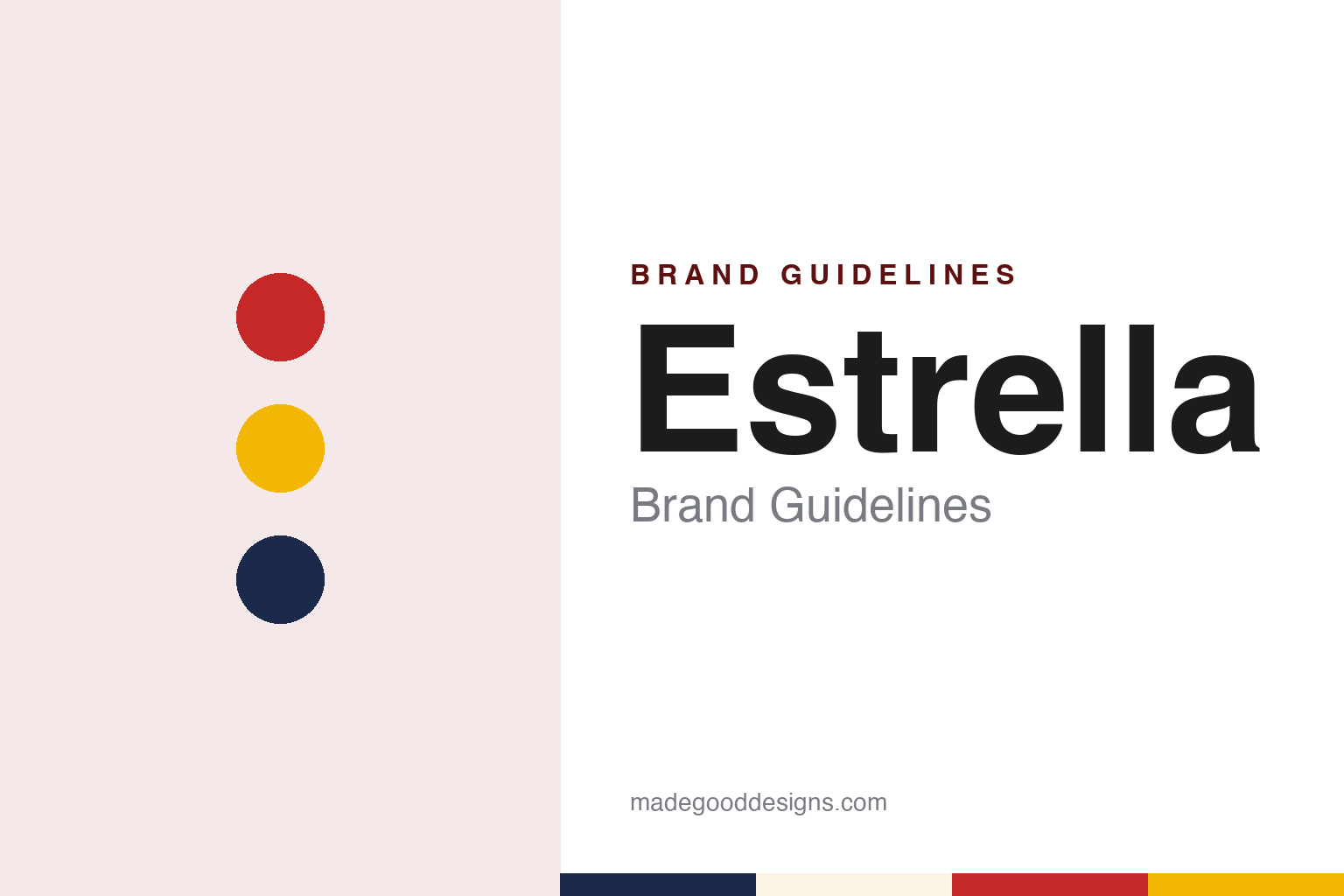
Estrella Brand Guidelines
The Swedish crisp maker named for a Spanish star.
Aa
Two constants: a star yellow, crisp red and night navy palette and a bold geometric sans register. Abstract homage — not an Estrella product or mark; no pack, logo or snack is reproduced.
A star from the banana trade
A banana importer, a trip to New York and a factory in Alingsås.
Estrella is a Swedish snack brand, not to be confused with the Spanish beers that share the word. Swedish Wikipedia says the name was registered in 1946 by Folke Andersson, who at the time owned banana plantations in South America; the company itself says he founded the brand that year to import bananas, and that the name grew out of that trade. Estrella is Spanish for “star,” and Swedish Wikipedia notes that a star appears in the logo. In Sweden the name is said as it is spelt, with an “l” sound, rather than the Spanish “y.”
The first Estrella business was not crisps. Swedish Wikipedia says the brand began by selling popcorn from carts in western Sweden. The turn came in 1957: after a visit to New York — at a boxing match, the company says — Andersson tasted potato crisps and decided to make them at home. Production started the same year in Alingsås, north-east of Gothenburg. At first only crisps and popcorn were made in Sweden, Swedish Wikipedia says, while the rest of the range was imported.
The company describes Estrella as Sweden’s first crisp maker. In 1964 production moved to Kortedala, a district of Gothenburg, and in 1965 the chocolate company Marabou bought the business from Andersson.
Colour
A famous flavour, a new factory and new markets.
Under Marabou the business grew. Swedish Wikipedia dates the opening of a new factory in Angered, on the north-eastern edge of Gothenburg, to 1983, and that site is still where Estrella is made and run: the company gives Angered as the home of both its factory and its head office. The range there today, the company says, covers crisps, cheese snacks, popcorn, nuts and dip mixes; Swedish Wikipedia’s list also includes ostbågar, the curved cheese puffs, and peanut rings.
The best-known flavour arrived in 1988, when Swedish Wikipedia says Estrella launched Sourcream & Onion crisps. The company says it pioneered the flavour in Sweden and calls it the Swedes’ favourite crisp; it also says it was the first in the country to sell ready-popped popcorn.
The brand also travelled. Swedish Wikipedia says Estrella was launched in Finland in 1987 and in Denmark in 1990, and that it later appeared in other markets, including Iceland, the Baltic states, Ukraine and Russia, under different owners in different countries.
The ownership chain followed the wider consolidation of Nordic confectionery. Marabou came under Kraft Foods, and Swedish Wikipedia says AB Estrella became a Kraft subsidiary before being merged, a little over a decade later, into Kraft Foods Sverige, the former Kraft Freia Marabou.
Typography
Design and documentation.
The seven brands in this group are all Nordic food and dairy names: Kalles Kaviar, Felix, Estrella, Valio, Arla, Stabburet and Nidar. Nordic food brands in general sit at many different points in the trade, from names that still carry a founder’s story to brands that now belong to much larger food groups or farmer-owned co-operatives, and a single brand can be sold everywhere from a corner shop to a supermarket shelf.
A food brand’s identity is usually carried less by a single product than by a pack, a name and the meal or snack it promises, because the company behind the name may have changed hands, moved its factory or grown far beyond the town where it started. That makes the questions behind each name worth asking plainly: who started it, who owns it now, and where its food is actually made and packed.
Each guide separates what independent sources record from what the company says about itself — its founding story, its owners over time, where its products are made and how its packaging has changed — and marks plainly what rests only on the company’s own word.
Aa
A bold geometric sans for a brand named after a star. (Specimen set in Poppins, a sans STAND-IN; NOT the Estrella logo.)
Estrella
From Kraft to private equity to Intersnack.
In 2008 Estrella left the Kraft group. Swedish Wikipedia says the Norwegian fund Herkules Private Equity Fund bought Kraft Foods’ crisp business that year, a package that brought together Estrella in Sweden, Maarud in Norway and Taffel crisps in Finland and Lithuania. The Swedish company, Estrella AB, and the brand became part of a holding company, Estrella Maarud Holding AS.
The next and current owner arrived in 2014. Swedish Wikipedia says that the German snack group Intersnack bought Estrella Maarud from Herkules that year, and the company itself says Estrella has been part of Intersnack Group since 2014. Estrella describes Intersnack as a German family business founded in 1870 and says the Angered plant houses what the group calls its “Potato Chips House of Excellence.” The company says around 200 people from about 20 countries work there.
Read together, the dates give Estrella an unusually clear outline. The brand name is older than the crisps by eleven years and comes from the banana trade; the crisps themselves begin with one man’s trip to New York in 1957; and production moved from Alingsås to Kortedala in 1964 and then to Angered, where a new factory opened in 1983. Above the factory, the owners changed from the founder to a chocolate maker in 1965, then to Kraft, to a private-equity fund in 2008 and to a family-owned snack group in 2014. The name, Spanish for “star,” stayed the same throughout.
The flavour story is just as compact. Swedish Wikipedia dates Sourcream & Onion to 1988, and the company calls it the Swedes’ favourite crisp. The range the company describes today is broad — crisps, cheese snacks, popcorn, nuts and dip mixes — and its own account of its history begins with Andersson’s first taste of crisps in New York and ends with the plant in Angered, where the group’s potato-crisp expertise is now concentrated, the company says.
For a design guide, Estrella shows how a single foreign word and a simple symbol can carry a brand through six decades and five owners. Compare Marabou, the Swedish chocolate maker that owned Estrella from 1965, and Kalles Kaviar, another Swedish pantry brand from the west coast. For this guide we use star yellow, crisp red and night navy with a bold geometric sans, an unofficial interpretation; no product or logo is reproduced.
Explore & save
Keep Estrella’s identity on hand — save it to a board in the Made Good inspiration library.
Estrella identity set
Pin the Estrella star yellow, crisp red and night navy palette and the bold geometric sans register to your own board.