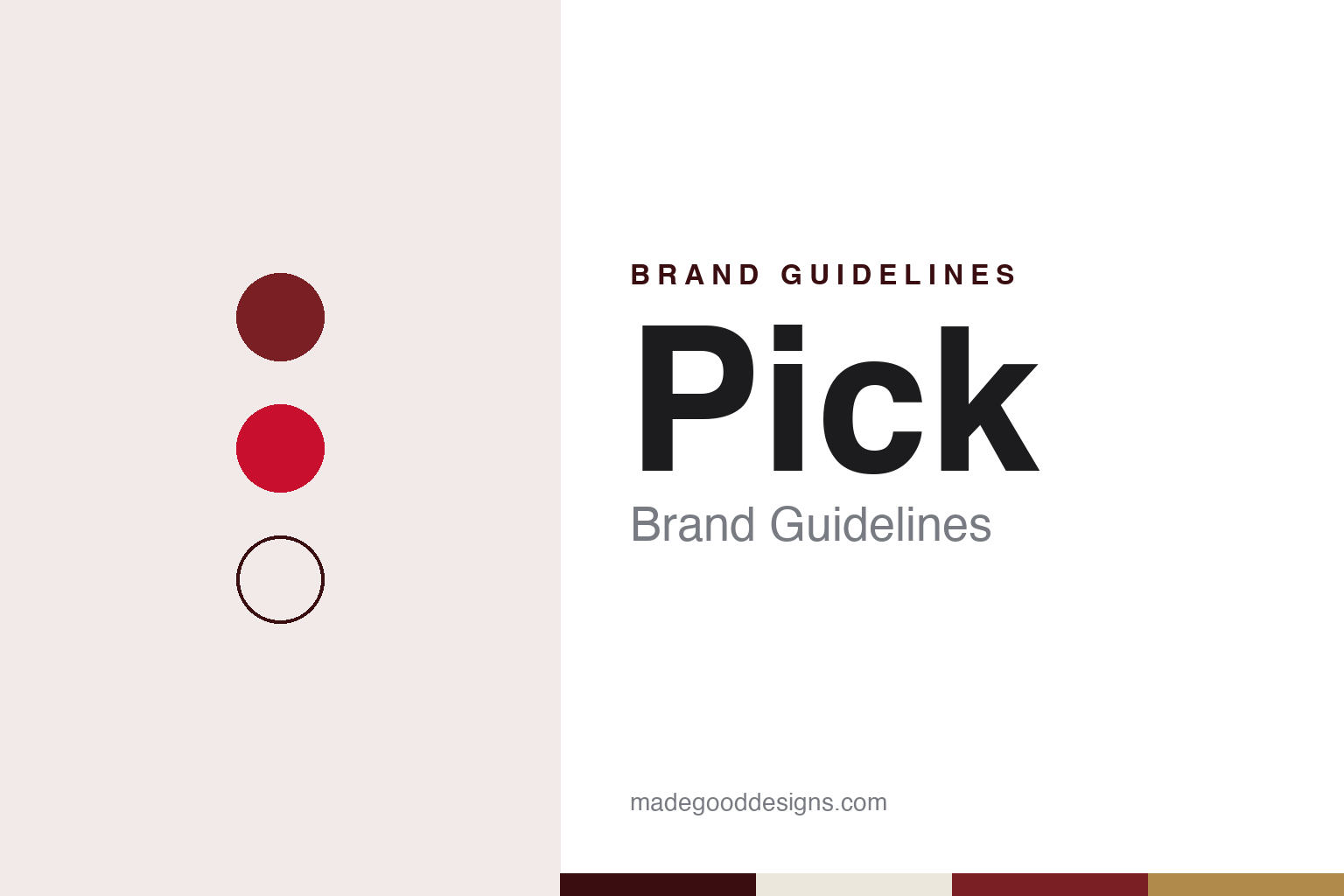
Pick Brand Guidelines
Márk Pick’s Szeged winter salami since 1869.
Aa
Two constants: a salami red, paprika red and mould white palette and a classic serif register. Abstract homage — not a Pick product or mark; no pack, logo or product is reproduced.
A produce trader on the Tisza
Winter batches, Italian workers and cool river air.
Pick began with a trader rather than a butcher’s shop. In 1869, the company says, Márk Pick, a produce trader, registered a “produce commission business” in the free royal city of Szeged, on the Tisza river in southern Hungary. Like other produce and paprika traders in the town, he made salami in winter, in batches of a few hundred kilograms. Hungarian Wikipedia, citing the history published by the Bonafarm Group, says that in 1883 he set up a separate salami manufactory staffed with skilled workers from Italy, and the company says its recipe was developed from Italian traditions. Tablet Magazine reported in 2014 that Pick was Jewish, and English Wikipedia describes him as of Jewish origin.
Hungarian Wikipedia says the early salami was stuffed into horse-gut casings, later replaced by cellulose, and that what set it apart was a fine spice blend and a coat of noble mould, brushed smooth by hand. From 1892 his wife took part in running the firm, and from 1906 so did his eldest son, Jenő Pick, who ran it alone from 1934.
Around 1900, the company says, the factory moved to the Upper Tisza bank, between Zsótér and Maros streets, on land the family bought in instalments; the cool air off the river suited the slow ripening of salami. That year its salami won a bronze medal at the Paris World Exposition, and in 1935 its products received a certificate of recognition at the Brussels World Exposition. Salami had been a winter product because the ripening needed cold weather. In October 1939, the company says, Jenő Pick announced that after years of experiment he could make salami in summer as well.
Colour
Nationalisation, a Brussels prize and a ripening tower.
The factory survived the Second World War, but not the family’s ownership. Hungarian Wikipedia says that in March 1948 the company was nationalised, Jenő Pick was interned and a workers’ director was appointed. The state enterprise moved from hand production to industrial scale, and by the mid-1950s it employed more than 400 people. In 1958, Hungarian Wikipedia says, its winter salami won a grand prize at the Brussels World’s Fair.
Export demand drove a long modernisation. Between 1959 and 1965, according to Hungarian Wikipedia, the factory installed a Krämer-Grebe production line that filled the meat straight into casings and ripened it in climate-controlled rooms, ending a century-old practice of kneading and ripening the mixture in troughs. A tower fitted with a climate system allowed ripening all year round regardless of the weather. Two-thirds of the winter salami went abroad.
The largest building came next. From 1972 a new salami factory was built on the edge of Szeged, on the site of the old slaughterhouse, with a laboratory and an office block. Its centrepiece was a salami-ripening tower that Hungarian Wikipedia gives as 63 metres high, completed in 1976, and the company as 64 metres; either way it was the tallest industrial structure in the city. From 1977, Hungarian Wikipedia says, the company produced more than 10,000 tonnes of salami a year.
Typography
Design and documentation.
The seven brands in this group all make food or drink, and all of them come from Central Europe — from Poland, Hungary, Croatia and the Czech Republic: Prince Polo, Tymbark, Hortex, Pick, Podravka, Vegeta and Kofola. Food and drink brands from the region in general sit at many different points in the trade, from names that began in state enterprises to names that now belong to much larger food groups, and a single brand can be sold everywhere from a village shop to a supermarket shelf.
A food or drink brand’s identity is usually carried less by a single product than by a pack, a name and the meal or snack it promises, because the company behind the name may have changed hands, moved its factory or grown far beyond the town where it started. That makes the questions behind each name worth asking plainly: who started it, who owns it now, and where its products are actually made and packed.
Each guide separates what independent sources record from what the company says about itself — its founding story, its owners over time, where its products are made and how its packaging has changed — and marks plainly what rests only on the company’s own word.
Aa
A classic serif for a salami recipe the company dates to 1869. (Specimen set in Fraunces, a serif STAND-IN; NOT the Pick logo.)
Pick
From state firm to the Bonafarm Group.
After the fall of communism the state enterprise became a company again. On 30 June 1992, the company says, it was converted into a joint-stock company, registered as PICK SZEGED Salami and Meat Processing. Hungarian Wikipedia says that in 1995 the founder’s heirs lost a lawsuit over the use of the name and trademark. In 2005 the meat processor Délhús became the owner, and the two merged in 2006; the news site Origo reported in 2019 that the deal brought Pick into the circle of interests of the banker Sándor Csányi. Since 2009 Pick Szeged Zrt. has been a member of the Bonafarm Group, the company says, and in 2010 the competition authority approved Bonafarm’s purchase of the assets of the Herz salami factory, bringing the HERZ brand into the same group.
Pick still makes its products in Hungary. The company says they are made in Szeged, Baja and Alsómocsolád by about 1,500 people, that it produces some 10,000 tonnes of its winter salami a year, and that the salami is still made to Márk Pick’s original recipe. Hungarian Wikipedia says both PICK Téliszalámi and HERZ Classic Téliszalámi have been recognised as Hungarikums, a Hungarian state designation for distinctive national products. In 2019 the brand marked its 150th anniversary, and in 2023, the company says, it began building a new salami factory in Szeged.
The brand has a public face beyond the deli counter. A Pick Salami and Szeged Paprika Museum opened on the Upper Tisza bank in 1999, for the company’s 130th anniversary, and has been closed for renovation since December 2018, Hungarian Wikipedia says. The company gives its name to the Szeged men’s handball club, Pick Szeged, and in 2008 it signed a one-race sponsorship with the McLaren Formula One team for the Spanish Grand Prix. On its own website the company sets the brand name in capitals, as PICK.
For a design guide, Pick shows how a founder’s surname and one mould-coated sausage can carry a brand through private, state and group ownership. Compare Campofrío, the Burgos charcuterie maker, and ElPozo, the Murcia meat brand. For this guide we use a salami red, a paprika red and a mould white with a classic serif, an unofficial interpretation; no product or logo is reproduced.
Explore & save
Keep Pick’s identity on hand — save it to a board in the Made Good inspiration library.
Pick identity set
Pin the Pick salami red, paprika red and mould white palette and the classic serif register to your own board.