Herta Brand Guidelines
The Herten butcher’s name behind Knacki and ready-rolled pastry.
Aa
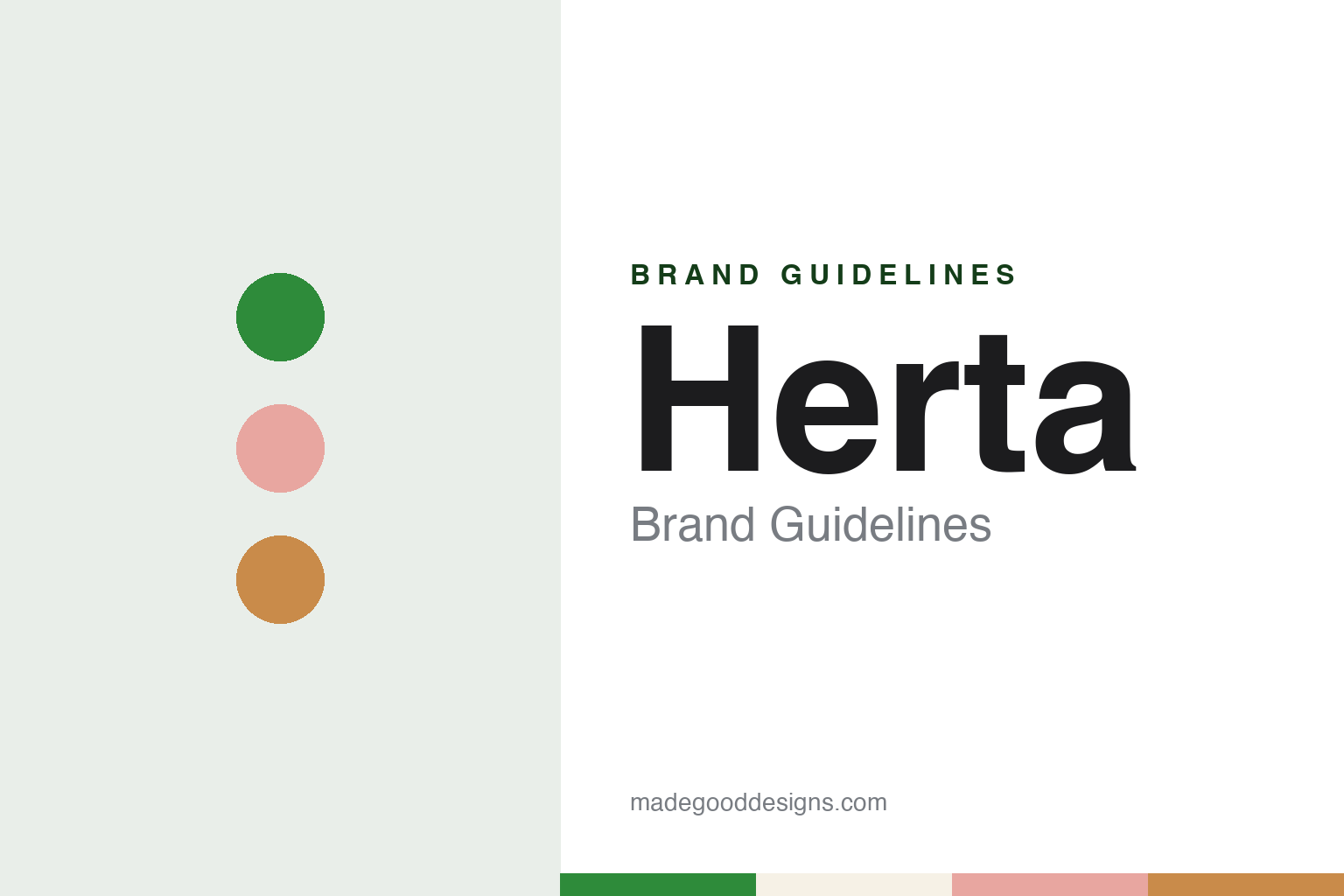
Two constants: a flower green, ham pink and grill tan palette and a rounded friendly sans register. Abstract homage — not a Herta product or mark; no pack, logo or product is reproduced.
A shop in Herten
A Westphalian butcher, a goddess’s name and a self-service counter.
Herta is one of the best-known names in French charcuterie, but it began in Germany. The company says that Ludwig and Wilhelmine Schweisfurth opened a charcuterie in Herten, in Westphalia, in 1897, and built their first factory in 1902. The journalist Jean Watin-Augouard, in a history of the brand published by La Revue des marques in October 2013, says the business had about fifty staff in 1917, five hundred in 1947 and six thousand in 1967, when it ran five factories, seventy-five shops and a fleet of five hundred delivery lorries.
The name came at the half-century. In 1947, for the company’s 50th anniversary, the founders’ son Karl Schweisfurth gave the name Herta to its charcuterie, both the company and La Revue des marques say; the magazine and French Wikipedia say it was the name of a goddess in Germanic mythology. German Wikipedia says the trademark was filed in 1948 and registered in 1951.
The third generation, Karl-Ludwig Schweisfurth, ran the business from 1964. La Revue des marques says a placement in the great Chicago slaughterhouses convinced him that charcuterie had an industrial future, and credits the company with opening Europe’s first self-service charcuterie counter, in Dortmund, in 1953; French Wikipedia dates its first sliced, pre-packed charcuterie to 1959. With the arrival of the European common market the company spread abroad: the company says Herta entered the French market in 1963, and it reached Belgium in 1968 and the United Kingdom in 1971, French Wikipedia says.
France became the brand’s heartland. The company dates its first French factory, at Saint-Pol-sur-Ternoise in the Pas-de-Calais, to 1973; La Revue des marques gives 1976. The company says the plant makes its Le Bon Paris ham and its Knacki sausages. A second French site, at Illkirch-Graffenstaden in Alsace, followed in 1989; the magazine says it had been built that year by the rival Olida and was sold to Herta to meet rising demand.
Colour
Knacki, a green flower and the “simple things”.
Herta’s best-known French product was born in 1975. La Revue des marques says the head of the French business, Karl Götze, wanted a sausage for campsites, and the result was Knacki Original, made at Saint-Pol-sur-Ternoise; the name imitates the “knack” of biting into the skin. The same article says Herta’s little green flower logo appeared that same year. Knacki became a family of products, from cocktail sausages in 1978 to the larger Knacki Max of 1998, which the magazine says came in a horizontal pack with a kraft-paper look, a code it describes as new and exclusive to Herta. The company dates a vegetable-based Knacki to 2018.
The brand also moved beyond charcuterie. Herta bought Supraliment, a croque-monsieur maker in Romainville, in 1984, the company and La Revue des marques say, and in 1986 it launched a ready-to-unroll pastry dough, which French Wikipedia calls the first on the market and the magazine one of the first. A pizza dough followed in 1994, and in 2017, the company says, a nitrite-free ham.
Its advertising became part of French television history. La Revue des marques says that in 1985 the young agency Jean & Montmarin, with music by the singer Pierre Bachelet, began a campaign around the line “Ne passons pas à côté des choses simples” (“Let’s not miss the simple things”). Between 1985 and 2001 it made twenty-three films, each showing a child discovering nature with a parent or grandparent while a simple meal was prepared, with no packshot and no tasting; the first three were directed by Jean Becker, a point Les Échos also made in 2013. The magazine quotes the agency’s co-founder Hubert de Montmarin as saying the aim was to make people forget the plastic, so the child grilled his sausages over a wood fire. Today the brand signs itself “Le goût des choses simples” (“The taste of simple things”).
Typography
Design and documentation.
The seven brands in this group all make food, and all of them come from France: Herta, Fleury Michon, Banania, Tipiak, Cassegrain, Saupiquet and Bjorg. French food brands in general sit at many different points in the trade, from family firms that still carry a founder’s surname to names that now belong to much larger food groups, and a single brand can be sold everywhere from a village grocer to a hypermarket shelf.
A food brand’s identity is usually carried less by a single product than by a pack, a name and the meal or snack it promises, because the company behind the name may have changed hands, moved its factory or grown far beyond the town where it started. That makes the questions behind each name worth asking plainly: who started it, who owns it now, and where its food is actually made and packed.
Each guide separates what independent sources record from what the company says about itself — its founding story, its owners over time, where its food is made and how its packaging has changed — and marks plainly what rests only on the company’s own word.
Aa
A rounded friendly sans for a brand built on “simple things”. (Specimen set in Nunito, a sans STAND-IN; NOT the Herta logo.)
Herta
From a family firm to Nestlé to a Spanish joint venture.
Herta left the Schweisfurth family in the 1980s. La Revue des marques says Karl-Ludwig Schweisfurth, tired of repeated labour disputes and competition and with neither of his two sons willing to take over, sold the company to Nestlé in stages: 26% in 1984, 51% in 1985 and all of it in 1986. In 1994 Herta, its Artois production company and Supraliment were merged into Herta SA, which moved in 1996 to the head office of Nestlé France at Noisiel, the magazine says.
Nestlé kept Herta for more than three decades. On 19 December 2019 it announced that it would sell a 60% stake to Casa Tarradellas, a Spanish family company founded in 1976 that makes pizza, fresh dough and charcuterie, and form a joint venture in which it kept 40%. Nestlé’s announcement said the venture covered Herta charcuterie in six European countries and the Herta dough business in France and Belgium, would be incorporated in Spain, and would leave operations with the existing Herta businesses in France, Germany, Belgium and the United Kingdom. Nestlé kept the Herta vegetarian business for itself. The company dates the new ownership to 2020. In December 2025 Nestlé announced the sale of its remaining 40% to Casa Tarradellas, French Wikipedia says, citing Reuters.
The German side of the business is smaller. German Wikipedia says Herten remains the main German site, and that in 2012 the Sprehe group took over Herta processing plants in Berlin and in Neuenkirchen-Vörden. In France the company says its newest sausages are made with 100% French pork.
For a design guide, Herta shows how a German family name, a small green flower and a long-running film campaign about “simple things” could make a charcuterie brand feel at home in French kitchens. Compare Fleury Michon, its Vendée rival in pre-packed ham, and Campofrío, the Spanish charcuterie maker. For this guide we use a flower green, a ham pink and a grill tan with a rounded sans, an unofficial interpretation; no product or logo is reproduced.
Explore & save
Keep Herta’s identity on hand — save it to a board in the Made Good inspiration library.
Herta identity set
Pin the Herta flower green, ham pink and grill tan palette and the rounded friendly sans register to your own board.