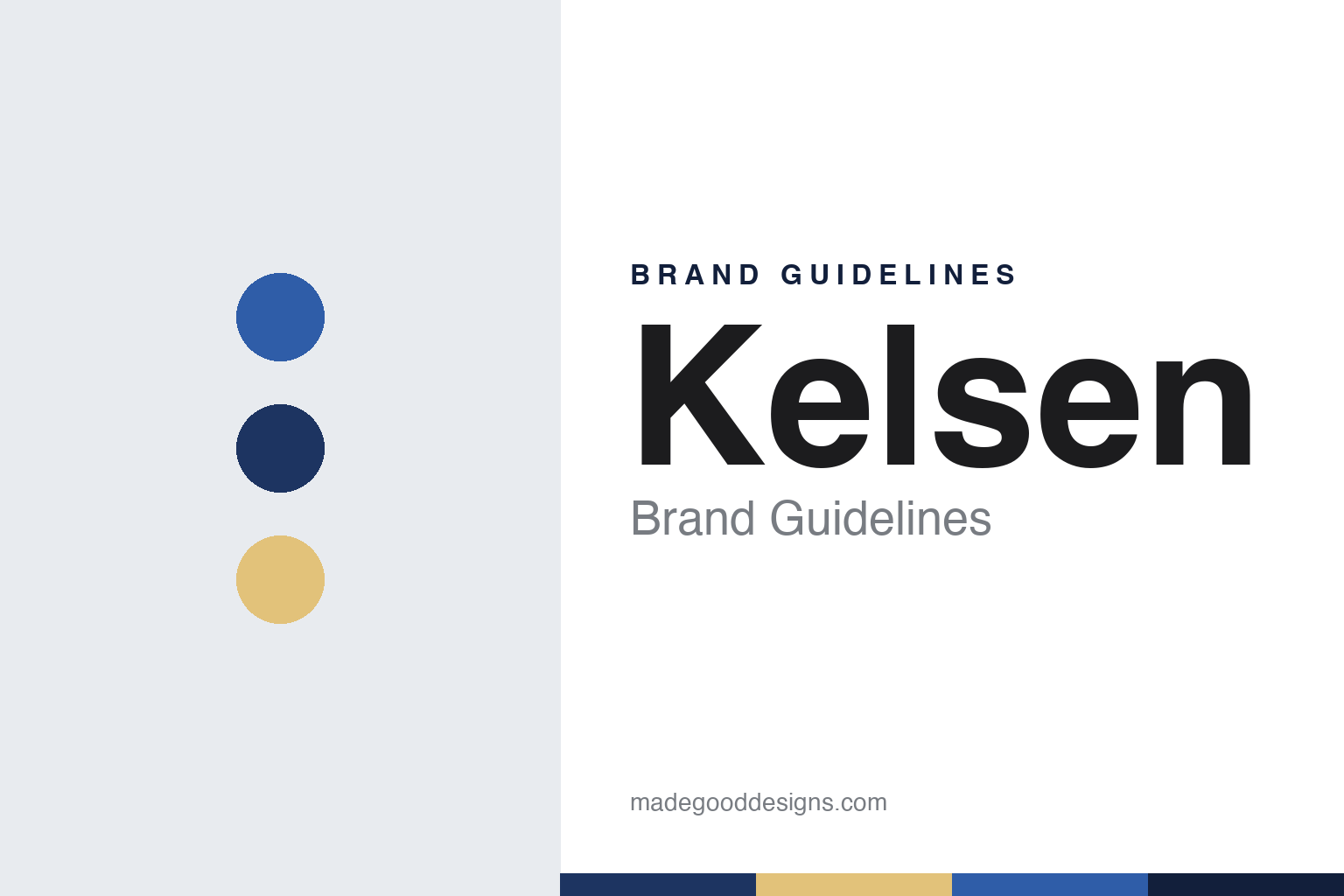
Kelsen Brand Guidelines
The Jutland family bakery that became the company behind two blue tins.
Aa
Two constants: a Kelsen navy, tin-blue and butter-gold palette and a bakery serif register. Abstract homage — not a Kelsen product or mark; no cookie, tin, logo or pack is reproduced.
Nørre Snede
A carpenter, a baker’s daughter and a home bakery.
Kelsen Group A/S is the Danish biscuit company behind two of the best-known butter-cookie tins in the world, Kjeldsens and Royal Dansk. Kelsen is a company name rather than a brand on the shelf, and its story is how a family bakery in central Jutland became an exporter, a merger partner and, eventually, part of a group linked to Ferrero. It is still based in Nørre Snede, the small town where it began.
The company dates its founding to 1933, when Marinus and Anna Kjeldsen started a home bakery in Nørre Snede under the name Kjeldsen & Co. Hjemmebageri. Kelsen’s history page says Marinus had trained as a carpenter and that Anna was the daughter of a master baker. Its page on the founders says Marinus first drove a baker’s van for his father-in-law’s bakery, and that Anna was a gifted saleswoman who persuaded grocers to taste the cookies and came home late in the evening with empty tins. In a 2017 article for Vice’s food site Munchies, the writer Mayukh Sen also gave 1933, Nørre Snede and the couple as the founders, and Danish Wikipedia gives the same year and town, citing the company.
The family era ended after less than four decades. Kelsen’s timeline says that in 1970 the founders sold Kjeldsen & Co. to an outside shareholder, Incentive A/S, ending its time as a family-owned business.
Colour
Hong Kong, a blue tin and designer tins.
Exports began early, according to the company. Its timeline says Kjeldsens butter cookies were first exported to the United States in the 1950s, and that in 1963 they reached Hong Kong for the first time. In 1966, it says, the first Royal Dansk butter cookies were baked in Helsingør and packed in a blue tin that soon became known simply as “the blue tin.” Vice described Royal Dansk as a cooperative factory in Helsingør that opened that year.
The company then set up sales companies abroad. Its timeline lists Kjeldsens Limited in Hong Kong in 1982 and Kelsen Inc. in the United States in 1987. Vice and English Wikipedia describe Kjeldsen and Royal Dansk merging in 1990, with the combined business renamed Kelsen; Kelsen’s own timeline says that after various changes of ownership, mergers and acquisitions the company took its present name, Kelsen Group A/S, in 2009. By the company’s account it also bought the Queens brand in 2003 and the Ripensa brand in 2004. In 2009, the year of the name change, it was appointed purveyor to the Royal Danish Court, and the company says the warrant lets Kjeldsens products carry the words “Kongelig Hofleverandør.”
Tins are a business in their own right. Kelsen says the idea of the “designer tin” began in 2000, when customers could first develop cookie products in tins of their own design. Today it describes a new range of designer tins each year, inspired by trends in fashion and interiors, offers customers a choice of colours, patterns, photographs and messages, and says several earlier designs have become collectors’ items. Besides Kjeldsens and Royal Dansk, its brands page lists house brands, private-label products and smaller names including First Choice, Riberhus, Denmark and Copenhagen.
Typography
Design and documentation.
The seven brands in this group all make food, and all of them come from Denmark, Sweden or the Netherlands: Toms, Kelsen, Göteborgs Kex, Polarbröd, HAK, De Ruijter and Venz. Food brands from these countries sit at many different points in the trade, from family firms that still carry a founder’s surname to names that now belong to much larger food groups, and a single brand can be sold everywhere from a corner shop to a supermarket shelf.
A food brand’s identity is usually carried less by a single product than by a pack, a name and the meal or treat it promises, because the company behind the name may have changed hands, moved its factory or grown far beyond the town where it started. That makes the questions behind each name worth asking plainly: who started it, who owns it now, and where its food is actually made and packed.
Each guide separates what independent sources record from what the company says about itself — its founding story, its owners over time, where its food is made and how its packaging has changed — and marks plainly what rests only on the company’s own word.
Aa
A warm bakery serif — for a company that sells under its brands’ names. (Specimen set in Lora, a serif STAND-IN; NOT the Kelsen logo.)
Kelsen Group
From Campbell to the Fine Biscuits Company.
Kelsen’s recent owners have been large. In August 2013 Campbell Soup Company completed its purchase of Kelsen Group from the Danish private equity firm Maj Invest, according to a Zacks analyst note published by Nasdaq; Kelsen says it also took over sales responsibility for Campbell’s business in Europe, the Middle East and Africa. In 2019 Campbell agreed to sell Kelsen to CTH Invest, a holding company affiliated with Ferrero. The Danish law firm Plesner announced the agreement on 6 August 2019, and Food Business News reported the sale complete on 24 September that year; Danish Wikipedia describes CTH Invest as Ferrero-owned. In 2020, Kelsen says, it became part of the newly formed Fine Biscuits Company, alongside its Belgian sister company Biscuits Delacre.
Where the cookies are made is stated plainly. Kelsen says all of its butter cookies are baked in Denmark, at its two bakeries in Nørre Snede and Ribe, and that each product’s country of origin is printed on its pack. Plesner put the workforce at about 400 people and output at about 25,000 tonnes of cookies a year in 2019; Kelsen’s history page, archived in 2022, gave 350 employees and the same tonnage. The company’s figures for its reach differ between its own pages: its history page says its butter cookies are exported to more than 67 markets, its brands page that they are sold in more than 95.
For a design guide, Kelsen shows how one company can run two distinct tin identities, and a catalogue of made-to-order designer tins, while selling under its brands’ names rather than its own. Compare Kjeldsens and Royal Dansk, its two flagship brands, and Delacre, its Belgian sister company. For this guide we use Jutland navy, tin blue and butter gold with a serif, an unofficial interpretation; no product or logo is reproduced.
Explore & save
Keep Kelsen’s identity on hand — save it to a board in the Made Good inspiration library.
Kelsen identity set
Pin the Kelsen navy, tin-blue and butter-gold palette and the bakery serif register to your own board.