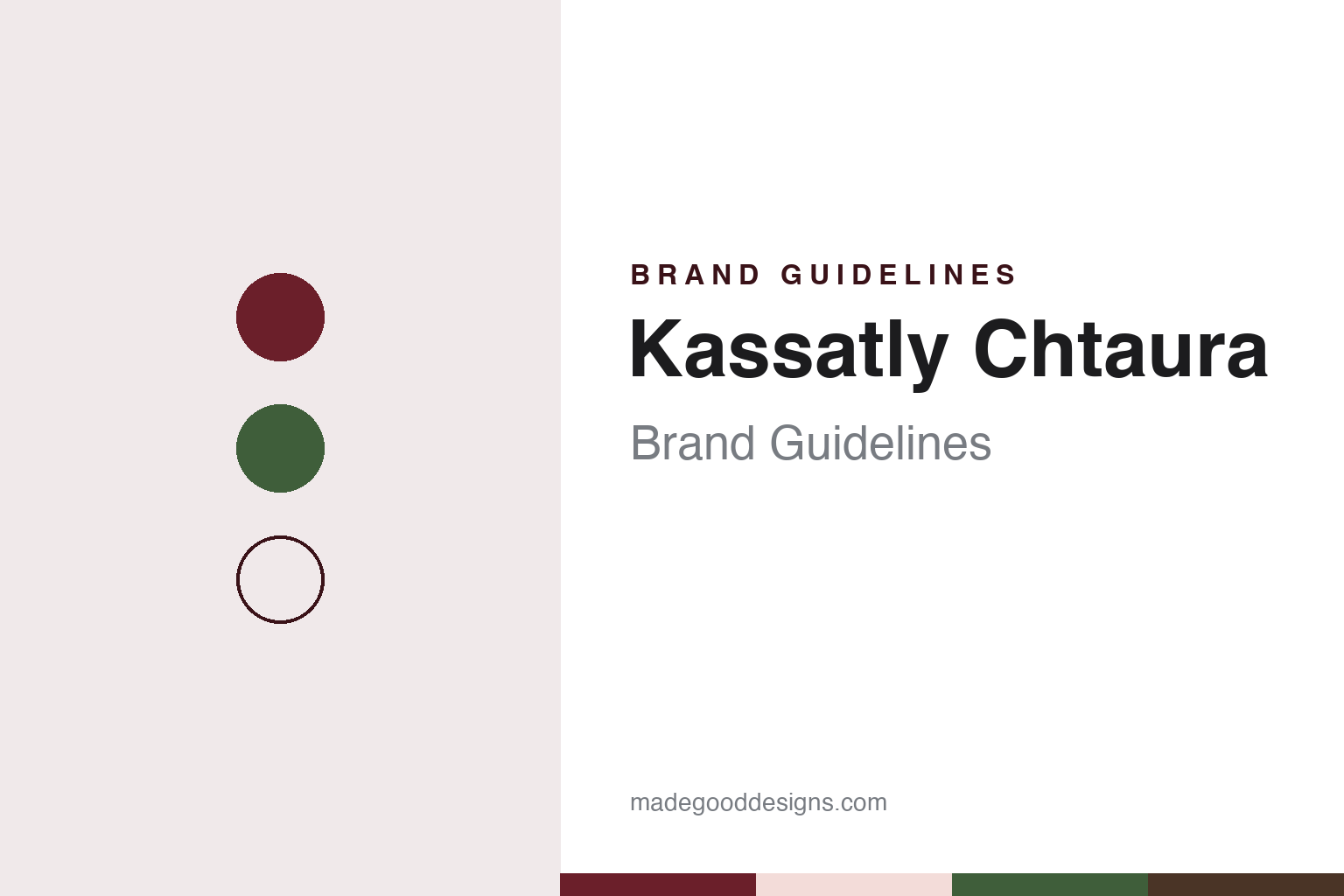
Kassatly Chtaura Brand Guidelines
The Bekaa Valley syrup maker that grew into a Lebanese drinks group.
Aa
Two constants: a Jallab garnet, Bekaa green and rose-water palette and a display serif register. Abstract homage — not a Kassatly Chtaura product or mark; no bottle, label or logo is reproduced.
Jallab in a bottle
An oenologist and a Levantine syrup.
Kassatly Chtaura is a Lebanese drinks company that dates itself to 1974. Its website, which carries the line “Catering quality products since 1974,” says it was founded that year by Akram Kassatly, an oenology graduate who became its president and chief executive, and that his starting idea was “the first bottled Jallab for home-preparation.” The company says it grew “from our roots in the Bekaa Valley,” and Chtaura, the name it carries, is a town in the Bekaa; its contact address today is in Nahr al-Mot, in the Metn district.
The company traces its family’s trade further back. Its history page says the roots go to 1919, when the family bottled wine for the French Army and sold syrups in the streets of Beirut. That account comes from the company alone, and we give it as its claim.
Jallab is the product the company built itself on. English Wikipedia describes it as a fruit syrup popular across the Levant, made from carob, dates, grape molasses and rose water, and, citing Middle East Eye in April 2022, says it is usually served over crushed ice with pine nuts and raisins. Bottled Jallab for preparing at home is the idea Kassatly Chtaura puts at the centre of its own story.
From there the range widened. The company says that in the 1980s it moved into syrups and liqueurs, with more than twenty traditional varieties, and that juices followed in the 1990s. Its current catalogue still lists syrups, which it describes as fruit and herbal syrups “inspired by Lebanese tradition,” alongside jams and mini jars, the Fruitastic juice range and a group of liqueurs.
Colour
Buzz, Freez and a coloured bottle.
Its best-known soft-drink and mixer brands arrived in the 2000s, according to its own timeline. In 2001 it launched Buzz, a ready-to-drink vodka mix sold in glass bottles and cans. A year later, in 2002, it launched Freez, which it describes as a non-alcoholic alternative to Buzz that grew into a premium carbonated soft drink in its own right.
Freez is also the subject of the company’s main documented packaging change. Its timeline says that in 2016 Freez was rebranded as Freez Mix, adding what it calls colour-bottling technology and an easy-open ring pull, and its catalogue describes Freez Mix as premium carbonated soft drinks in decorated glass bottles. The same catalogue lists Freez Crystal, a range of mixes, sodas and tonics. The company writes the names both in capitals, as BUZZ and FREEZ, and in title case on the same site.
Other lines followed. In 2018, the company says, it launched Mezza, a non-alcoholic malt drink, in six flavours. Its website also gathers a long run of television and online advertisements for its brands on a single page, without naming the campaigns, their years or the agencies behind them.
Kassatly Chtaura also makes wine. It says Akram Kassatly built his own winery, Château Ka, in 2005; its catalogue presents Château Ka as a Lebanese wine from the Bekaa Valley, and English Wikipedia’s list of Lebanese wineries includes it, citing the company’s page.
Typography
Design and documentation.
The seven brands in this group are all drink names from Africa and the Middle East: Tusker, Maltina, Stoney, Almaza, Kassatly, Zamzam and Barbican. African and Middle Eastern drink brands in general sit at many different points in the trade, from family firms that still carry a founder’s name to names that now belong to much larger drinks groups, and a single brand can be sold everywhere from a corner shop to a supermarket shelf.
A drink brand’s identity is usually carried less by a single product than by a bottle, a can, a name and the refreshment it promises, because the company behind the name may have changed hands, moved its production or grown far beyond the place where it started. That makes the questions behind each name worth asking plainly: who started it, who owns it now, and where its drinks are actually made and bottled.
Each guide separates what independent sources record from what the company says about itself — its founding story, its owners over time, where its drinks are made and how its packaging has changed — and marks plainly what rests only on the company’s own word.
Aa
A display serif — for a family syrup maker turned drinks group. (Specimen set in DM Serif Display, a serif STAND-IN; NOT the Kassatly Chtaura logo.)
Kassatly Chtaura
From syrup to a second Lebanese beer.
The company’s largest move came in 2014, when it launched Beirut Beer. Kassatly Chtaura says the beer was created in eleven months and broke what it calls a long-standing monopoly in the Lebanese market. English Wikipedia’s article on beer in Lebanon, citing Executive Magazine in October 2014, says that Almaza’s long market dominance ended as competition arrived, naming Kassatly Chtaura’s Beirut Beer and new craft beers; citing Campaign Middle East in December 2022, it describes Beirut Beer as a pilsner produced and bottled by Kassatly Chtaura. The same article, citing Executive Magazine in February 2018, says Beirut Beer’s advertising campaign played a key role in expanding the Lebanese beer market, and, citing The National in December 2022, calls Kassatly Chtaura one of the largest drinks producers in Lebanon.
The business remains under the Kassatly name, with Akram Kassatly named on its site as founder, president and chief executive. It says it runs factories in Lebanon serving the Middle East and Africa, and that in 2024 it built a plant in Cyprus to export Freez Mix to Europe and America; it describes its Lebanese and Cypriot factories as state-of-the-art, which we give as its own description.
One naming point is worth knowing. The web address kassatly.com belongs to a separate Lebanese business, the Wadih Kassatly Company of Beirut, which says it has made drinks since 1947 and sells the Caprice d’Orient range; Kassatly Chtaura’s own website is kassatly.net.
For a design guide, Kassatly Chtaura shows how a single traditional syrup can anchor a family company that later adds soft drinks, mixers, wine and beer under separate names. Compare Cortas, another Lebanese maker of jams and flower waters, and Almaza, the long-dominant Lebanese beer. For this guide we use a garnet, a green and a rose-water pink with a display serif, an unofficial interpretation; no product or logo is reproduced.
Explore & save
Keep Kassatly Chtaura’s identity on hand — save it to a board in the Made Good inspiration library.
Kassatly Chtaura identity set
Pin the Kassatly Chtaura garnet, green and rose-water palette and the display serif register to your own board.