Zamzam Brand Guidelines
The Iranian soft drink that began as a Pepsi bottler.
Aa
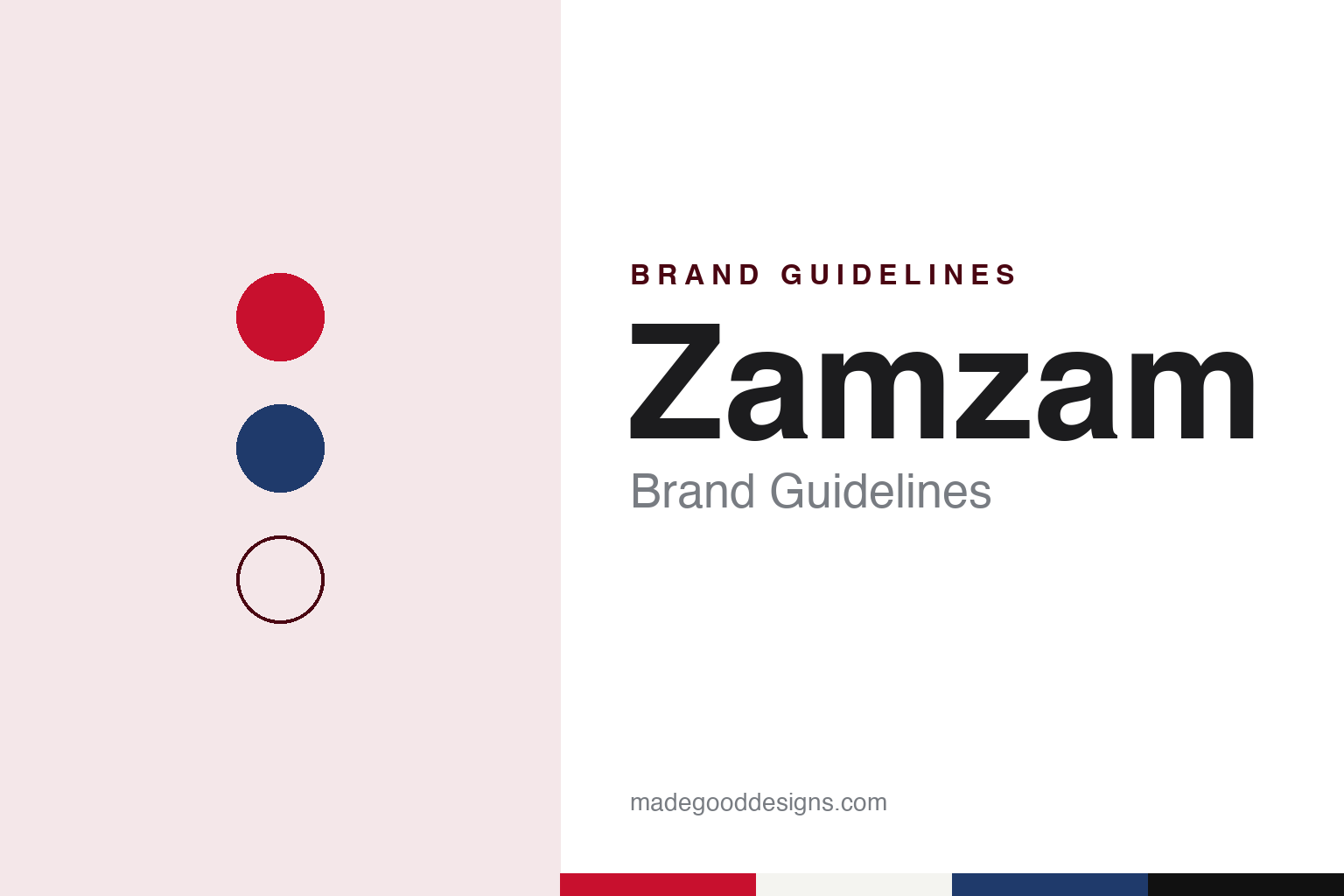
Two constants: a cola red, Tehran blue and white palette and a heavy grotesque sans register. Abstract homage — not a Zamzam product or mark; no bottle, can or logo is reproduced.
Pepsi in Tehran
An industrialist, a licence and a revolution.
Zamzam began as something else. Persian Wikipedia, citing the Iranian business site Eghtesad Saramad and the company, says its first factory, Zamzam Tehran, was founded in 1954 by the industrialist Habib (Habibollah) Sabet and began production in 1955 as Iran’s first carbonated soft-drink company. English Wikipedia’s article on Sabet, citing a 2020 Leiden University doctoral thesis, dates his acquisition of the rights to bottle Pepsi-Cola in Iran to 1955, so the sources give 1954 for the company and 1955 for the start of bottling.
Before the revolution, the factories produced Pepsi products under licence, Persian Wikipedia says, citing The New York Times of December 2002. English Wikipedia describes the business as a subsidiary of Pepsi in Iran and the country’s first carbonated soft-drink producer.
The 1979 revolution changed the ownership and the name. Sabet’s companies and other assets were confiscated by the new government shortly after it was established, English Wikipedia says, citing a 2007 history of Lebanese–Iranian encounters by H. E. Chehabi and Hassan Mneimneh. Afterwards the drinks were sold under the Zamzam name. The group’s parent company, Zamzam Iran, was established in 1979, according to the group’s English-language website in 2007, or in 1980, according to Persian Wikipedia, citing the company.
The name refers to the Well of Zamzam in Mecca, a stop on the Hajj pilgrimage, English Wikipedia says, citing The Daily Meal. The BBC described Zamzam Cola in August 2002 as “an Iranian soft drink named after a holy spring in Mecca.”
Colour
A boycott and a moment abroad.
Zamzam’s best-documented moment outside Iran came in 2002. On 21 August that year BBC News reported that Zamzam Cola, presented as an alternative to the American brands Coca-Cola and Pepsi, had gone on sale in Saudi Arabia as a campaign to boycott American goods gathered momentum. Its Saudi distributor, Al-Majarah, said it had imported four million one-litre bottles in the previous week and had ordered several million more, the BBC reported, and its general manager told Reuters that the boycott and “the good quality of Zamzam Cola” had brought excellent sales.
The same report said the distributor had asked the Iranian parent company for permission to set up a bottling plant in Saudi Arabia, that preparations were under way for a plant in neighbouring Bahrain, and that Zamzam Cola was also sold in Iraq, Pakistan and some African countries. The French newspaper Libération covered the same story that month, and the Belgian La Libre returned to it in April 2003, according to Persian Wikipedia’s citations. English Wikipedia, citing IslamOnline in August 2002, says that during this period Zamzam was unofficially dubbed the soft drink of the Hajj.
At home the range is broad. In 2007 the group’s website said Zamzam made more than 65 products, including cola, orange, lemon and mango soft drinks in glass, PET and cans, drinking and mineral water, and non-alcoholic malt drinks. Persian Wikipedia lists cola, orange and lemon sodas, lemonade, a zero-sugar cola, the yogurt drink doogh, sold as Doogh Abali, water and energy drinks among its current products. In 2007 the group’s website called it the largest soft-drink manufacturer in the Iranian market, a claim we give as its own.
Typography
Design and documentation.
The seven brands in this group are all drink names from Africa and the Middle East: Tusker, Maltina, Stoney, Almaza, Kassatly, Zamzam and Barbican. African and Middle Eastern drink brands in general sit at many different points in the trade, from family firms that still carry a founder’s name to names that now belong to much larger drinks groups, and a single brand can be sold everywhere from a corner shop to a supermarket shelf.
A drink brand’s identity is usually carried less by a single product than by a bottle, a can, a name and the refreshment it promises, because the company behind the name may have changed hands, moved its production or grown far beyond the place where it started. That makes the questions behind each name worth asking plainly: who started it, who owns it now, and where its drinks are actually made and bottled.
Each guide separates what independent sources record from what the company says about itself — its founding story, its owners over time, where its drinks are made and how its packaging has changed — and marks plainly what rests only on the company’s own word.
Aa
A heavy grotesque sans — for a national soft drink in red and white. (Specimen set in Archivo, a sans STAND-IN; NOT the Zamzam logo.)
Zamzam
A group of regional bottlers.
Zamzam is organised as a group rather than a single plant. Its English-language website said in 2007 that the group consisted of 16 soft-drink companies, with Zamzam Iran as the parent supplying extract, concentrate, bottle crowns, caps and PET bottles to the others, and that licensees in other countries also produced its drinks. Persian Wikipedia, citing the company, now lists eleven factories — in Tehran, Tabriz, Gorgan, Isfahan, Urmia, Mashhad, Shiraz, Kerman, Rasht, Kermanshah and Abadan — plus a syrup unit and a bottle-cap plant in western Tehran. It says that until 2025 each factory was a separate joint-stock company overseen by Zamzam Iran, and that they were then merged into a single company.
Ownership runs through Iran’s foundations. The historian Ervand Abrahamian, in A History of Modern Iran (2008), wrote that the Mostazafan Foundation controlled 40 percent of Iran’s soft-drink production, including Zamzam Cola, which it owned and produced. English Wikipedia names the group’s current owner as Sina Industrial Food Holding. In 2020 the United States placed sanctions on the Mostazafan Foundation, Reuters reported.
The brand has also been distributed abroad under its own name; English Wikipedia links an archived site for a North American distributor, Zam Zam Foods, and Persian Wikipedia says its products have been sold in countries from China and Australia to Venezuela.
For a design guide, Zamzam shows how a national soft drink can grow out of a foreign licence and keep a cola, an orange and a lemon soda at the centre of a much wider range. Compare Inca Kola, Peru’s golden soda, launched in Lima in 1935, and Kofola, the Czechoslovak cola born in a pharmacy lab. For this guide we use a cola red, a deep blue and white with a heavy sans, an unofficial interpretation; no product or logo is reproduced.
Explore & save
Keep Zamzam’s identity on hand — save it to a board in the Made Good inspiration library.
Zamzam identity set
Pin the Zamzam cola red, Tehran blue and white palette and the heavy grotesque sans register to your own board.