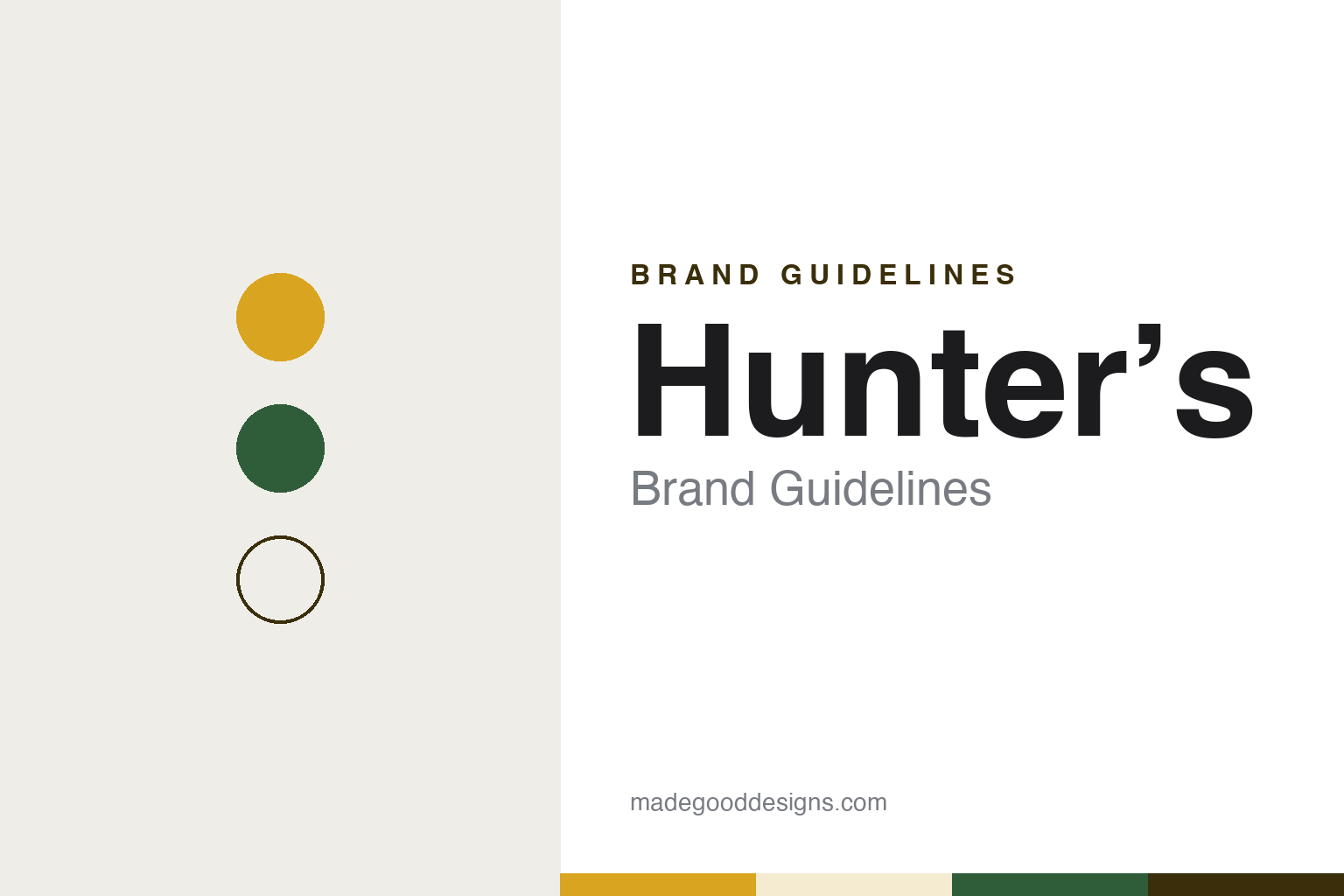
Hunter’s Brand Guidelines
The South African cider born as an alternative to beer.
Aa
Two constants: a cider gold, orchard green and pale straw palette and a condensed confident sans register. Abstract homage — not a Hunter’s product or mark; no bottle, label or logo is reproduced.
An alternative to beer
A gold cider for a beer-drinking market.
Hunter’s is one of the two big names in South African cider. English Wikipedia, in its article on cider, describes the country’s market as dominated by two major brands, Hunter’s and Savanna, both produced and distributed today by Heineken, which completed its acquisition of the drinks group Distell in April 2023. The brand writes its name with an apostrophe — Hunter’s — and that is the spelling Heineken used when it listed the brand in its completion announcement of 26 April 2023.
The first product came in 1988. English Wikipedia says Hunter’s Gold was introduced in South Africa that year as an alternative to beer. Alongside Gold, Hunter’s Dry became the other pillar of the range, and both are named in Heineken Beverages’ brand list today.
Over the following decades the line grew. English Wikipedia lists Hunter’s Dry, Hunter’s Gold and Hunter’s Export as the range, adding that Hunter’s Edge was launched in April 2017; the English Wikipedia article on Distell also names a Hunter’s Extreme among the group’s ciders. The cider sits in a country with a serious apple industry: the Sunday Times reported in 2017 that the Elgin Valley, east of Cape Town, grows around 60% of South Africa’s apples, and the same valley is home to a cluster of small craft cider makers that has grown up alongside the big brands.
Colour
The Stellenbosch drinks group that carried the brand.
For most of its life Hunter’s belonged to Distell, the Stellenbosch-based wine, spirits and cider group. Distell was itself the product of two older South African companies. English Wikipedia, citing Distell’s own history, says Stellenbosch Farmers’ Winery was formed in 1925 by William Charles Winshaw, an American medical doctor, and was listed on the Johannesburg Stock Exchange in 1956. Distillers Corporation was formed in 1945 by the industrialist Anton Rupert; it built up South African brandy and devised the Bergkelder concept, under which wine estates could use Distillers’ bottling, sales and marketing.
The two companies announced their merger on 20 September 2000, and the deal concluded on 4 December 2000, when the combined business took the name Distell; its shares began trading on the Johannesburg Stock Exchange on 19 March 2001, English Wikipedia says, citing the trade magazine WineLand. Distell’s portfolio ran from brandies such as Klipdrift and Richelieu to wines such as Nederburg, from the cream liqueur Amarula to ciders, and in 2013 it bought the Scotch whisky maker Burn Stewart Distillers, the BBC reported. Its share register shifted with the global beer industry: after Anheuser-Busch InBev took over SABMiller, Bloomberg reported on 15 December 2016 that AB InBev would sell the 26.4% Distell stake it had inherited to South Africa’s Public Investment Corporation. Through all of this the group kept its head office in Stellenbosch, in the heart of the Cape winelands.
Hunter’s lived online under Distell too. An archived 2012 copy of the terms of use on the brand’s South African website, hunterscider.co.za, states that the site was provided by Distell Limited and its associated companies, and archived page titles from 2011 to 2018 show the site running a summer campaign under the name “Hunter’s Urban Oasis.” The similarly named hunterscider.com was not the brand’s site; an archived 2011 capture shows a suspended hosting page there.
Typography
Design and documentation.
The seven brands in this group are all drink names from South Africa: Castle Lager, Savanna, Hunter’s, Amarula, Appletiser, Liqui-Fruit and Oros. South African drink brands in general sit at many different points in the trade, from names that still carry a founder’s story to names that now belong to much larger food and drink groups, and a single brand can be sold everywhere from a corner shop to a supermarket shelf.
A drink brand’s identity is usually carried less by a single product than by a bottle, a label, a name and the occasion it promises, because the company behind the name may have changed hands, moved its production or grown far beyond the place where it started. That makes the questions behind each name worth asking plainly: who started it, who owns it now, and where its drinks are actually made and bottled.
Each guide separates what independent sources record from what the company says about itself — its founding story, its owners over time, where its drinks are made and how its packaging has changed — and marks plainly what rests only on the company’s own word.
Aa
A condensed confident sans for a cider pitched at beer drinkers. (Specimen set in Oswald, a sans STAND-IN; NOT the Hunter’s logo.)
Hunter’s
From Distell to Heineken Beverages.
The brand changed hands with the whole of Distell. On 15 November 2021 Heineken announced a plan to buy Distell and Namibia Breweries, Reuters reported, in a deal meant to make it the market-leading alcoholic-drinks supplier in South Africa. The structure ran through a special-purpose company, Sunside Acquisitions Limited, later renamed Heineken Beverages Holdings, into which Heineken folded Heineken South Africa, Namibia Breweries and its operations in several East and southern African countries alongside the bulk of Distell, English Wikipedia says.
Heineken announced completion on 26 April 2023, and The Drinks Business reported it the following day. In its release Heineken described the combined business, HEINEKEN Beverages, as a new majority-owned company, and named Hunter’s among the Distell brands it brought in, alongside Amarula, Savanna, Klipdrift, Nederburg, Richelieu and others. Distell ceased to exist as a listed company on the same date, and English Wikipedia now gives Heineken Beverages as the producer of the Hunter’s and Savanna ciders.
Hunter’s now sits beside its long-time rival. Savanna, introduced in 1996 according to English Wikipedia, has been a stablemate since both were Distell brands, so the two ciders that define the South African category answer to the same owner.
For a design guide, Hunter’s shows how a cider can borrow the confidence of a beer brand — gold, dry, short and direct — and hold a place in a beer market for more than three decades. Compare Savanna, its South African cider stablemate, and Castle Lager, the South African beer. For this guide we use a cider gold, an orchard green and a pale straw with a condensed sans, an unofficial interpretation; no product or logo is reproduced.
Explore & save
Keep Hunter’s’s identity on hand — save it to a board in the Made Good inspiration library.
Hunter’s identity set
Pin the Hunter’s cider gold, orchard green and pale straw palette and the condensed confident sans register to your own board.