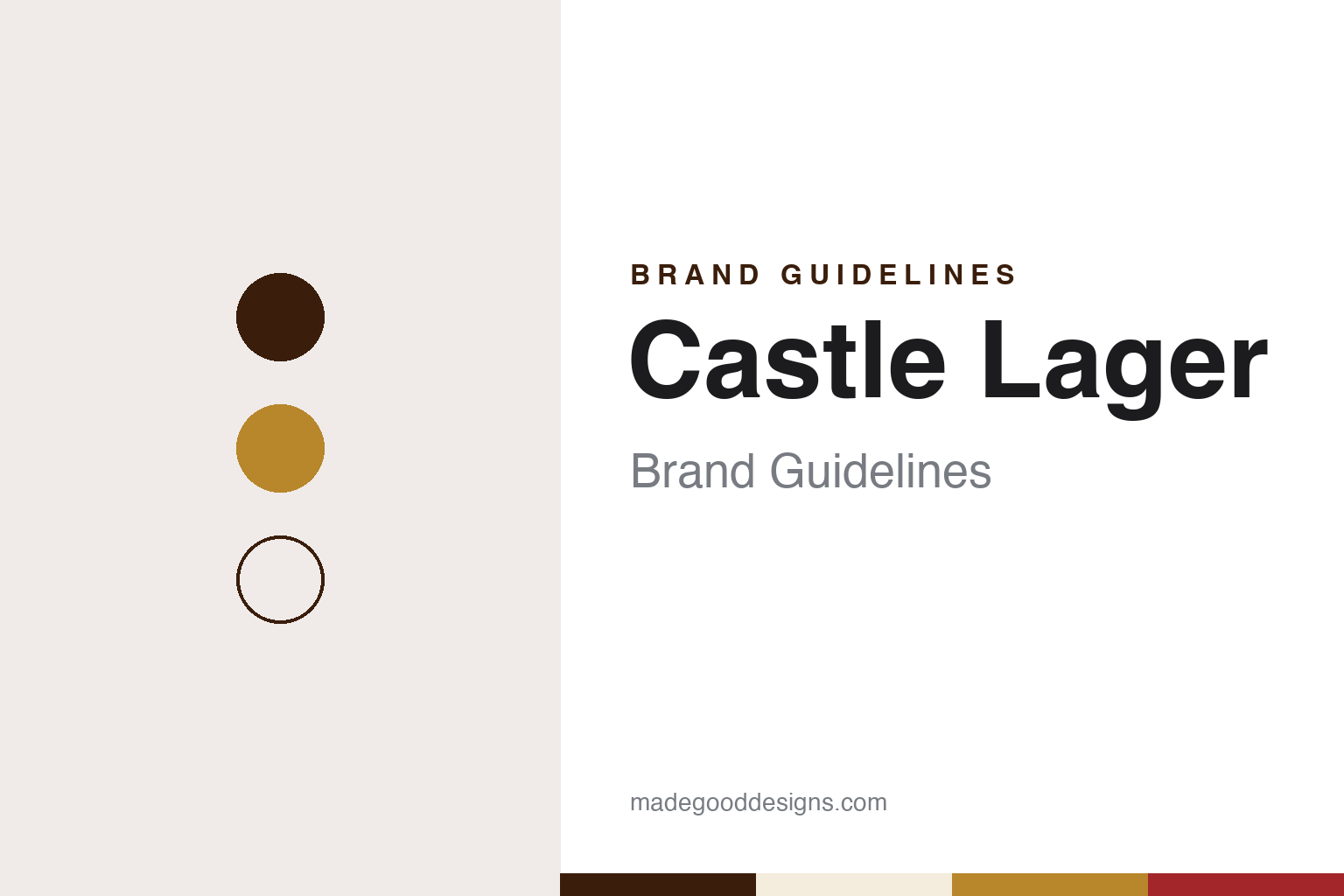
Castle Lager Brand Guidelines
The Johannesburg gold-rush beer behind South African Breweries.
Aa
Two constants: a bottle brown, gold-rush gold and brewery red palette and a Victorian brewery serif register. Abstract homage — not a Castle Lager product or mark; no bottle, label or logo is reproduced.
Charles Glass
A gold-rush brewer and the company his beer started.
Castle Lager belongs to the story of Johannesburg itself. SABMiller’s own history, as archived in 2014, placed its origins in the Witwatersrand gold rush of 1886, when brewers set out to supply the miners and prospectors crowding into the new town. “Foremost among these,” the company wrote, was Charles Glass, founder of the Castle Brewery, a perfectionist in its telling whose business soon drew the attention of investors.
The dates in the story do not all agree. South African Breweries’ brand page, archived in 2016, said Glass “first started brewing” Castle Lager at the Castle Brewery in Johannesburg in 1895, and the Castle Lager website of the same year also gave 1895; yet the SAB page also quoted an early Johannesburg newspaper, The Digger’s News, which in 1889 called the beer “a phenomenal success” at a time when it sold for sixpence a glass. English Wikipedia’s article on the Castle Brewery gives 1894 as the founding year in what it calls the company-endorsed account. What is consistent is the sequence: a Johannesburg brewery, a popular beer, and then a company built on it.
The official account has also been challenged on who did the brewing. In Beer, Sociability and Masculinity in South Africa, the University of Cape Town historian Anne Kelk Mager argued that Glass’s wife, Lisa Glass, was the main brewer behind the setting up of Castle Lager around 1890, and that SAB’s Charles Glass story was “a discourse for men about men,” as a column in IOL Business Report summarised her work in April 2011.
On the strength of Castle Lager, South African Breweries was founded in 1895, with its head office at the Castle Brewery, SABMiller’s history says. Two years later SAB became the first industrial company listed on the Johannesburg Stock Exchange, and English Wikipedia adds that it listed in London in 1898; its headquarters sat in London until 1950, when control moved to Johannesburg.
Colour
From South African Breweries to SABMiller to AB InBev.
For its first sixty years SAB was one of several large South African brewers. By 1955, SABMiller’s history says, it ranked among the three biggest alongside Ohlsson’s and Chandlers Union Breweries; when a change in excise duty that year made beer the country’s most heavily taxed drink, the smaller SAB bought both rivals and, by the company’s account, came to hold a 98% share of the South African beer market. English Wikipedia dates the purchase to 1955 in one article and 1956 in another.
SAB later looked abroad. It created a UK holding company and moved its primary listing to London in 1999, then in May 2002 bought the American brewer Miller, becoming SABMiller plc. On 10 October 2016 Anheuser-Busch InBev completed its acquisition of SABMiller, ending the SABMiller name; South African Breweries is now a subsidiary of AB InBev, English Wikipedia says, and Castle Lager remains its flagship beer.
On where the beer is made, SAB’s brand page said in 2016 that Castle Lager was brewed in nine countries and drunk in more than 40. The company described its ingredients as malted barley, maize, hops and water, with twelve days of brewing and fermenting followed by six days of maturation. English Wikipedia lists seven SAB breweries in South Africa, from Newlands in Cape Town and Prospecton in KwaZulu-Natal to Rosslyn, Alrode, Chamdor, Ibhayi and Polokwane. In 2000 Castle Lager won the “World’s Best Bottled Lager” category at the Brewing Industry International Awards, according to the same encyclopedia.
The name now covers a family of beers. Castle Lite, introduced in 1994, comes in a green bottle where Castle Lager’s is brown; Castle Milk Stout is the darker sibling; Castle Free, launched in 2017, was described by The Citizen that October as South Africa’s first locally brewed alcohol-free beer; and Castle Double Malt followed in 2021, English Wikipedia says.
Typography
South Africa’s drinks makers.
The seven brands in this group are all drink names from South Africa: Castle Lager, Savanna, Hunter’s, Amarula, Appletiser, Liqui-Fruit and Oros. South African drink brands in general sit at many different points in the trade, from names that still carry a founder’s story to names that now belong to much larger food and drink groups, and a single brand can be sold everywhere from a corner shop to a supermarket shelf.
A drink brand’s identity is usually carried less by a single product than by a bottle, a label, a name and the occasion it promises, because the company behind the name may have changed hands, moved its production or grown far beyond the place where it started. That makes the questions behind each name worth asking plainly: who started it, who owns it now, and where its drinks are actually made and bottled.
Each guide separates what independent sources record from what the company says about itself — its founding story, its owners over time, where its drinks are made and how its packaging has changed — and marks plainly what rests only on the company’s own word.
Aa
A Victorian brewery serif — the register of a gold-rush beer. (Specimen set in Playfair Display, a serif STAND-IN; NOT the Castle Lager logo.)
Castle Lager
Jazz festivals, sponsorships and a long-running line.
Castle Lager’s advertising history reaches well beyond the bottle. In 1960 SAB and Castle Lager sponsored the Cold Castle National Jazz Festival, held each year for four years, according to the Rough Guide to World Music. Its performers included the Jazz Epistles, Chris McGregor’s Blue Notes and Philip Tabane’s Malombo, and the 1962 edition, at Moroka-Jabavu Stadium outside Johannesburg, was the first open-air jazz festival on the continent, English Wikipedia says, citing the South African audio archive flatinternational. In 1963 Chris McGregor formed the Castle Lager Big Band, with members including Kippie Moeketsi and Dollar Brand, and with the company’s support it recorded the LP Jazz: The African Sound for Gallo, the Oxford Handbook of Music Revival notes.
Sport has been the other constant. SAB’s 2016 brand page listed Castle Lager as premier sponsor of the national football team, Bafana Bafana, team sponsor of the cricket side, then known as the Castle Lager Proteas, and associate sponsor of the Springboks; English Wikipedia now names it head sponsor of The Rugby Championship in South Africa.
The 2016 Castle Lager website described the taste as “somewhat bitter, somewhat dry, but never sweet” and used the line “It all comes together with a Castle,” and SAB’s brand page closed with “Inqaba!”, the isiZulu word for a fortress or castle. SABMiller’s history called Castle “South Africa’s most famous beer,” and English Wikipedia says it is widely regarded as the country’s national beer.
For a design guide, Castle Lager shows how a brewery founding story, retold for more than a century, can carry a beer and a whole company. Compare Águila, the Colombian lager now in the same AB InBev group, and Jupiler, AB InBev’s Belgian pils. For this guide we use a bottle brown, a gold-rush gold and a brewery red with a serif, an unofficial interpretation; no product or logo is reproduced.
Explore & save
Keep Castle Lager’s identity on hand — save it to a board in the Made Good inspiration library.
Castle Lager identity set
Pin the Castle Lager bottle brown, gold-rush gold and brewery red palette and the Victorian brewery serif register to your own board.