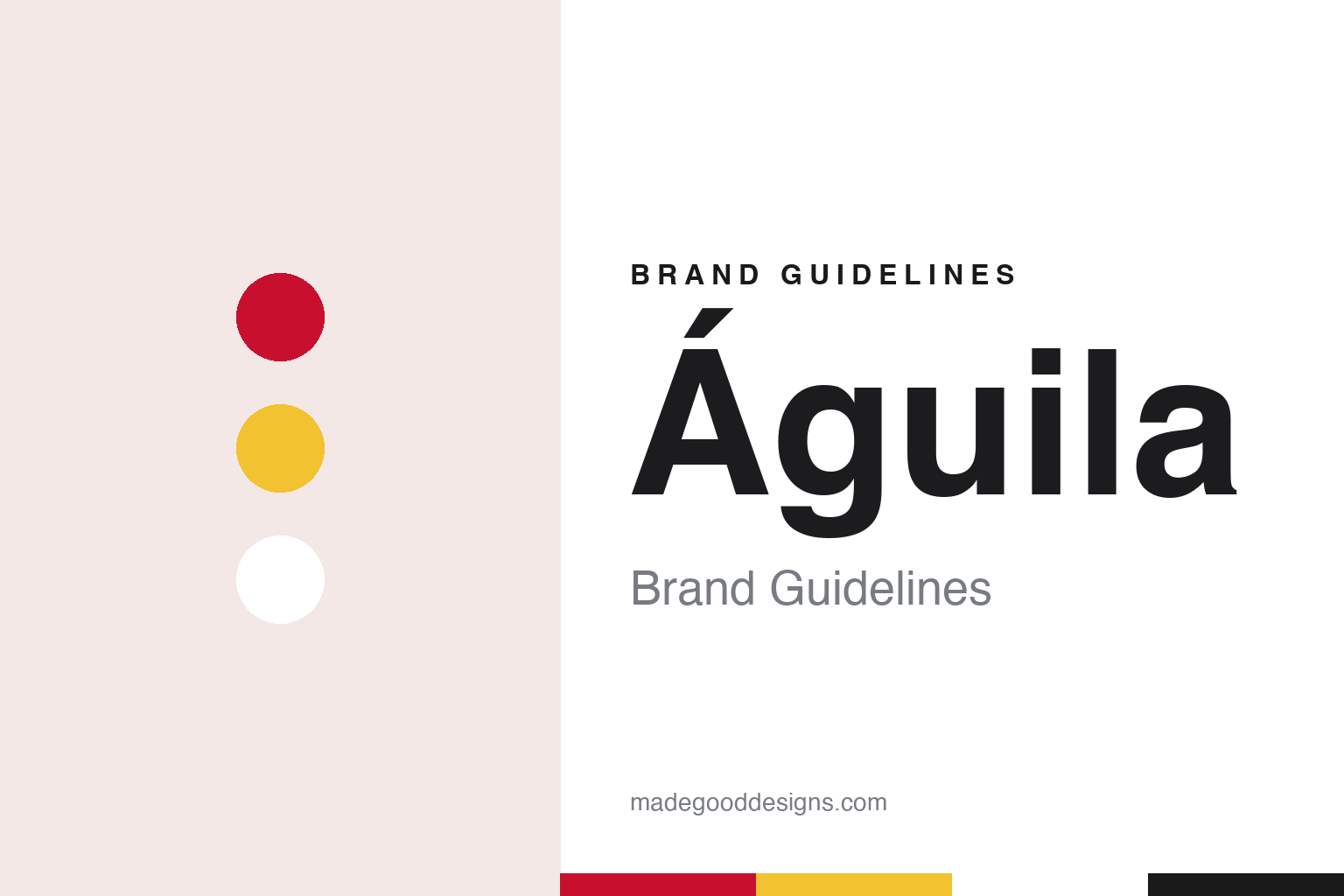
Águila Brand Guidelines
Barranquilla’s 1913 lager and its imperial eagle.
Aa
Two constants: an eagle red, lager gold and label white palette and a condensed poster sans register. Abstract homage — not an Águila product or mark; no bottle, label or eagle is reproduced.
A Caribbean lager
Barranquilla, 1913, and the brewery that absorbed it.
Águila is a Colombian lager from the Caribbean coast. Spanish Wikipedia says it was launched on 22 April 1913 in Barranquilla by the Compañía de Cervecerías Unidas. Bavaria, the brewer that sells it today, tells the story from its own side: its company timeline says that in 1913 “we opened the Barranquilla brewery” and that Águila, which it calls the most valuable brand in its portfolio, was born.
Bavaria itself is older and from the other end of the country. English Wikipedia says the German immigrant Leo S. Kopp registered the purchase of a lot for a brewery in Bogotá on 4 April 1889, and that the plant opened in the centre of the city on 28 May 1891. Its timeline says its first popular brand, La Pola, launched in December 1911 for the centenary of independence and named after the heroine Policarpa Salavarrieta, became the generic Colombian word for beer. Through the 20th century Bavaria absorbed regional brewers. Its timeline says that in 1930 it joined with the Cervecería Continental of Medellín to form the Consorcio de Cervecerías Bavaria, which went on to take in the Manizales maker of Póker and plants in Santa Marta, Cali, Pereira and Honda, and that on 8 October 1934 it launched its own Barranquilla beer, Costeña. Águila came to it in 1967. Spanish Wikipedia says Bavaria, in exchange for its own shares, took over the assets of the Barranquilla and Bolívar breweries, adding the existing Águila beer to its portfolio. Bavaria’s timeline describes the same deal as one in which Julio Mario Santo Domingo became owner of the Cervecería de Barranquilla y Bolívar in exchange for shares, creating Cervecería Águila S.A., and calls it fundamental to the consolidation of Bavaria.
The chain of owners then ran through the Santo Domingo group. Spanish Wikipedia says that in October 2005 the Grupo Empresarial Bavaria and its largest shareholder, Santo Domingo, with 71.8 per cent, merged the company into the Anglo-South African brewer SABMiller; Bavaria dates the signing of the merger agreement to 18 July 2005. When AB InBev bought SABMiller, Bavaria came with it, on 10 October 2016, English Wikipedia says.
Colour
An eagle on the label and a family of variants.
The brand’s name means “eagle,” and the bird is its emblem. Spanish Wikipedia says Águila adopted the logo of the imperial eagle in the 1960s, describing it as a symbol of freedom and strength, and that over the years the beer has changed its presentation and campaigns while keeping its essence. The eagle was a Bavaria image before it was an Águila one: the brewer’s timeline recalls that, in its early years, it registered an imperial eagle as the image of its Bogotá brewery. Spanish Wikipedia gives the Águila slogan as “Sabor de la amistad,” the taste of friendship.
The beer has also become a family. Bavaria’s timeline says it launched Águila Light in May 2002, and it later added Águila Cero an alcohol-free version. Spanish Wikipedia lists the current line as Águila Original, Águila Light, Águila 0.0%, Águila Imperial and Águila Fusión Limón, a lemon-flavoured variant. Águila Imperial is a returning name: the business daily Portafolio reported on 4 April 2025 that it was reappearing on the market.
Águila has also been sent abroad. El Tiempo reported on 4 January 2002 that it would begin exports to the Latino market in the United States, and the paper marked the brand’s centenary in an article on 12 May 2013. Spanish Wikipedia records awards for the beer and its marketing between 2011 and 2024, among them Superior Taste Awards from 2011 to 2013, a silver medal at the Copa Cervezas de América in 2011, and a run of Effie Awards in Colombia, the advertising-effectiveness prizes, from 2018 to 2024.
Typography
Design and documentation.
The seven brands in this group all make food or drink, and all of them come from Colombia or Chile: Alpina, Zenú, Corona, Águila, Soprole, Colún and Watt’s. Colombian and Chilean food and drink brands in general sit at many different points in the trade, from family firms that still carry a founder’s surname to names that now belong to much larger food groups, and a single brand can be sold everywhere from a corner shop to a supermarket shelf.
A food or drink brand’s identity is usually carried less by a single product than by a pack, a name and the meal or moment it promises, because the company behind the name may have changed hands, moved its factory or grown far beyond the town where it started. That makes the questions behind each name worth asking plainly: who started it, who owns it now, and where its products are actually made and packed.
Each guide separates what independent sources record from what the company says about itself — its founding story, its owners over time, where its products are made and how its packaging has changed — and marks plainly what rests only on the company’s own word.
Aa
A condensed poster sans for a beer tied to Colombian football. (Specimen set in Oswald, a sans STAND-IN; NOT the Águila logo.)
Águila
Six breweries and the official beer of football.
Águila is brewed within Bavaria’s Colombian network. English Wikipedia lists Bavaria breweries in six cities, Barranquilla, Bucaramanga, Tibasosa, Medellín, Tocancipá and Yumbo, with malt plants in Cartagena and Tibitó, two label factories and a bottle-cap factory; Bavaria’s own site also names a Cervecería del Atlántico at Palmar de Varela.
The brand’s largest stage is football. In a press release dated 28 January 2020, Bavaria said that Águila would continue as an ally of DIMAYOR, the body that runs Colombian professional football, as the “official beer of Colombian professional football” for four more years, and that it would sponsor ten clubs of the top division. The same release traced Bavaria’s involvement back to a first contract with the Colombian Football Federation in 1990, named past club sponsorships including Junior de Barranquilla, América de Cali and Independiente Santa Fe, and said that in 2015 the Águila brand had become DIMAYOR’s main sponsor.
For a design guide, Águila shows how one emblem, an eagle, can carry a regional lager through a century of mergers and into the sponsorship of a national sport. Compare Zenú and Alpina, two other Colombian food brands. For this guide we use an eagle red, a lager gold and a label white with a condensed sans, an unofficial interpretation; no product or logo is reproduced.
Explore & save
Keep Águila’s identity on hand — save it to a board in the Made Good inspiration library.
Águila identity set
Pin the Águila eagle red, lager gold and label white palette and the condensed poster sans register to your own board.