Amarula Brand Guidelines
The marula cream liqueur with an elephant on the bottle.
Aa
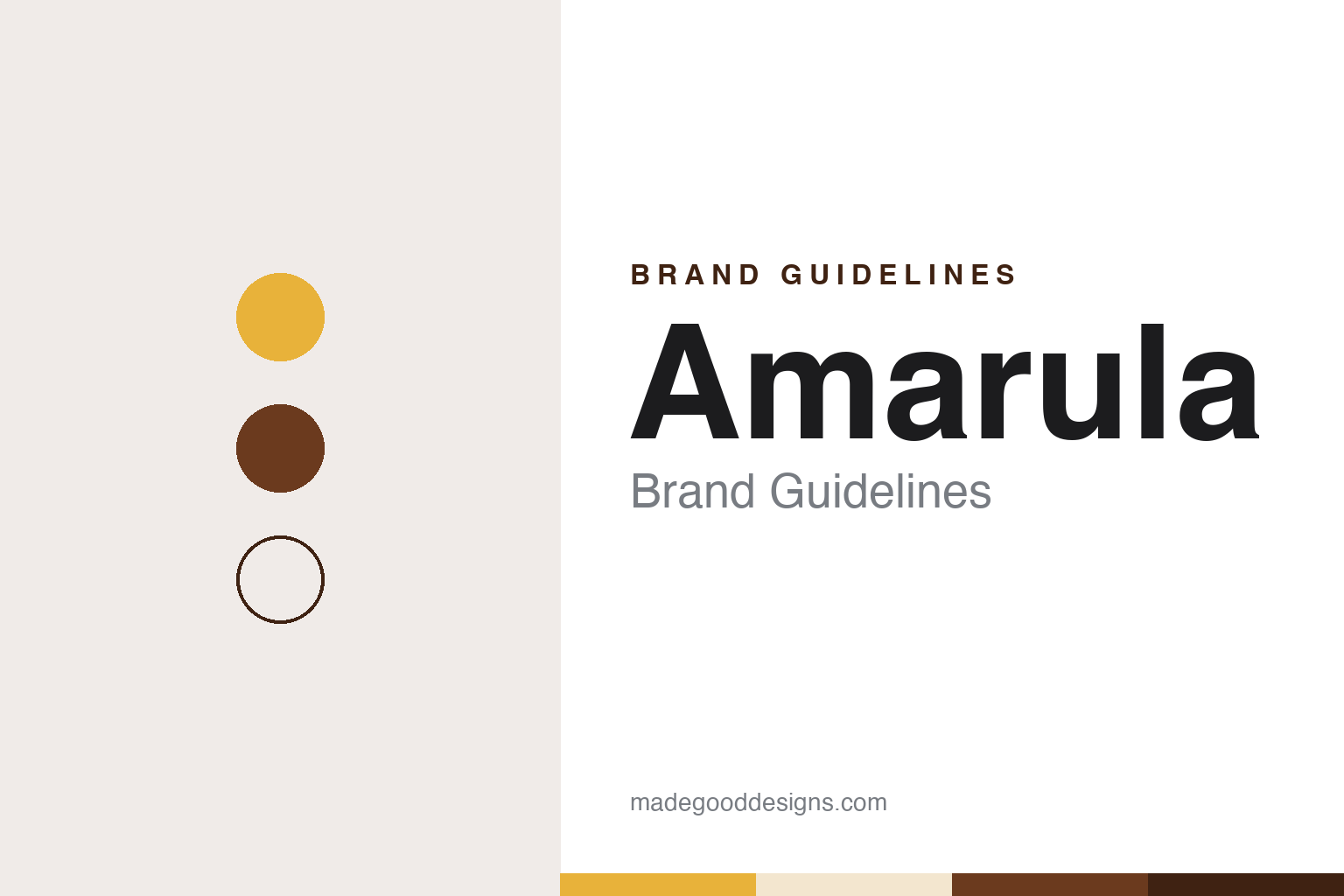
Two constants: a marula gold, cream and bark brown palette and a warm classic serif register. Abstract homage — not an Amarula product or mark; no bottle, label or elephant emblem is reproduced.
The fruit of the elephant tree
A wild African fruit, a spirit and then cream.
Amarula is a cream liqueur from South Africa made with sugar, cream and the fruit of the marula tree, Sclerocarya birrea, which is known locally as the elephant tree or the marriage tree, English Wikipedia says. The standard Amarula Cream is bottled at 17% alcohol by volume. Its emblem and its long-running conservation work both centre on the elephant, an animal closely associated with the marula fruit.
The product came in two stages. It was launched first as a spirit, in 1983, and then as a cream liqueur in 1989, The Hindu Business Line reported in July 2007, quoting the company; English Wikipedia dates the liqueur to September 1989 and says it was first marketed by the Southern Liqueur Company of South Africa, the trademark owner and a wholly owned subsidiary of Distell. Amarula was a creation of Distillers Corporation, the South African brandy and spirits company founded by Anton Rupert in 1945; English Wikipedia, citing Distell’s own history, credits Distillers with creating Amarula Cream. When Distillers merged with Stellenbosch Farmers’ Winery in December 2000 to form Distell, Amarula went into the new group.
The spirit inside the cream was refreshed in 2014 as a product of its own. The Drinks Business reported in February 2014 that Amarula was releasing its first new product in 25 years, and German Wikipedia identifies it as Amarula Gold, a marula-fruit spirit at 30% alcohol. A run of flavoured cream liqueurs followed from around 2019 and 2020, among them a Raspberry, Chocolate & African Baobab, a Vanilla Spice and an Ethiopian Coffee, then a vegan version and, in Europe from October 2022, an Amarula African Gin, the German trade magazine Spirituosen-Journal reported.
Colour
From Phalaborwa to Stellenbosch.
The marula harvest anchors the brand in a particular landscape. In a 2007 report datelined Phalaborwa, The Hindu Business Line described how the fruit is gathered: the facility known as the Amarula Lapa, about 12 km from the Phalaborwa Gate of the Kruger National Park, housed Distell’s first stage of production, where the fruit was sorted and quality-checked. Distell’s Thato Makgolane told visiting journalists that the tree grows in abundance in Limpopo province, that all of Amarula’s marula products came from that region, and that local people brought fruit to the facility or to delivery points in nearby villages; he said the trade gave income to about 60,000 people. The fruiting season, he said, runs from January to March.
The same report traced the process from there. The fruit is selected, sorted and washed and then de-stoned, and the pulp is taken by tanker to Distell’s cellar at Stellenbosch, in the Western Cape winelands. There it is fermented in a process similar to wine-making, distilled into marula spirit and matured in oak for two years, before being blended with fresh cream. At the time, the paper said, Amarula Cream was distributed in more than 100 countries.
The elephant follows from the fruit. African bush elephants eat marula fruit, and because of that association the maker made the elephant its symbol and backed elephant conservation, English Wikipedia says. In 2002 the Amarula Elephant Research Programme was launched at the University of KwaZulu-Natal in Durban under Professor Rob Slotow, studying elephants’ movements and behaviour, according to an archived page of the university’s foundation. The brand has also produced elephant-themed collectibles, and in November 2007 the British trade site TalkingRetail reported an on-pack “Win-an-Elephant” promotion. A Khanyisa limited edition, the company says, raised money for the rehabilitation of an orphaned albino elephant calf.
Typography
Design and documentation.
The seven brands in this group are all drink names from South Africa: Castle Lager, Savanna, Hunter’s, Amarula, Appletiser, Liqui-Fruit and Oros. South African drink brands in general sit at many different points in the trade, from names that still carry a founder’s story to names that now belong to much larger food and drink groups, and a single brand can be sold everywhere from a corner shop to a supermarket shelf.
A drink brand’s identity is usually carried less by a single product than by a bottle, a label, a name and the occasion it promises, because the company behind the name may have changed hands, moved its production or grown far beyond the place where it started. That makes the questions behind each name worth asking plainly: who started it, who owns it now, and where its drinks are actually made and bottled.
Each guide separates what independent sources record from what the company says about itself — its founding story, its owners over time, where its drinks are made and how its packaging has changed — and marks plainly what rests only on the company’s own word.
Aa
A warm classic serif for a cream liqueur sold on African origin. (Specimen set in Cormorant Garamond, a serif STAND-IN; NOT the Amarula logo.)
Amarula
Awards, Brazil and a new owner.
Amarula has collected recognition at international spirits competitions. English Wikipedia records a gold medal at the 2009 San Francisco World Spirits Competition; in 2022 the Raspberry, Chocolate & African Baobab version was named a Master in The Spirits Business’s Liqueur Masters, and Amarula Cream was named best South African cream at that year’s World Liqueur Awards. English Wikipedia describes the taste as that of a slightly fruity caramel.
Outside South Africa its standout market is Brazil. Introduced in the country in the 1990s, Amarula marked 30 years in Brazil in 2025 as the leader in cream liqueurs, the Brazilian outlet Fator Brasil reported, and Bloomberg Línea Brasil reported in September 2025 that Brazil accounted for about 8% of the brand’s global volume. Its Brazilian marketing has leaned on the elephant: a 2019 co-branded Amarula cappuccino with the café chain Rei do Mate, and in 2025 an urban-art project called “Elephant Heart,” a disco-ball sculpture that toured São Paulo in support of Elephant Sanctuary Brazil, the advertising trade paper Meio & Mensagem reported. In Germany the liqueur is distributed by Semper idem Underberg, German Wikipedia says.
Ownership changed with Distell. Heineken announced its plan to buy Distell on 15 November 2021, Reuters reported, and completed the deal on 26 April 2023, combining Distell, Namibia Breweries and Heineken South Africa into Heineken Beverages, a new business majority-owned by HEINEKEN. Heineken named Amarula among the Distell brands in its completion announcement, and the company’s website today greets visitors with the line “The soul of Africa in a bottle.”
For a design guide, Amarula shows how one fruit and one animal can carry a brand across more than 100 markets. Compare Riga Black Balsam, another liqueur with a strong sense of place, and Savanna, a former Distell stablemate. For this guide we use a marula gold, a cream and a bark brown with a serif, an unofficial interpretation; no product or logo is reproduced.
Explore & save
Keep Amarula’s identity on hand — save it to a board in the Made Good inspiration library.
Amarula identity set
Pin the Amarula marula gold, cream and bark brown palette and the warm classic serif register to your own board.