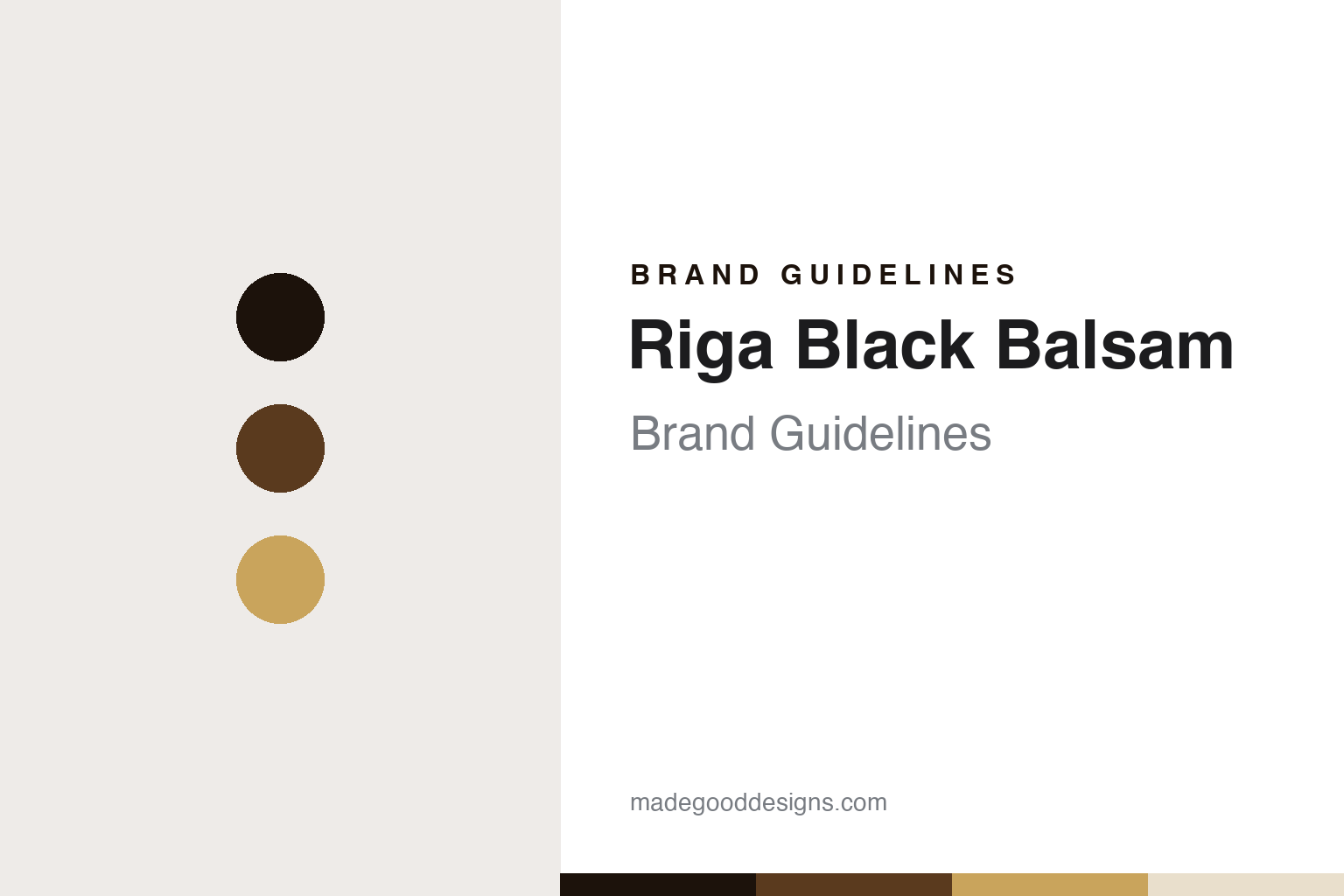
Riga Black Balsam Brand Guidelines
Kunze’s 1752 recipe, the ceramic bottle and Amber.
Aa
Two constants: a balsam black, oak brown and seal gold palette and an old-style apothecary serif register. Abstract homage — not a Riga Black Balsam product or mark; no bottle, label or logo is reproduced.
An apothecary’s recipe
Abraham Kunze, a Russian merchant and a drink turned black.
Riga Black Balsam — in Latvian, Rīgas Melnais balzams — dates its story to 1752. English Wikipedia says the recipe was created that year by Abraham Kunze, an apothecary in Riga, and Latvian Wikipedia records the drink as “Kunze’s balsam” from the same year. Its maker today says the brand’s origins go back to 1752 and calls it one of the oldest alcoholic-drink brands in Europe.
The earliest printed trace is an advertisement. English Wikipedia says that in the 23 December 1762 issue of the Rigische Anzeigen newspaper Kunze offered his balsam in flasks, jugs and bottles sealed with wax and pressed with his initials, A.K.. Later Eva Sofia Kunze carried on selling it, and the right to make it was disputed: a Riga glazier who claimed to have invented it first was turned down by the city council, and in 1774 the city granted the right to the carpenter Martin Roslau, whose daughter and son-in-law later continued, according to English Wikipedia.
The balsam took its modern character in 1789. That year, English Wikipedia says, Semyon Leluchin, a merchant from Vyazma in Russia, obtained a patent to make and sell it, and he turned Kunze’s pale, relatively weak preparation into a stronger black balsam meant for general drinking. By 1804 the factory of his son and heir, Yegor Leluchin, employed six workers and an apprentice. By the middle of the nineteenth century, English Wikipedia says, balsam was being made in Riga, Liepāja, Bauska, Talsi and Ventspils, and in the 1840s the firm of Wolfschmidt began production, becoming the best-known maker of the century; Latvian Wikipedia dates Albert Wolfschmidt’s start to 1847 and says he raised the strength to 45%.
The drink also travelled by sea. English Wikipedia says merchant ships from Marstal, in Denmark, brought it home from Riga in the late eighteenth century, and that in Marstal a few drops of “a Riga” topped with akvavit is still known as a “Marstaller.”
Colour
A lost recipe, a technologist and a stoneware bottle.
The continuous line broke in the twentieth century. According to English Wikipedia, the original recipe was lost in 1939, when its last keepers, the Schrader brothers, left Latvia for Germany with the resettlement of the Baltic Germans. Riga’s distillery, which its present owner dates to 1900 as the Riga State Vodka Warehouse No. 1, was nationalised by the Soviet authorities in 1940 and renamed the Riga spirits and vodka distillery, the company’s history says.
The balsam came back in 1950. The company says that its technologist Maiga Podračniece restored the formula lost during the Second World War; English Wikipedia describes the restoration as a collective effort of the factory’s staff in which she played the essential part. The distillery took the name Latvijas balzams in 1970, and in 1976, the company says, it produced its millionth decalitre of the balsam. During the Soviet period, English Wikipedia notes, the drink was scarce and became a sought-after souvenir and gift.
Its best-known piece of design dates from that era. In 1969, English Wikipedia says, a joint team from the Latvijas Keramika works and the Riga Polytechnical Institute designed the first ceramic bottles for the balsam. Inside, the maker says, the Original is made from 24 ingredients, among them linden blossom, birch bud, valerian root, raspberry, bilberry, ginger, nutmeg and black peppercorn, prepared in oak barrels and bottled at 45%. English Wikipedia adds that, by tradition, only the head liquor master and two apprentices know the full recipe.
Typography
Design and documentation.
The seven brands in this group all make food or drink, and all of them come from Latvia and Estonia: Laima, Selga, Spilva, Riga Black Balsam, Aldaris, Saku and A. Le Coq. Food and drink brands in general sit at many different points in the trade, from firms that still carry a founder’s name to names that now belong to much larger groups, and a single brand can be sold everywhere from a corner shop to a supermarket shelf.
A food or drink brand’s identity is usually carried less by a single product than by a pack, a name and the taste it promises, because the company behind the name may have changed hands, moved its factory or grown far beyond the town where it started. That makes the questions behind each name worth asking plainly: who started it, who owns it now, and where its products are actually made and packed.
Each guide separates what independent sources record from what the company says about itself — its founding story, its owners over time, where its products are made and how its packaging has changed — and marks plainly what rests only on the company’s own word.
Aa
An old-style serif for a recipe that began in an apothecary’s shop. (Specimen set in Cormorant Garamond, a serif STAND-IN; NOT the Riga Black Balsam logo.)
Riga Black Balsam
Privatisation, SPI, Amber and new flavours.
The maker changed hands after Latvia restored its independence. According to the company and Latvian Wikipedia, Latvijas balzams became a public joint-stock company in 1997, its shares were listed on the Riga Stock Exchange in 1998, and the business was fully privatised in 2000. In 2003 a Netherlands-registered subsidiary of the S.P.I. Group bought a controlling stake, and the company began bottling vodkas for the group’s world markets, Latvian Wikipedia says.
In October 2014 the S.P.I. Group set up Amber Beverage Group to bring its Baltic businesses together, and in November that year the controlling stake in Latvijas balzams passed to it, according to Latvian Wikipedia. Shareholders voted in 2021 to rename the company Amber Latvijas balzams, and the new name took effect in April 2022. Amber Beverage Group, now headquartered in Luxembourg, lists Riga Black Balsam among its core brands next to Moskovskaya vodka, Cross Keys Gin and Rooster Rojo tequila, and says the Riga distillery makes the balsam alongside Moskovskaya, Gradus, Cross Keys Gin and Cosmopolitan Diva. The company says it runs two production sites in Riga and employs more than 600 people.
The range has widened around the Original. Latvijas balzams marked the balsam’s 250th anniversary in 2002 and created a special label for its 260th in 2012, the company’s history says. It added a Cherry version in 2017, which it tied to the recipe’s 265th anniversary; English Wikipedia records a coffee-and-cinnamon version in 2019 and limited XO and Chocolate & Mint editions in 2020. The current line-up on the maker’s site runs to Original, Currant, Cherry, Tropical, Chocolate & Mint and Espresso. The company says the balsam won a Grand Prix at the Prodexpo exhibition in Moscow in 2006, and that a cream liqueur under the Riga Black Balsam name won a silver award for design and packaging from The Spirits Business in 2008. English Wikipedia says the balsam has collected more than 100 awards at international fairs.
For a design guide, Riga Black Balsam shows how a dark stoneware bottle, a wax seal and a founding date can carry a drink across two and a half centuries. Compare it with the Riga brewer Aldaris and the Riga confectioner Laima. For this guide we use balsam black, oak brown and seal gold with an old-style serif, an unofficial interpretation; no product or logo is reproduced.
Explore & save
Keep Riga Black Balsam’s identity on hand — save it to a board in the Made Good inspiration library.
Riga Black Balsam identity set
Pin the Riga Black Balsam balsam black, oak brown and seal gold palette and the old-style apothecary serif register to your own board.


