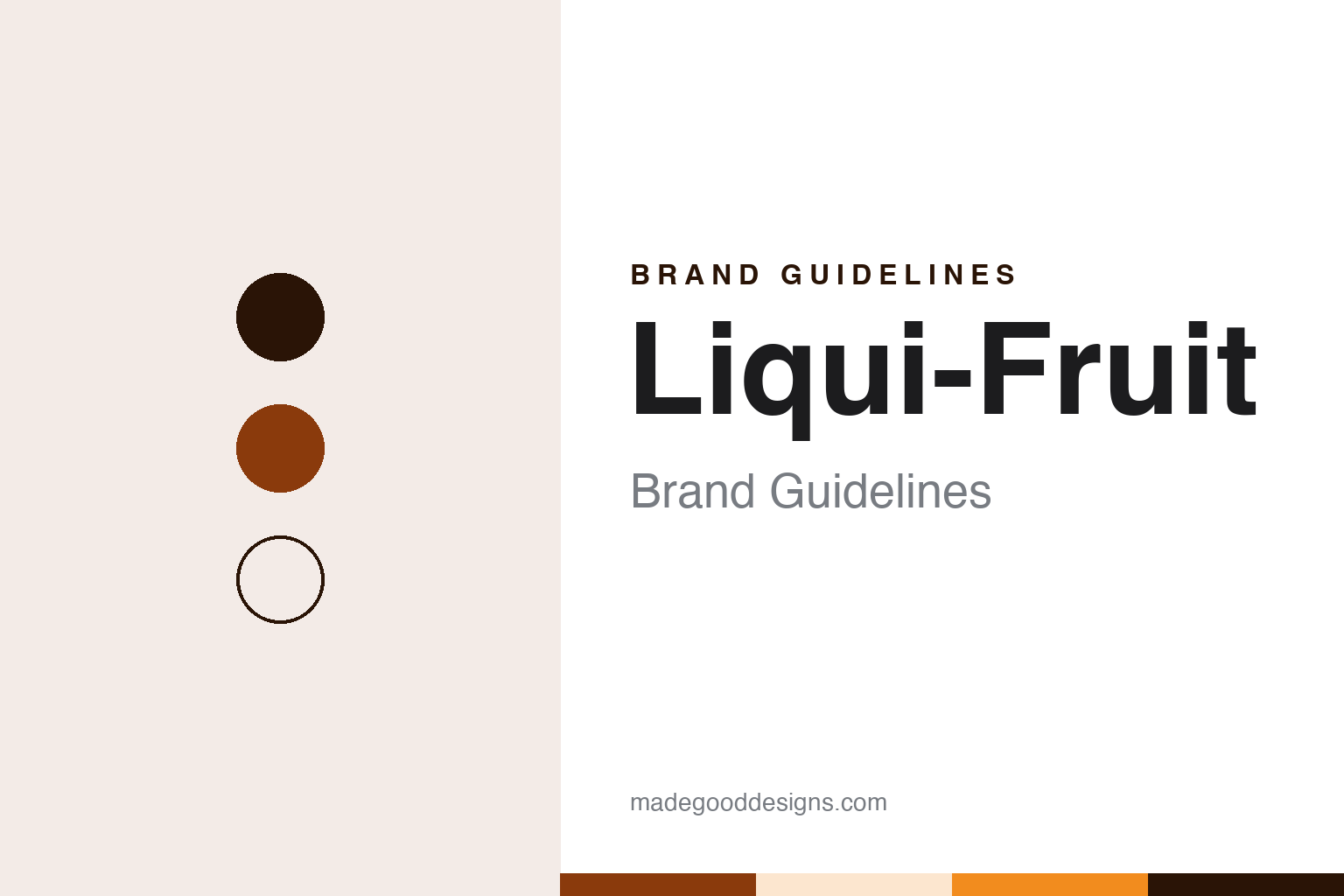
Liqui-Fruit Brand Guidelines
South Africa’s long-life juice since 1975.
Aa
Two constants: a Liqui-Fruit orange palette and a rounded sans register. Abstract homage — not a Liqui-Fruit product or mark; no carton, logo or label is reproduced.
Late 1975
A long-life juice in a carton.
Liqui-Fruit is a South African fruit juice brand, and its owner dates it to 1975. The brand’s website in 2006 said Liqui-Fruit “was introduced in South Africa in late 1975” and called it the market leader in the country’s long-life fruit juice market. Its current website goes further, saying that fifty years ago the brand “revolutionised the South African juice industry by introducing the first ever 100% long life fruit juice,” and that it was also the first to make 100 per cent fruit juice blends; we give those as the company’s claims. A banner on the same site reads “Refreshing summers since 1975.”
The 2006 site listed the range in Tetra Brik Aseptic cartons of one litre and 200 millilitres, as well as cans, and described the juice under the trademarked line “Nothing but Fruit.” The brand’s stated philosophy at the time was “0% Fake.”
The name is written in more than one way. The 2006 site used Liqui-Fruit, with a hyphen, throughout its brand pages; the current site uses “Liqui Fruit” in its page title and image descriptions and “Liquifruit” for its logo, and the web address has no hyphen. We use the hyphenated form here.
Flavour names have long carried the brand’s voice. The 2006 range of 100 per cent juices included Passion Power, Summer Pine, Tangerine Teaser and Red Grape, and the site said Liqui-Fruit had added blends to what it called its traditional base of single-fruit flavours.
Colour
From Ceres to Pioneer Foods.
Liqui-Fruit’s ownership runs through a group of fruit growers in the Western Cape. In a company history published on the Liqui-Fruit website in 2006, Ceres Fruit Juices said its story began in 1923 with Ceres Fruit Growers, in the Ceres valley, and that it first produced juice in 1982 with the launch of the Ceres brand in South Africa. In 1986, the same history says, the Ceres Fruit Juices company was established through the merger of LiquiFruit and Fruitree with Ceres. English Wikipedia describes Ceres Fruit Juices as trading as The Ceres Beverage Company, based in the town of Ceres, and lists Liqui-Fruit among its products.
The juice company then became part of a larger food group. Wikipedia says Ceres became a wholly owned subsidiary of the Bellville-based Pioneer Foods in 2004, citing the Ceres website. Wikipedia says Pioneer Foods itself was formed in 1997 through the merger of SASKO and Bokomo; the Mail & Guardian reported in April 2008 that it would list on the Johannesburg Stock Exchange. Its brands include Bokomo cereals, Ceres Fruit Juice, SASKO bread and Liqui-Fruit. The 2006 company history also says Ceres Fruit Juices acquired the assets of Frucon Food and Beverages in April 2005.
Through the 2000s the brand stretched beyond pure juice. The 2006 site described Liqui-Spritz, a sparkling drink with 15 per cent juice sold in cans; Liqui-Cooler, a non-alcoholic drink in a 275-millilitre glass bottle; a seasonal Marula Mania flavour; and a range of drinks tied to the film Shrek 2 in 2004. Liqui-Spritz came in Tropical, Kiwi Strawberry and Ruby Grapefruit and was presented as an alternative to fizzy soft drinks; Liqui-Cooler, in Cranberry & Blackcurrant, Marula and Lemon, was pitched at nightclubs, bars, house parties and restaurants, with a resealable top and six-packs. In both cases the site said the extension kept the central “0% Fake” idea while leaving the 100 per cent juice unchanged, apart from a packaging update.
Typography
Design and documentation.
The seven brands in this group are all drink names from South Africa: Castle Lager, Savanna, Hunter’s, Amarula, Appletiser, Liqui-Fruit and Oros. South African drink brands in general sit at many different points in the trade, from names that still carry a founder’s story to names that now belong to much larger food and drink groups, and a single brand can be sold everywhere from a corner shop to a supermarket shelf.
A drink brand’s identity is usually carried less by a single product than by a bottle, a label, a name and the occasion it promises, because the company behind the name may have changed hands, moved its production or grown far beyond the place where it started. That makes the questions behind each name worth asking plainly: who started it, who owns it now, and where its drinks are actually made and bottled.
Each guide separates what independent sources record from what the company says about itself — its founding story, its owners over time, where its drinks are made and how its packaging has changed — and marks plainly what rests only on the company’s own word.
Aa
A rounded sans — for a brand that sells itself as “Nothing but Fruit.” (Specimen set in Baloo 2, a rounded sans STAND-IN; NOT the Liqui-Fruit logo.)
Liqui-Fruit
A PepsiCo brand since 2020.
The most recent change of ownership came from the United States. In March 2020 the American food and drinks group PepsiCo completed its purchase of Pioneer Foods, BusinessLive reported on 6 March 2020; Wikipedia says Pioneer was delisted from the Johannesburg Stock Exchange that year. As part of the deal, the South African Department of Trade and Industry said in a statement on 8 March 2020, PepsiCo made commitments on jobs, investment, local empowerment and procurement, and agreed to base its sub-Saharan headquarters in South Africa. The same statement said Pioneer Foods’ roughly 10,000 employees would be protected from merger-related retrenchments and would receive shares in PepsiCo. Wikipedia describes Pioneer as operating in South Africa and two other African countries and exporting a number of its brands.
The footer of its website now reads “Pioneer Foods – a PepsiCo company,” and the brand presents itself under the headline “There’s Nothing Quite Like It,” with product names such as Berry Blaze, Cranberry Cooler and Cranberry Cocktail alongside the single-fruit juices. Its social channels use further variants of the name, from LiquiFruit on Facebook to liqui_fruit on Instagram and TikTok.
For a design guide, Liqui-Fruit shows how a packaging technology, the long-life carton, can become the core of a brand story, and how a name can survive a merger, two changes of parent and several spellings. Compare it with Appletiser, the sparkling apple juice from the Elgin Valley, and Oros, another South African soft-drink name. For this guide we use burnt orange, juice orange and peach cream with a sans, an unofficial interpretation; no product or logo is reproduced.
Explore & save
Keep Liqui-Fruit’s identity on hand — save it to a board in the Made Good inspiration library.
Liqui-Fruit identity set
Pin the Liqui-Fruit orange palette and the rounded sans register to your own board.