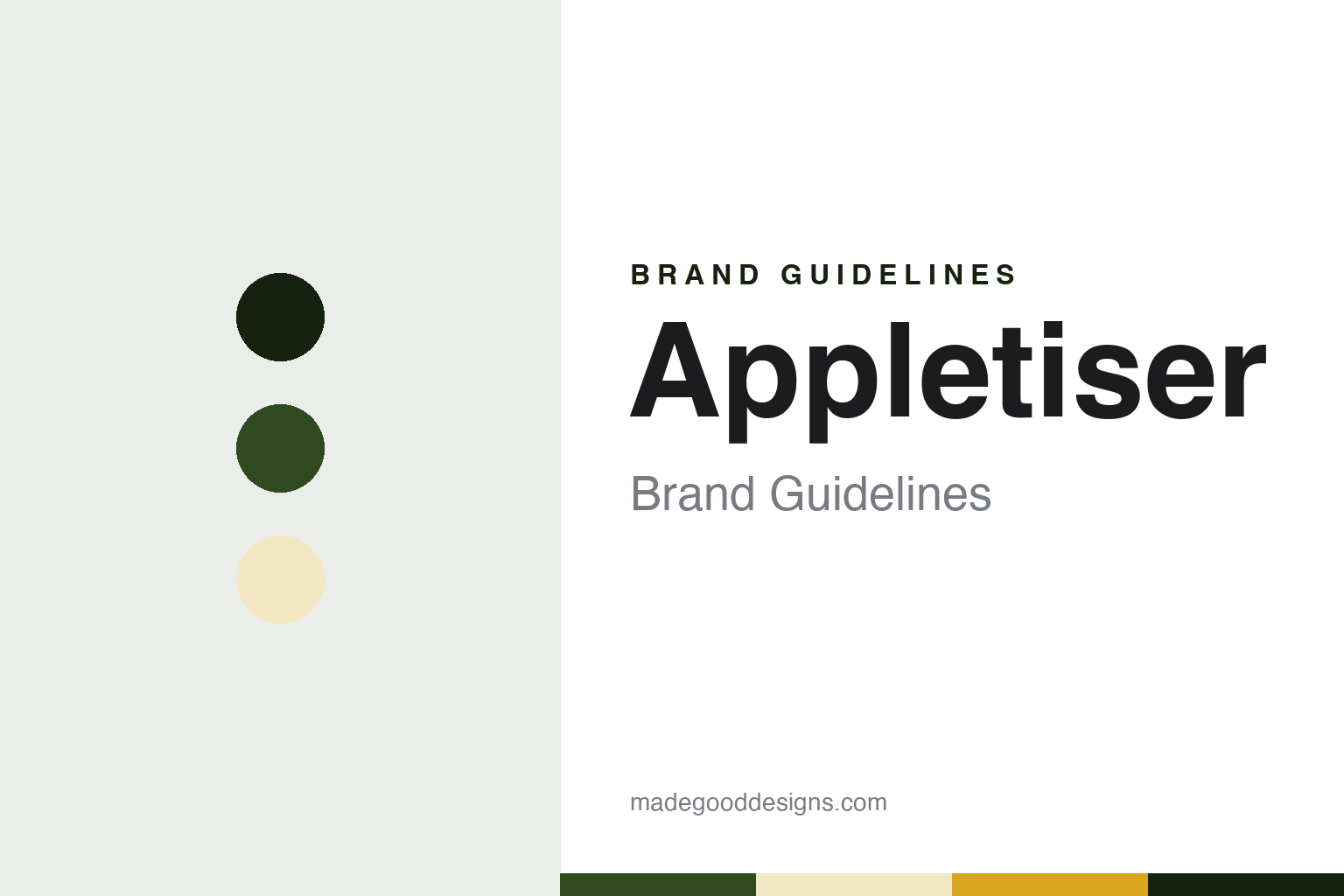
Appletiser Brand Guidelines
Edmond Lombardi’s 1966 sparkling apple juice from the Elgin Valley.
Aa
Two constants: an Appletiser green and gold palette and a crowned serif register. Abstract homage — not an Appletiser product or mark; no bottle, logo or label is reproduced.
The Elgin Valley
An apple valley, an immigrant and a light touch of gas.
Appletiser began in 1966 in the Elgin Valley of the Western Cape, South Africa. Its maker was Edmond Lombardi, an entrepreneur of French and Italian origin, according to both English Wikipedia and the brand’s own Spanish website. The Coca-Cola Company’s South African brand page says Lombardi arrived in South Africa in the 1930s and settled in the Elgin Valley, and it ties the idea for the drink to that place.
The recipe is simple. Wikipedia describes Appletiser as a sparkling fruit juice made by blending fruit juice with carbonated water, and says the name is a play on the word “appetiser.” The brand’s Spanish website, in a 2019 history page, says Lombardi combined the juice of ten varieties of golden apples grown in the valley with “a light touch of gas,” using Swiss technology of the time, and that the juice was filtered and bottled straight away. The same page says the drink has kept to its original recipe for more than fifty years; we give that as the company’s claim.
Exports came early. The Spanish site says the first shipments, in 1969, went to two island groups, the Canary Islands and Japan. Wikipedia says the brand is now sold in more than twenty countries beyond South Africa, among them Britain, Belgium, Spain, Japan, Hong Kong, Australia and New Zealand, while South Africa remains its main market.
The drink’s description has stayed close to that first idea. Wikipedia’s entry gives its colour as golden and its ingredients as apple juice from concentrate, water and carbon dioxide, and BeverageDaily, reporting on the brand in 2014, listed the same three: water, apple concentrate and CO2. Wikipedia lists pack sizes from a 150-millilitre can to a 1.25-litre bottle, including a 750-millilitre bottle and, in Britain, a 250-millilitre can.
Colour
A missing letter in Britain.
One well-documented episode in Appletiser’s history is about a single letter. When the drink reached the United Kingdom in 1982, it went on sale there as “Appletise.” The Daily Telegraph reported in May 2001 that the final “r” had been dropped after AG Barr, the Glasgow maker of the fizzy drink Tizer, complained that customers would confuse the two names.
The same report, by Gary Parkinson, said that South African Breweries, then Appletiser’s owner, was relaunching the drink in Britain as Appletiser that week after more than a year of negotiation with AG Barr, begun in early 2000. It noted that the branding agency Interbrand had named Appletiser among the top 300 brands in the world, while in Britain it had remained “one letter short” of its full name. Cans carrying the full name were to be shipped from South Africa at first, with Coca-Cola’s UK distribution arm planning to make the drink locally using some South African ingredients. Wikipedia says the change let the brand standardise its name, packaging and positioning internationally.
The range grew around the original. Wikipedia says red and white Grapetiser followed in 1981 and that two limited citrus flavours, Orangetise and Lemontise, appeared in 1995, and it lists a later Appletiser Colours range in Pink and Amber. Recognition from tasting juries is something the company points to: the Spanish site lists a gold medal in the 2014 Monde Selection World Quality Selections and a two-star Superior Taste Award from the International Taste & Quality Institute in 2013.
Typography
Design and documentation.
The seven brands in this group are all drink names from South Africa: Castle Lager, Savanna, Hunter’s, Amarula, Appletiser, Liqui-Fruit and Oros. South African drink brands in general sit at many different points in the trade, from names that still carry a founder’s story to names that now belong to much larger food and drink groups, and a single brand can be sold everywhere from a corner shop to a supermarket shelf.
A drink brand’s identity is usually carried less by a single product than by a bottle, a label, a name and the occasion it promises, because the company behind the name may have changed hands, moved its production or grown far beyond the place where it started. That makes the questions behind each name worth asking plainly: who started it, who owns it now, and where its drinks are actually made and bottled.
Each guide separates what independent sources record from what the company says about itself — its founding story, its owners over time, where its drinks are made and how its packaging has changed — and marks plainly what rests only on the company’s own word.
Aa
A crowned serif — for a brand that says it has been “crowning every moment since 1966.” (Specimen set in Playfair Display, a serif STAND-IN; NOT the Appletiser logo.)
Appletiser
From South African Breweries to Coca-Cola.
Appletiser changed hands as part of a larger African deal. In November 2014 BeverageDaily reported that SABMiller, which described Appletiser as its global non-alcoholic ready-to-drink brand, was selling it to The Coca-Cola Company, alongside an agreement to combine the two groups’ soft-drink bottling businesses in Southern and East Africa as Coca-Cola Beverages Africa. Wikipedia says the “-tiser” drinks are now made under licence by Appletiser South Africa, part of the bottling operations of Coca-Cola Beverages South Africa. In May 2017 Fin24 reported that the South African bottler had sold a 17.5 per cent stake in Appletiser South Africa to the African Pioneer Group.
The brand’s Spanish website said in 2019 that Appletiser had been made in the Canary Islands since 2008, at more than eight million units a year, and called the drink an institution in the islands, known in almost every household there. The 2014 agreement also gave Coca-Cola licences to rights to nineteen other non-alcoholic brands in Africa and Latin America, BeverageDaily reported. The Coca-Cola Company now holds the brand’s web presence: appletiser.com redirects to Coca-Cola’s country selector, and the South African brand page carries the line “Appletiser, crowning every moment since 1966.”
For a design guide, Appletiser shows how a single product, a place of origin and a founding year can carry a brand for six decades, and how one missing letter can matter in a new market. Compare it with Liqui-Fruit, another South African juice of the same era, and Pago, the Austrian fruit juice in the green bottle. For this guide we use orchard green, golden apple and pale straw with a serif, an unofficial interpretation; no product or logo is reproduced.
Explore & save
Keep Appletiser’s identity on hand — save it to a board in the Made Good inspiration library.
Appletiser identity set
Pin the Appletiser green and gold palette and the crowned serif register to your own board.