Bintang Brand Guidelines
Indonesia’s star lager, from Surabaya to Heineken.
Aa
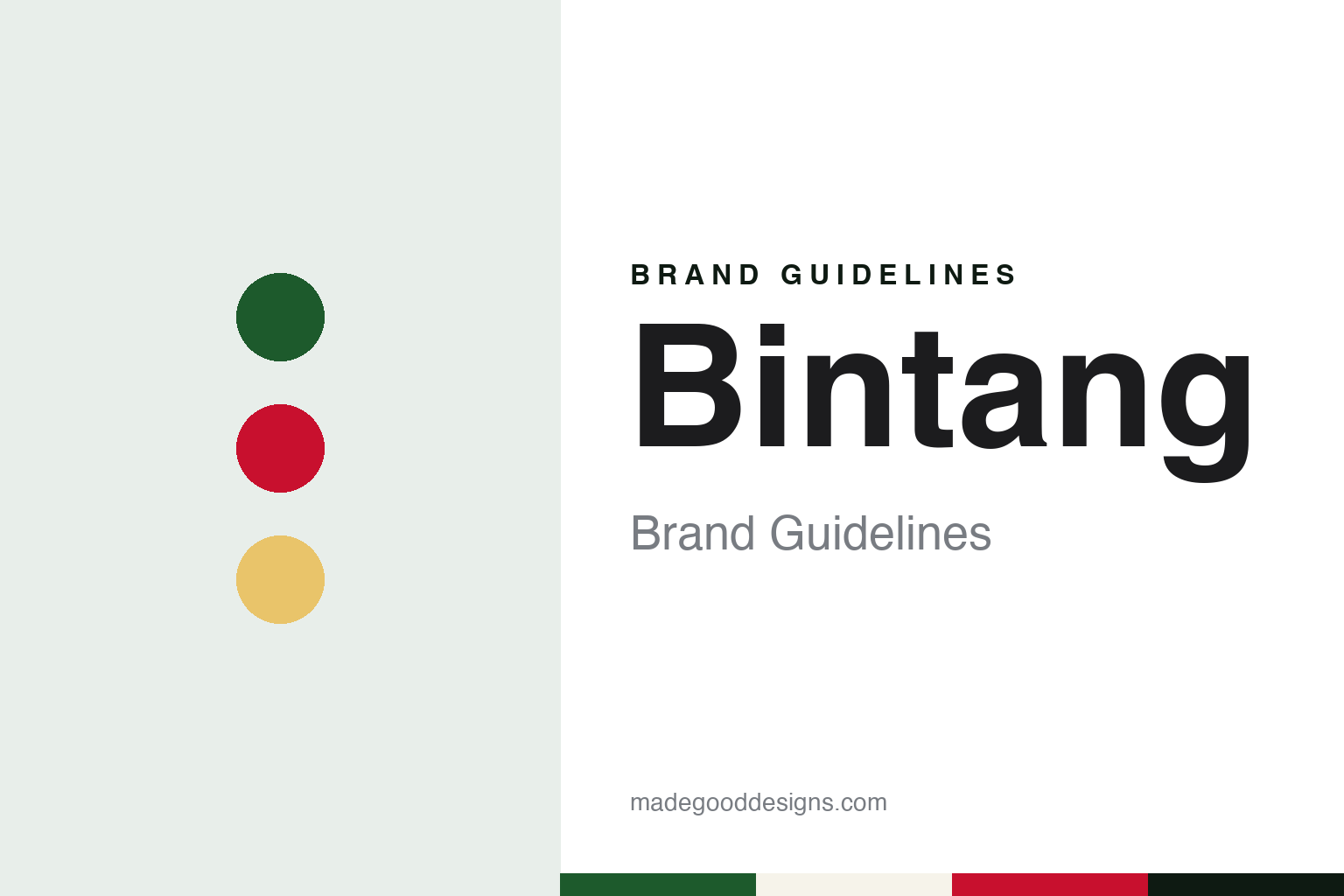
Two constants: a bottle green, star red and gold palette and a colonial-era serif register. Abstract homage — not a Bintang product or mark; no bottle, label or logo is reproduced.
A brewery in the tropics
Heineken’s first brewery in a tropical region.
Bintang — the Indonesian word for “star” — is the lager of PT Multi Bintang Indonesia, part of Heineken. Its roots are in the Dutch colonial period. In 1929, according to Heineken’s own published history, the Dutch brewer took part for the first time in building a brewery in a tropical region, and construction began at Surabaya, in what was then the Dutch East Indies. The same history describes the decade of the Great Depression as one of significant international expansion for Heineken, which moved “decisively” into the American and Asian markets.
The operating company, NV Nederlandsch-Indische Bierbrouwerijen, was founded in Medan, in Sumatra, in 1929, according to Indonesian Wikipedia and a 2023 history of the company in Liputan6; the Surabaya brewery began commercial operation on 21 November 1931. Indonesian Wikipedia’s timeline says its first beer there was “Java Bier,” which it describes as the forerunner of Bir Bintang.
Heineken became the largest shareholder in 1936, the year the company moved its seat from Medan to Surabaya and took Heineken’s name, Indonesian Wikipedia says. After the Netherlands transferred sovereignty to Indonesia in 1949, Heineken’s history says, the Surabaya brewery became “Heineken’s Indonesian Brewery Company.” Liputan6 dates a further renaming, to Heineken’s Indonesische Bierbrouwerijen Maatschappij, to 1951, after a closure during the Second World War.
Colour
Nationalisation, a new star and a new name.
The brewery then spent years out of Heineken’s hands, and the sources differ on when that began. Heineken’s history says the Indonesian government took over the Surabaya brewery in 1957 and held it until 1967; Indonesian Wikipedia’s timeline and Liputan6 date the nationalisation to 1965. All agree that Heineken regained the business in 1967, and Indonesian Wikipedia says the Bintang Baru (“New Star”) brand was born that year.
Growth followed. In 1972 the company was renamed PT Perusahaan Bir Indonesia and began a second brewery at Tangerang, west of Jakarta, which started production in 1973. On 1 January 1981 it took over PT Brasseries de l’Indonesia, a beer and soft-drink maker in Medan, and on 2 September 1981 it became PT Multi Bintang Indonesia, moved its seat to Jakarta and listed its shares on the Jakarta and Surabaya stock exchanges, Indonesian Wikipedia says. In 1997 brewing moved from Surabaya to a new plant at Sampang Agung in East Java; Sampang Agung and Tangerang are its two breweries today, according to the same source.
English Wikipedia describes Bintang as a pale lager in the pilsner style at 4.7 per cent alcohol. Around it the company has built a wider range. Indonesian Wikipedia says Multi Bintang has made the soft drink Green Sands since 1982, opened a plant for non-alcoholic drinks at Sampang Agung in August 2014 and launched Bintang Radler with lemon that year, followed by a grapefruit version in 2015 and Bintang Radler 0.0% in 2016; the malt drink Bintang Zero is also part of the range. The company also brews and sells Heineken in Indonesia, the same source says, and since 2016 its portfolio has taken in Bintang Maxx 0.0%, the malt-based soda Fayrouz and Strongbow cider.
Selling is handled separately. Since January 2005, Indonesian Wikipedia says, the brands have been marketed and distributed through a subsidiary, PT Multi Bintang Indonesia Niaga, in which Multi Bintang holds 99 per cent. Heineken’s history, for its part, lists Perusahaan Bir Indonesia — the company’s name in the early 1970s — among Heineken’s holdings abroad in that decade, alongside Malayan Breweries in Singapore.
Typography
Design and documentation.
The seven brands in this group are all beer names from Asia: Tiger, Anchor, Beerlao, Bintang, Cobra, Kingfisher and Taiwan Beer. Asian beer brands in general sit at many different points in the trade, from names first brewed by a single local company to names that now belong to much larger brewing groups, and a single brand can be sold everywhere from a street stall to a supermarket shelf.
A beer brand’s identity is usually carried less by a single brew than by a label, a name and the occasion it promises, because the company behind the name may have changed hands, moved its brewing or grown far beyond the place where it started. That makes the questions behind each name worth asking plainly: who started it, who owns it now, and where its beer is actually brewed and packed.
Each guide separates what independent sources record from what the company says about itself — its founding story, its owners over time, where its beer is brewed and how its packaging has changed — and marks plainly what rests only on the company’s own word.
Aa
A colonial-era serif for a brewery begun in 1929. (Specimen set in Fraunces, a serif STAND-IN; NOT the Bintang logo or label lettering.)
Bintang
A star inside the Heineken family.
In the last fifteen years ownership has moved within the Heineken family. In 2010 Asia Pacific Breweries (APB) of Singapore — the maker of Tiger, founded in 1931 as a joint venture between Heineken and Fraser and Neave — acquired Multi Bintang from Heineken International, English Wikipedia says, citing Pack Web Asia. In August 2012 Fraser and Neave accepted Heineken’s offer for its stake in APB, and shareholders approved the sale on 28 September 2012, English Wikipedia says, citing Channel NewsAsia; in 2013 APB was renamed Heineken Asia Pacific. Indonesian Wikipedia says Heineken International became the company’s main shareholder again in September 2013. Multi Bintang’s shares still trade on the Indonesia Stock Exchange, under the code MLBI.
The beer has collected outside recognition. At the Brewing Industry International Awards in London in 2011, Bintang won a gold medal in its lager class and was named champion beer in the lager category, English Wikipedia says, citing the awards’ own results. Brand Finance listed Bir Bintang among the 50 most valuable Indonesian brands in 2013, and Indonesian Wikipedia says the listing continued to 2016.
For a design guide, Bintang shows how a brand born in a colonial brewery became a national name while staying inside an international group. Compare Tiger and Anchor, two more beers from Heineken Asia Pacific. For this guide we use bottle green, a star red and pilsner gold with a serif, an unofficial interpretation; no product or logo is reproduced.
Explore & save
Keep Bintang’s identity on hand — save it to a board in the Made Good inspiration library.
Bintang identity set
Pin the Bintang bottle green, star red and gold palette and the colonial-era serif register to your own board.