Cobra Brand Guidelines
The curry-house lager founded in London in 1989.
Aa
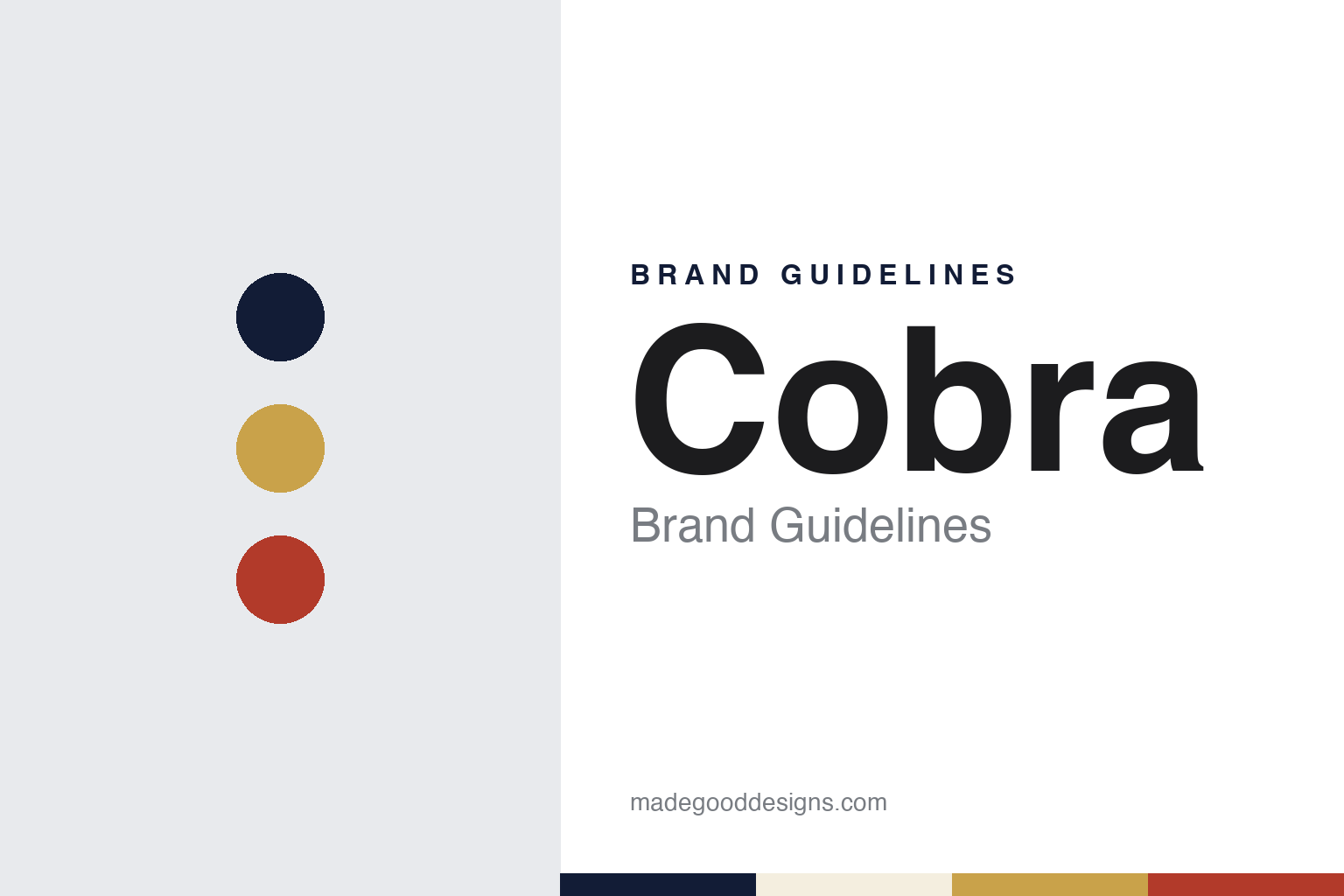
Two constants: a night navy, brass gold and chilli red palette and a high-contrast display serif register. Abstract homage — not a Cobra product or mark; no bottle, label or logo is reproduced.
A lager for the curry house
A law student, a Bangalore brewer and a 2CV.
Cobra is a British beer brand with an Indian accent. It was founded in 1989 by Karan Bilimoria, who had moved from India to London, qualified as a chartered accountant and then studied law at Cambridge in the late 1980s, which is when the idea came to him, BBC News reported in a 2014 profile. Bilimoria told the BBC that he found British lager “too fizzy, too harsh and too bloating” to drink with a curry, while real ale was “too bitter and heavy with food”, so he set out to make a beer “with the refreshment of a lager, but with the smoothness of an ale”.
He had no experience of the beer industry. According to the BBC, Bilimoria went to the head brewer at what was then India’s largest independent brewery, and together they developed the recipe. English Wikipedia names that supplier as the Bangalore-based Mysore Brewery. The first deliveries arrived in Britain by container ship in 1990, at the start of a recession.
The early business was small and personal. Working from an office in Fulham, in south-west London, Bilimoria spent the first year delivering bottles door-to-door to Indian restaurants in a Citroën 2CV, the BBC reported. At first Cobra came only in big 660ml bottles, the size most popular in India, and Bilimoria told the BBC that the large bottles stood out on curry-house tables: diners at other tables would ask what the beer was. That restaurant trade remained the brand’s core. By 2014 the company said Cobra was sold in more than 98% of licensed curry houses in the UK, the BBC reported, and it had also reached the main supermarkets.
Colour
From Indian imports to British breweries.
Cobra’s Indian origin and its British production have sat side by side for most of its life. As demand grew, Bilimoria moved brewing from India to the United Kingdom. The BBC dates the switch to 1997; English Wikipedia, citing the trade magazine Brewers’ Guardian, says the beer was brewed under contract by Charles Wells, the Bedford brewer, from 1996. Bilimoria told the BBC that the company first checked with drinkers, who said they did not mind where it was brewed, and drew the comparison that the Indian food eaten in Britain is not flown in from Delhi either.
The range widened in the 2000s. In 2005 the company launched King Cobra, a stronger premium lager brewed at the Rodenbach brewery in Belgium, which the company described in 2014 as fermented a second time in the bottle. An alcohol-free version, Cobra Zero, was also launched in 2005, English Wikipedia says. Bilimoria wrote about the early years and the expansion in his 2007 book Bottled for Business: The Less Gassy Guide to Entrepreneurship, published by Wiley.
Production has since settled in the English brewing town of Burton upon Trent. The Burton Mail reported in April 2010 that Burton was becoming the new home of Cobra, and English Wikipedia says that, as of 2014, the beer was made primarily in Burton, with King Cobra in Belgium and beer for the Indian market brewed in Patna, in the state of Bihar, according to the company’s Indian arm at the time. The founder’s own profile rose with the brand: Bilimoria was knighted in 2004 for services to business and entrepreneurship and appointed to the House of Lords two years later, the BBC reported, and he was still Cobra’s chairman when the BBC interviewed him in 2014.
Typography
Design and documentation.
The seven brands in this group are all beer names from Asia: Tiger, Anchor, Beerlao, Bintang, Cobra, Kingfisher and Taiwan Beer. Asian beer brands in general sit at many different points in the trade, from names first brewed by a single local company to names that now belong to much larger brewing groups, and a single brand can be sold everywhere from a street stall to a supermarket shelf.
A beer brand’s identity is usually carried less by a single brew than by a label, a name and the occasion it promises, because the company behind the name may have changed hands, moved its brewing or grown far beyond the place where it started. That makes the questions behind each name worth asking plainly: who started it, who owns it now, and where its beer is actually brewed and packed.
Each guide separates what independent sources record from what the company says about itself — its founding story, its owners over time, where its beer is brewed and how its packaging has changed — and marks plainly what rests only on the company’s own word.
Aa
A high-contrast display serif for a lager pitched at the restaurant table. (Specimen set in Playfair Display, a serif STAND-IN; NOT the Cobra logo.)
Cobra
A pre-pack rescue and a Molson Coors partnership.
Rapid growth eventually outran the company’s finances. The BBC reported in 2014 that Cobra had grown by an average of 40% a year since 1989, but had built up debts and was making a loss when the 2008 financial crisis hit, and that it put itself up for sale in November 2008. On 29 May 2009 the company went into administration and was sold the same day in a pre-pack deal to Cobra Beer Partnership, a joint venture between the North American brewer Molson Coors, with 50.1%, and Bilimoria, who became chairman, The Times reported at the time. Bilimoria told the BBC that the crisis never interrupted production or supply of the beer.
Molson Coors has held the majority since. In June 2011 The Times of India reported that Molson Coors had also bought a 51% stake in Cobra’s Indian business, renamed Molson Coors Cobra India, with Bilimoria keeping the rest. Under the joint venture, the BBC reported in 2014, sales kept growing at a high-single-digit rate, and Cobra had become Molson Coors’ most profitable brand in the UK; the company was then planning a fresh push into pubs and bars beyond the curry house.
The curry house was the target from the start: the BBC described Cobra as initially aimed at Britain’s Indian restaurants, and Bilimoria credits the tall bottle with doing early marketing work at the table. Our separate guide to the Cobra beer font looks at the lettering on its labels.
For a design guide, Cobra shows how a beer can be Indian in idea and British in production, and build a brand around one kind of meal. Compare Kingfisher, the Bangalore lager also sold in Britain, and Patak’s, the Indian food brand built in Britain. For this guide we use night navy, brass gold and a chilli red with a high-contrast serif, an unofficial interpretation; no product or logo is reproduced.
Explore & save
Keep Cobra’s identity on hand — save it to a board in the Made Good inspiration library.
Cobra identity set
Pin the Cobra night navy, brass gold and chilli red palette and the high-contrast display serif register to your own board.