Radeberger Brand Guidelines
The Saxon pilsner with a royal warrant and a 1937 script.
Aa
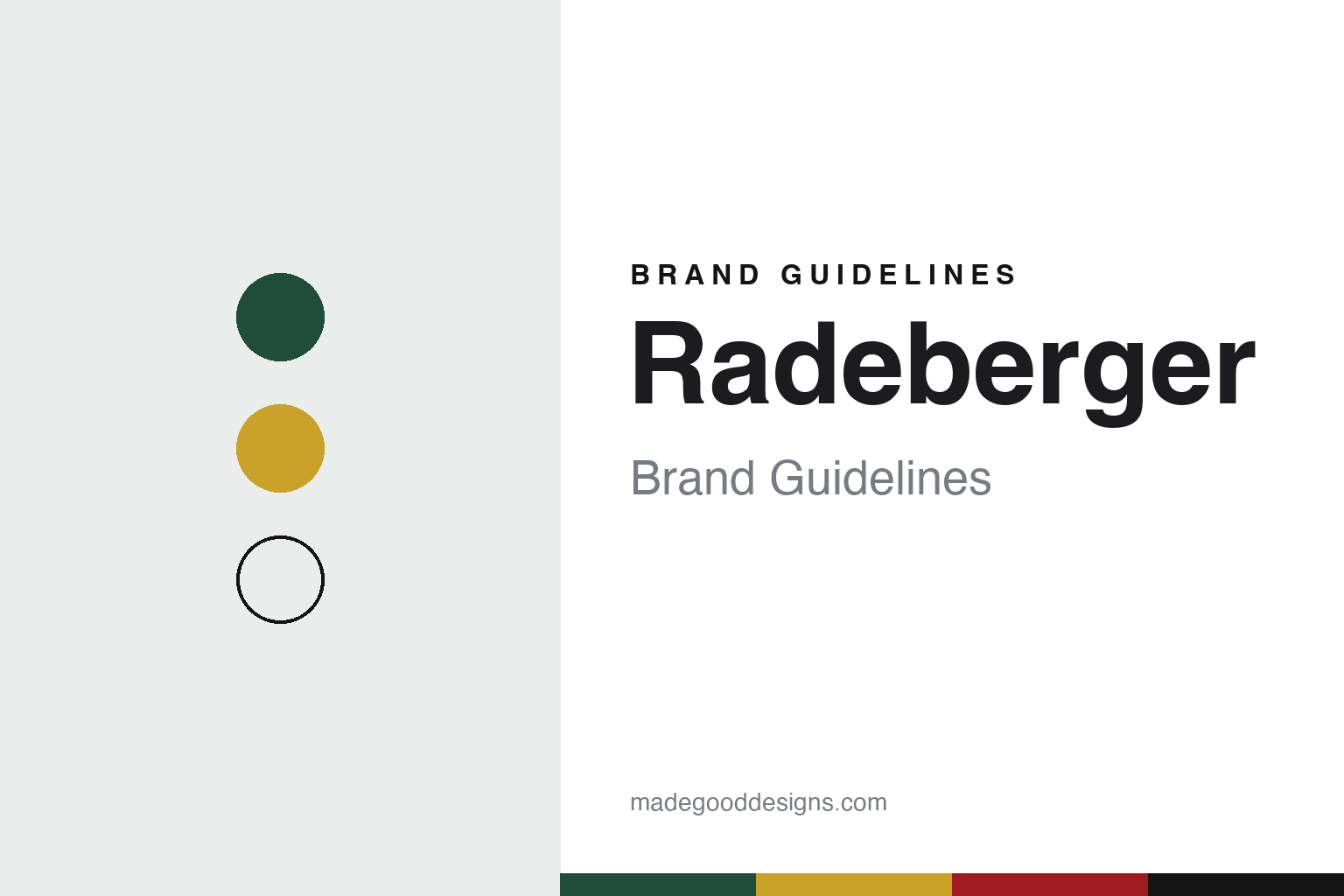
Two constants: a bottle green, pilsner gold and royal red palette and an engraved display serif register. Abstract homage — not a Radeberger product or mark; no bottle, label, crest or logo is reproduced.
Zum Bergkeller
Five local notables, a wine shop and a share company.
Radeberger began as a share company in 1872. The idea for a large brewery in Radeberg, a small town near Dresden in Saxony, was hatched among well-to-do locals in Knobloch’s wine shop, according to a history of the brewery written by Katja Altmann of the town’s Museum Schloss Klippenstein for its 150th anniversary. The Actienbrauerei zum Bergkeller was entered in the commercial register on 12 April 1872. Its founders were the estate owner Gustav Philipp, who became its first director, the town councillor August Max Rumpelt, the town treasurer Carl Hermann Rasche, the Dresden lawyer Heinrich Eduard Minckwitz and a ribbon-weaving manufacturer named Schöne from nearby Großröhrsdorf, the museum history and the company both say.
The company bought an existing brewery on the road to Dresden, run by a brewer named Gäbler since 1866, and built a new one beside it. Brewing in the new plant began in June 1873, and its first lager went on sale that September. Money was short from the start: the company went into liquidation in 1883 and was refounded in April 1885 as the Radeberger Exportbierbrauerei AG, a name chosen to point to both the town and the export trade, Altmann writes.
Several of the brand’s lasting symbols date from these years. In March 1887 the brewery sent a decorated barrel to Berlin for the birthday of Chancellor Otto von Bismarck, who agreed that a new lager could be called “Kanzler-Bräu”. The brewery began bottling its own beer in May 1887, and the Radeberg town council approved the town’s coat of arms as its trademark, first on the porcelain swing-top stoppers and later on the bottle neck. From 1892 it developed its own spring in the Karswald forest; the soft brewing water still comes to the brewery through a pipeline of about eight kilometres, the museum history says.
Colour
A king’s table drink and a pure pilsner brewery.
In 1903 the brewery’s assets passed to a new company, the Deutsche Bierbrauerei AG of Berlin, which took the Radeberger name again in 1925, German Wikipedia says, citing the 1925 Handbuch der deutschen Aktiengesellschaften. By a decree of 11 December 1905, the brewery was allowed to call its Radeberger Pilsner the table drink of King Frederick Augustus III of Saxony; the museum history adds that the warrant carried the right to use the royal Saxon arms, which it says are still found on every bottle. The king visited the brewery in July 1907.
A 1906 agreement with the Feldschlößchen brewery in Dresden moved every beer except the pilsner there, which made Radeberg a pure pilsner brewery, Altmann writes. The company describes itself as the first brewery in Germany to brew only in the pilsner style. Brewers in Pilsen took it to court over the word; in September 1913 the Reichsgericht, Germany’s supreme court, ruled that “Radeberger Pilsner” clearly stated where the beer came from, the museum history and the company say.
The wordmark also has a documented date. According to the museum history, a trademark of 1931 showed a shield divided into four fields with the letters R and P; a new mark was used from 1936, and the “Radeberger Pilsner” script lettering still in use was filed with the patent office early in 1937.
After the Second World War the Soviet military administration seized the company on 30 October 1945, and it was expropriated after the Saxon referendum of 30 June 1946, Altmann writes. As the state-owned VEB Radeberger Exportbierbrauerei it was named the only specialist brewery of East Germany on 1 January 1958 and brewed only export beer; German Wikipedia, citing Der Spiegel in 1990, says the beer was mostly exported or sold in the Interhotel chain. In November 1967 the brewery switched to half-litre Euro bottles and its own plastic crates of twenty, the museum history says.
Typography
Design and documentation.
The seven brands in this group are all German beer brands: Beck’s, Krombacher, Warsteiner, Bitburger, Paulaner, Erdinger and Radeberger. German beer brands in general sit at many different points in the trade, from family firms that still carry a founder’s name to names that now belong to much larger brewing and drinks groups, and a single brand can be sold everywhere from a corner shop to a supermarket shelf.
A beer brand’s identity is usually carried less by a single product than by a bottle, a label, a name and the town it comes from, because the company behind the name may have changed hands, moved its production or grown far beyond the place where it started. That makes the questions behind each name worth asking plainly: who started it, who owns it now, and where its beer is actually brewed and bottled.
Each guide separates what independent sources record from what the company says about itself — its founding story, its owners over time, where its beer is brewed and how its packaging has changed — and marks plainly what rests only on the company’s own word.
Aa
An engraved display serif for a beer that has used one script since 1937. (Specimen set in Playfair Display, a serif STAND-IN; NOT the Radeberger logo.)
Radeberger
Binding, a new brewhouse and the Oetker group.
West German brewers came to Radeberg soon after the Berlin Wall opened. The Frankfurt Binding-Brauerei made contact in November 1989, the state-owned brewery became a limited company on 1 July 1990, and the Treuhand privatisation agency sold it to Binding in September 1990, according to the museum history. A new brewhouse, designed by the Hamburg architect Horst Vollquars, was inaugurated on 20 June 1992, and by 1994 annual output had passed one million hectolitres.
Binding was part of the group controlled by the Bielefeld family company Dr. August Oetker KG, and in 2002 its brewing arm was renamed the Radeberger Gruppe, German Wikipedia says. Today the Radeberger Gruppe, based in Frankfurt am Main, is the beer and soft-drinks division of the Dr. Oetker family’s Oetker group, which split into two separate groups in 2021; German Wikipedia counts around 60 beer brands in the Radeberger Gruppe. Until the end of 2017 it also owned the organic soft drink Bionade, the Frankfurter Allgemeine Zeitung reported.
The company says Radeberger Pilsner is still brewed only in Radeberg. The brewery introduced redesigned bottles and crates in 2007, and since 2017 it has advertised with the line “Radeberger Pilsner – das Pilsner”, the museum history says. In 2020 it gave up its single-beer strategy, and a Radeberger Alkoholfrei has been on sale since January 2022, the jubilee year. The brewery says it has had an advertising partnership with Dresden’s Semperoper since 1992, and the Augsburger Allgemeine reported in 2010 that Charlie Harper, Charlie Sheen’s character in the American sitcom Two and a Half Men, drinks bottled Radeberger.
For a design guide, Radeberger shows how a town crest, a royal warrant and a 1937 script can carry one beer through an empire, two German states and a family food group. Compare Budvar, the Czech lager from České Budějovice in Bohemia, and Dr. Oetker, the family group that owns it today. For this guide we use bottle green, pilsner gold and a royal red with an engraved display serif, an unofficial interpretation; no product or logo is reproduced.
Explore & save
Keep Radeberger’s identity on hand — save it to a board in the Made Good inspiration library.
Radeberger identity set
Pin the Radeberger bottle green, pilsner gold and royal red palette and the engraved display serif register to your own board.