Miller Lite Brand Guidelines
The Chicago recipe Milwaukee turned into a category.
Aa
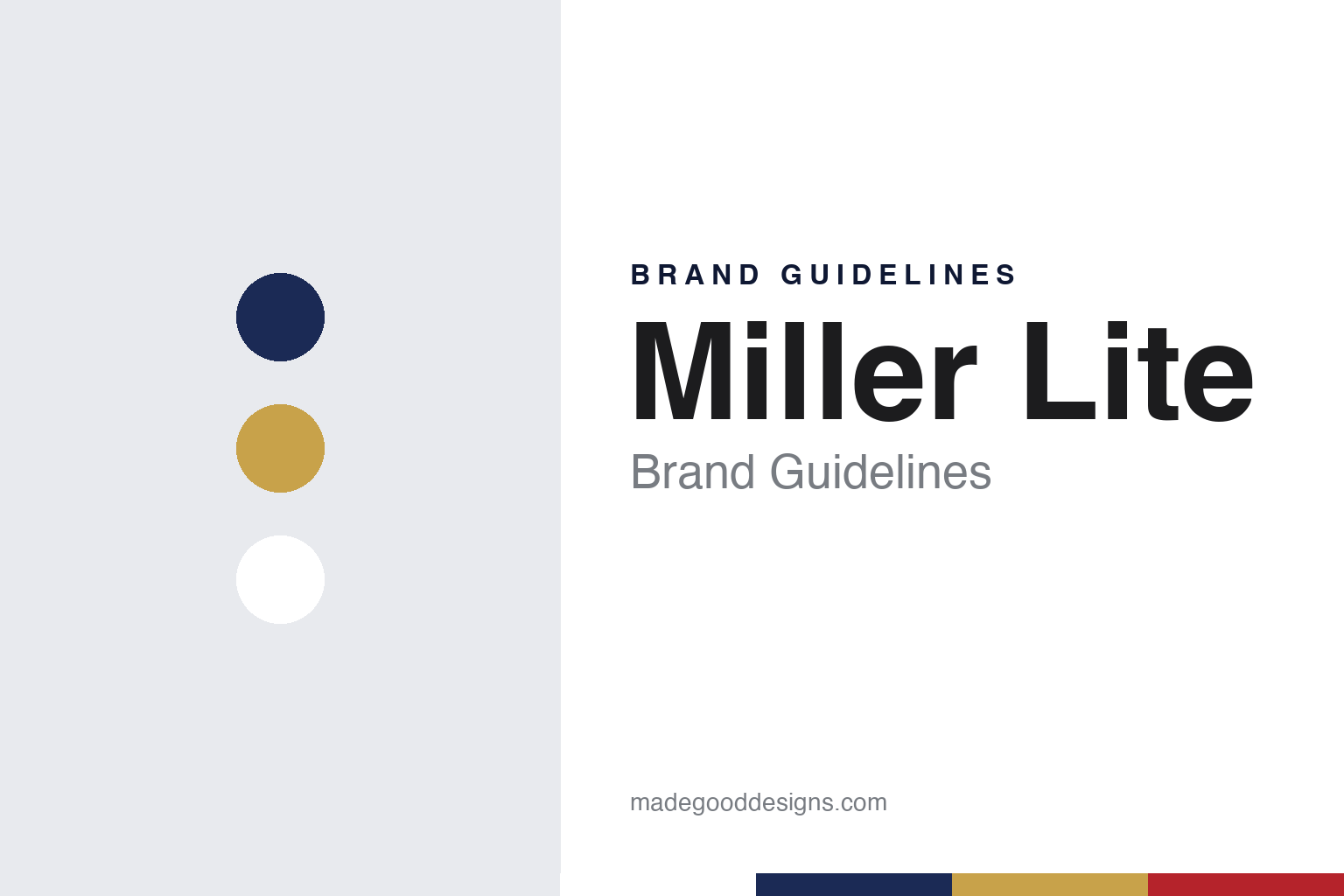
Two constants: a Miller Lite white, navy and gold palette and a Blackletter register. Abstract homage — not a Miller Lite product or mark; no can, label or logo is reproduced.
Meister Brau Lite
Born in Chicago, raised in Milwaukee.
Miller Lite’s story begins in Chicago, not Milwaukee. In May 1967 the Chicago brewer Meister Brau, formerly the Peter Hand Brewery, introduced Meister Brau Lite, the Chicago Tribune reported at the time. English Wikipedia says Meister Brau spent two years developing its process, which used an enzyme, amyloglucosidase, during brewing, and that the company held the trademark “Lite” as the beer’s name.
The Chicago firm did not last. In June 1972, in financial difficulty, Meister Brau sold its brands, Lite among them, to the Miller Brewing Company of Milwaukee, the Chicago Tribune reported. Miller was by then owned by the tobacco company Philip Morris, which had bought it from W. R. Grace in 1969, English Wikipedia says. Miller itself dated back to 1855, when Frederick Miller, an immigrant from Germany, bought the small Plank Road Brewery in Milwaukee.
Miller reworked the recipe. Reports from 1978 cited by English Wikipedia say it spent more than a year testing about 30 brewing formulas. The beer was relaunched as “Lite” in 1973 in four test markets — Springfield, Illinois; Providence, Rhode Island; Knoxville, Tennessee; and San Diego — according to a history on the brewer’s own blog titled “Born in Chicago, Raised in Milwaukee,” and went national in 1975. English Wikipedia’s article on Miller Brewing gives 1972 as its introduction instead. Other brewers followed with light beers of their own; Anheuser-Busch launched Bud Light in 1982, and English Wikipedia says it overtook Lite in sales by 1994 and that Miller relabelled its brand “Miller Lite” in 1998.
Colour
From Philip Morris to Molson Coors.
The brand has changed owners with its brewery. Miller stayed in the founding family until 1966, when the conglomerate W. R. Grace bought it; Philip Morris took over in 1969. In 2002 South African Breweries bought Miller from Philip Morris, forming SABMiller, English Wikipedia says.
On 1 July 2008 SABMiller and Molson Coors combined their brewing, marketing and sales in the United States in a joint venture, MillerCoors, with SABMiller holding the larger share. When Anheuser-Busch InBev agreed to buy SABMiller, the US Justice Department required SABMiller to give up its Miller interests, and on 11 October 2016 it sold its stake in MillerCoors to Molson Coors. Molson Coors gained full ownership of the Miller brands outside the United States and kept the rights within it, English Wikipedia says. On 1 January 2020 the group renamed itself Molson Coors Beverage Company and retired the MillerCoors name.
The Miller Brewing Company is still based in Milwaukee, where the Miller Brewery stands, and English Wikipedia lists that brewery among Molson Coors’s main sites. Its sports links run deep: the brand has sponsored many NFL and Major League Baseball teams, and from 1997 the Miller Lite name rode on Rusty Wallace’s No. 2 Penske Racing car in NASCAR, nicknamed the “Blue Deuce” for its number and blue paint. Brad Keselowski won the 2012 Sprint Cup title in the car, and the sponsorship ended in 2020, when Keystone Light replaced it, Racer reported in January 2021.
Typography
Design and documentation.
The seven brands in this group are all beer names from the United States, Italy and Spain: Michelob, Shiner, Blue Moon, Miller Lite, Pabst, Ichnusa and Estrella Galicia. American, Italian and Spanish beer brands in general sit at many different points in the trade, from family firms that still carry a founder’s name to names that now belong to much larger brewing groups, and a single brand can be sold everywhere from a corner bar to a supermarket shelf.
A beer brand’s identity is usually carried less by a single product than by a label, a name and the place it promises to come from, because the company behind the name may have changed hands, moved its brewing or grown far beyond the town where it started. That makes the questions behind each name worth asking plainly: who started it, who owns it now, and where its beer is actually brewed and packed.
Each guide separates what independent sources record from what the company says about itself — its founding story, its owners over time, where its beer is brewed and how its packaging has changed — and marks plainly what rests only on the company’s own word.
Lite
A blackletter — the 1974 “Lite.” (Specimen set in UnifrakturMaguntia, a blackletter STAND-IN; NOT the Miller Lite logo.)
Miller Lite
Back to the white can.
The brand is best known for an argument. Its “Tastes Great! … Less Filling!” campaign set one drinker praising the taste against another praising the lightness, often escalating into a mock saloon shouting match; Advertising Age ranked it eighth among the century’s greatest advertising campaigns, and English Wikipedia credits it to McCann-Erickson. The ads cast retired athletes and celebrities, among them Bob Uecker, Rodney Dangerfield and the writer Mickey Spillane, and closed with Eddie Barth’s voice-over: “Lite Beer from Miller: Everything you’ve always wanted in a beer. And less.” Later campaigns included Fallon’s surreal “Dick” ads from January 1997, directed by Gerald Casale of Devo, and Crispin Porter + Bogusky’s “Man Laws” in 2006. In March 2024, Marketing Dive reported, Leo Burnett revived the debate as “Great Taste, Less Filling” with J.J. Watt, David Ortiz and Mia Hamm.
The pack has its own history. English Wikipedia says the original 1972 cans used a light-blue script logo, and that in December 2013, as a tie-in with the film Anchorman 2, Miller brought back the 1974 white can with a navy blackletter “Lite” on 16-ounce cans for a limited time. Bloomberg Businessweek reported in September 2014 that the white can, replacing blue cans used since 2001, was meant as a three-month novelty, but sales rose and MillerCoors made it permanent, extending it to bottles and tap handles. Ryan Reis, a senior director for Miller’s brands, told the magazine the problem was that light beers are often blue, particularly Bud Light, and that the retro design was the favourite in tests with drinkers aged 21 to 29. For more on the lettering, see our note on the Miller Lite font.
For a design guide, Miller Lite shows how a brand can find its future in its own archive: a white can and a blackletter word that set it apart from blue competitors. Compare Blue Moon, its sister brand at Molson Coors, and Michelob, an American beer from its long-time rival Anheuser-Busch. For this guide we use white, a navy and a gold with a blackletter serif, an unofficial interpretation; no product or logo is reproduced.
Explore & save
Keep Miller Lite’s identity on hand — save it to a board in the Made Good inspiration library.
Miller Lite identity set
Pin the Miller Lite white, navy and gold palette and the Blackletter register to your own board.