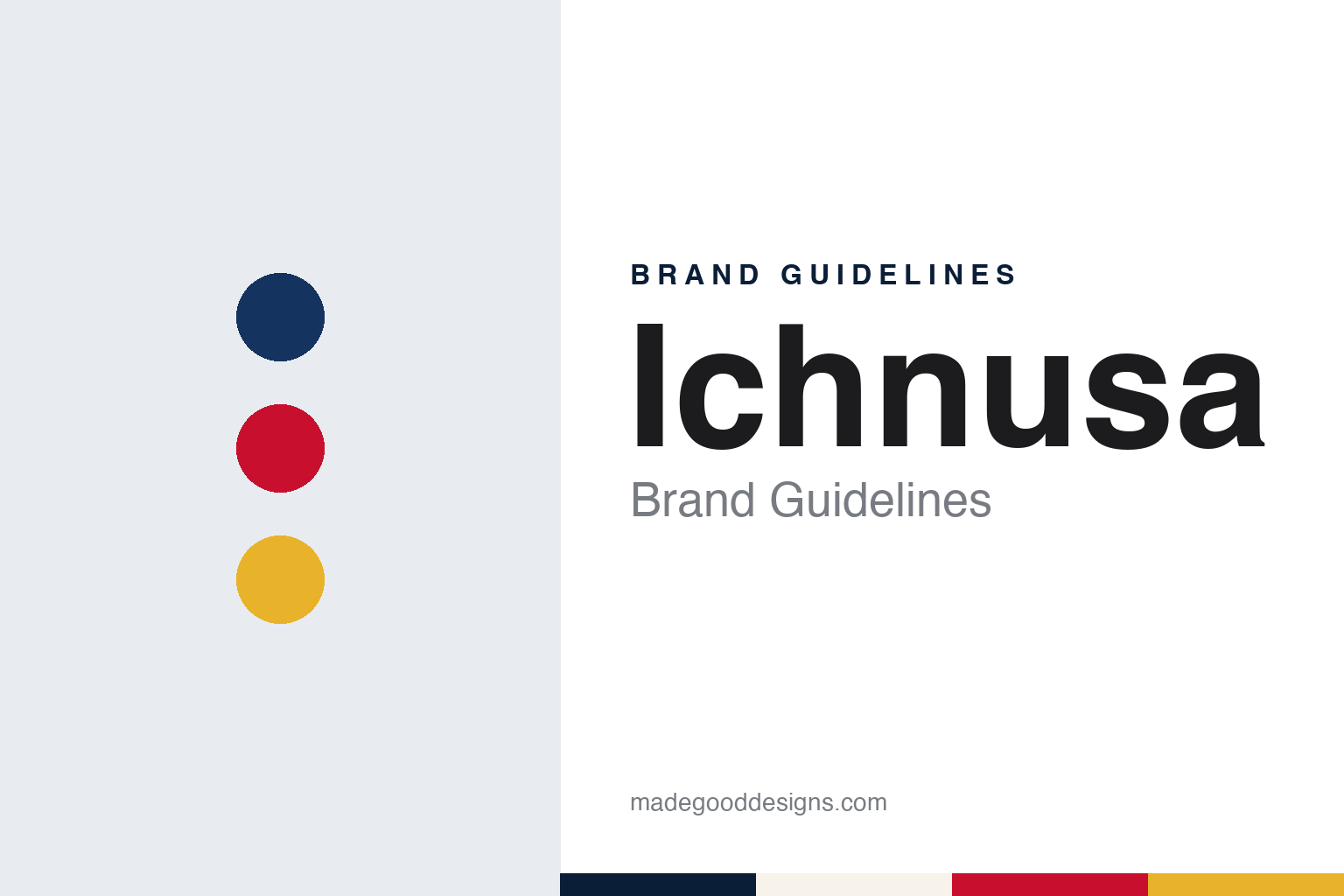
Ichnusa Brand Guidelines
The Sardinian lager named for the island’s ancient Greek name.
Aa
Two constants: a Cagliari blue, Moorish red and lager gold palette and an island grotesque sans register. Abstract homage — not an Ichnusa product or mark; no bottle, label, flag emblem or logo is reproduced.
Industria Birraria Ichnusa
Three partners, German machinery and a wine baron’s rescue.
Ichnusa takes its name from Sardinia itself. Ichnoussa was an ancient Greek name for the island, meaning “footprint,” for the shape of its coastline, Italian Wikipedia says. The beer began in Cagliari, the island’s capital. In August 1911 the city council sold a plot of land on the road to Pirri, in an area then called Is Stelladas and now the La Vega district, to Antonio Birocchi and Aristide Giorgetti. With Francesco Vincenzi they fitted out a brewery with German machinery and technology, and on 8 June 1912 they founded the Industria Birraria Ichnusa, to make beer and ice.
The start was promising, but the partners had spent heavily and were short of capital. Italian Wikipedia, drawing on Paolo Fadda’s history of the Vinalcool group, says the rescue came from Amsicora Capra, the leading Sardinian businessman in wine and spirits of his day and the owner of Vinalcool. Capra saw beer as a complement to wine rather than a rival, and wanted to widen his range at a time when phylloxera had destroyed many of the island’s vineyards. Vinalcool lent the partners money on condition that they turn the business into a joint-stock company, which it then bought into. The Società Anonima Birreria Ichnusa was formed on 1 December 1915 with Capra as managing director.
The brewery ran on its own until August 1928, when Vinalcool took over its production and sales under a lease, and in 1940 the company was absorbed into Vinalcool and Birra Ichnusa became one of its brands. For about thirty years the beer was sold only in Sardinia. During the Second World War the Via Marche brewery was used as an air-raid shelter in 1943, according to a 2013 history of Cagliari’s wartime shelters. After the war, with more advertising, demand grew both on the island and on the mainland.
Colour
A new brewery at Assemini, then Heineken.
Vinalcool grew into a group of companies, and the one that held the Ichnusa brand, S.P.A.I., decided in 1963 to build a new brewery at Assemini, in the Macchiareddu-Grogastu industrial zone near Cagliari, an area then rich in groundwater. Italian Wikipedia says the plant opened in 1967 and was the first in Italy to install vertical cylindro-conical fermentation tanks. The original brewery at La Vega closed and was demolished in 1975 to make way for housing. Another group company, based in Abbasanta, made soft drinks under the Ichnusa name, including orangeade, chinotto and ginger, and S.P.A.I. later became Birra Ichnusa S.p.A.
Italian Wikipedia puts production at 400,000 hectolitres in 1981 and 580,000 in 1986, with 85 employees. In 1986 the brand was bought by Heineken, then operating in Italy as Dreher, which kept the recipe and the Assemini brewery and enlarged the plant to brew other beers of the Dutch group as well. The Ichnusa soft drinks ended with the takeover. Heineken Italia lists Ichnusa among its brands today, and Italian Wikipedia says all Ichnusa beer has been brewed only at Assemini since 1967. In May 2019 a plan was presented to raise the brewery’s capacity by 54%, Business Insider Italia reported.
The range has grown around the original lager, sold since 1912 and made from water, barley malt, maize and hops. An unpasteurised beer launched in 2007 as Jennas, a Sardinian word for “door,” was renamed Ichnusa Cruda for the centenary in 2012, Beverfood and ANSA reported. Ichnusa Non Filtrata, an unfiltered lager in a shorter, stubbier bottle, arrived in 2017 to mark fifty years at Assemini, and a lemon radler followed in 2014. In January 2023 came Ambra Limpida, in a bottle based on an example found in the company’s archive, L’Unione Sarda reported. Two specials did not last: a myrtle-flavoured beer called Spirtu, launched in 1999 and withdrawn the following year, and Ichnusa Speciale, made for the 90th anniversary in 2002.
Typography
Design and documentation.
The seven brands in this group are all beer names from the United States, Italy and Spain: Michelob, Shiner, Blue Moon, Miller Lite, Pabst, Ichnusa and Estrella Galicia. American, Italian and Spanish beer brands in general sit at many different points in the trade, from family firms that still carry a founder’s name to names that now belong to much larger brewing groups, and a single brand can be sold everywhere from a corner bar to a supermarket shelf.
A beer brand’s identity is usually carried less by a single product than by a label, a name and the place it promises to come from, because the company behind the name may have changed hands, moved its brewing or grown far beyond the town where it started. That makes the questions behind each name worth asking plainly: who started it, who owns it now, and where its beer is actually brewed and packed.
Each guide separates what independent sources record from what the company says about itself — its founding story, its owners over time, where its beer is brewed and how its packaging has changed — and marks plainly what rests only on the company’s own word.
Aa
A strong grotesque for a lager that sells an island. (Specimen set in Archivo, a sans STAND-IN; NOT the Ichnusa logo.)
Ichnusa
Four Moors, a long I and an island identity.
Ichnusa’s labels have changed many times, and the company has reissued its history. For the centenary in 2012 it released 66 cl and 75 cl swing-top bottles carrying four historic labels, the trade site italgrob and the beer site ilovebeer reported that spring. Italian Wikipedia describes them: a deep blue label reading “Birra Ichnusa Cagliari” with the Four Moors, used before the Second World War and the only one to name the home city; a strong yellow postwar label with the Four Moors in a white oval; a white label with a gold border and a pale blue base, typical of the 1970s and 1980s; and a label with a red lozenge broken by the logo in a gold polygon.
The slogans have followed the same path. Italian Wikipedia says the 1970s line was “La birra dalla I lunga,” the beer with the long I, a feature also drawn into the logo, where the I has been shortened over successive redesigns. For about four decades after that the beer was “Bionda Sardegna,” and since 2017 it has been “Anima sarda,” or Sardinian soul. Under Heineken, Italian Wikipedia says, the brand has been marketed as made in Sardinia, with sponsorships tied to the island’s symbols and especially the Four Moors flag, positioning it in Italy as a local beer that is not confined to Sardinia; La Nuova Sardegna reported in 2014 that the Dutch owner was betting on the island identity.
Advertising has done the same work. The centenary television spot in 2012 was directed by Alessandro D’Alatri, L’Unione Sarda reported. The campaign that accompanied the 2017 redesign, made by the agency Leo Burnett and directed by David Holm, won best advertisement in the food and drink section of the 49th Key Award, La Nuova Sardegna reported in November 2017. From 2008 to 2016 the brand staged Mondo Ichnusa, free beach concerts first at the Poetto in Cagliari and later near Oristano. Ichnusa became the main shirt sponsor of Cagliari Calcio from the 2016–17 season, and in 2019 it introduced a returnable-bottle line for bars and restaurants, marked by green caps, ANSA reported.
For a design guide, Ichnusa shows how a regional lager can carry an island’s ancient name, its flag and its dialect from a Cagliari workshop to a Heineken brand sold across Italy. Compare Cruzcampo, another regional lager in Heineken’s portfolio, and Estrella Galicia, a lager just as tied to its home region. For this guide we use a Cagliari blue, a Moorish red and a lager gold with a grotesque sans, an unofficial interpretation; no product or logo is reproduced.
Explore & save
Keep Ichnusa’s identity on hand — save it to a board in the Made Good inspiration library.
Ichnusa identity set
Pin the Ichnusa Cagliari blue, Moorish red and lager gold palette and the island grotesque sans register to your own board.